

If you want more cryptocurrency analysis, including full-length research reports, trading signals, and social media sentiment analysis, use the code "Publish0x" when subscribing to CryptoEQ.io to make your first month of CryptoEQ just $10! Or simply click the button above!
The cryptocurrency market is considered a risk-on, highly volatile asset class that, in the past, had discouraged institutional-level investment. This is also a cited obstacle for significant, mainstream adoption. The demand for stable assets within the cryptocurrency landscape was the turning point in the creation of “stablecoins.”
Stablecoins are relatively price-stable assets that typically have a pegged value in relation to the underlying collateral of the asset. Key examples of this concept include Tether (USDT), USD Coin (USDC), and platform-specific currencies like Binance’s BUSD.
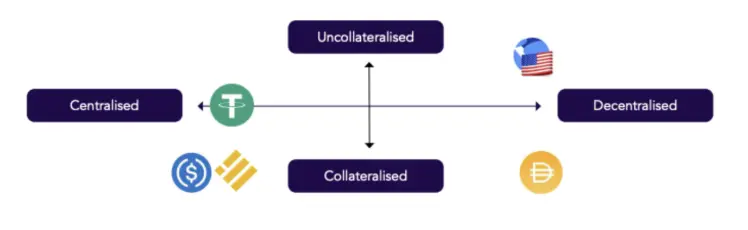
However, not all stablecoins are created equal. There are several different approaches projects have taken to keep their stablecoin "stable.” By far, the easiest approach (and therefore most popular) is backing a crypto stablecoin 1:1 with fiat dollars in a bank. This is the approach market leaders USDT and USDC have taken. For every one USDC in circulation, there's $1 (or dollar equivalent) in reserves with the Circle Consortium. There are also stablecoins like PAXG backed by the equivalent amount in gold. While these are the current market leaders, fiat-backed stablecoins inherit all of the issues that come with fiat plus require trust in a centralized custodian. This isn't exactly the revolution crypto promised!
Because of this, over-collateralized stablecoins, such as DAI and others were created. These stablecoins are over-collateralized with another cryptoasset (usually at a ~2:1 ratio), ensuring you can always redeem one unit of their stablecoin from the collateral’s value. If the collateral’s value drops below the liquidation level (varies depending on the protocol), the collateral is sold to ensure no losses are sustained. While these stablecoin solutions generally hold their peg, they can suffer in times of high volatility due to cascading liquidations as well as suffer from being capital inefficient due to the over-collateralization required.
Source: Chain Debrief
Finally, algorithmic stablecoins—which have been around for years, but only really began gaining adoption after 2020—use algorithms to control the stablecoin peg and the underlying tokenomics. Generally speaking, algorithmic stablecoins are run by pre-programmed smart contracts that execute specific actions to maintain the peg. They usually exhibit some or all of the following properties:
- No outside collateral backing the token
- Partially/fully-collateralized by a native token
- Floating peg (e.g. RAI)
Terra’s UST remains the most infamous example of an algorithm stablecoin. While UST enjoyed great success during the bull market of 2020-21, it, like many algorithmic stablecoins before it, imploded during a down market and times of distress due to the inherent “doom loop” properties built into the protocol design.
The Rise of the Stablecoin Market
Since the creation of these assets, the stablecoin asset class has exploded to tens of billions in value. Stablecoins routinely dominate the trading volume of the entire cryptocurrency space and are immensely popular assets for transferring value between blockchain networks and decentralized applications.
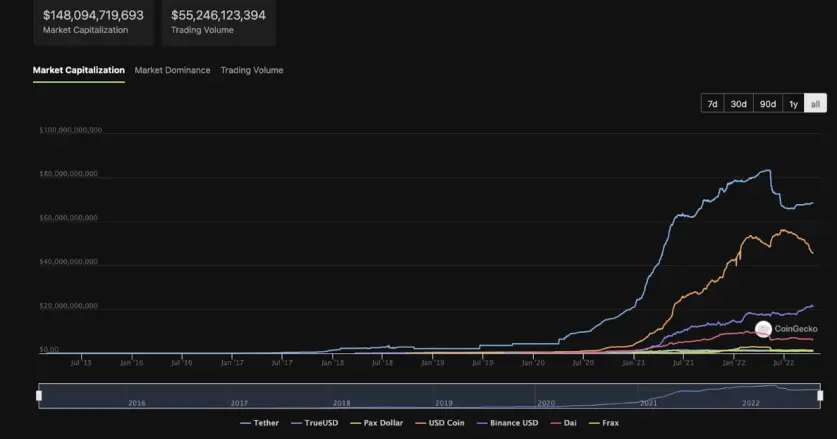
Here are the top five leading stablecoins by market capitalization as of Q4 2022:
- USDT - $68 billion
- USDC - $45 billion
- BUSD - $22 billion
- DAI - $6 billion
- FRAX - $1.4 billion
Stablecoins hold three of the top ten spots for cryptocurrencies by market cap and two of the top five. The importance of these assets has prompted deep inquiries into the levels of decentralization and stability that they bring. This is notable in the case of the Tornado Cash fallout in which both USDC and USDT blacklisted ETH addresses that had interacted with the Tornado Cash protocol, freezing their stablecoin funds.
Since these events, many native DeFi applications have begun taking the initial steps to launch their own native stable assets. The two highlighted protocols taking these steps for this article are Curve (CRV) and Aave (AAVE).
Curve (CRV)
Curve is a decentralized exchange (DEX) that has a specific orientation towards stablecoins and related financial activities associated with them such as swaps and yield generation. Curve operates as an automated market maker (AMM) that works to pair agents with others to conduct transactions without an intermediary party. Curve powers its platform through its own novel dual token infrastructure in the form of CRV and locked CRV tokens (veCRV). This token infrastructure has enabled very unique liquidity battles known as “Curve Wars''. Due to the unique voting rights stemming from locking up CRV into veCRV, governance over the protocol is extremely sought after, leading to the phenomenon known as Curve Wars.
Liquidity providers for Curve are rewarded with CRV tokens; CRV tokens can also be locked (up to 4-year time horizons) in exchange for veCRV which is required to participate in governance decisions, including setting the CRV rewards issued to pools on the platform. Lockers are issued veCRV (vote-escrowed CRV) which represents a non-transferrable claim on CRV, meaning their holdings are illiquid for the locking period.
Although holders are giving up liquidity, they are being compensated for this risk by being awarded special privileges within the protocol, as veCRV holders are entitled to a share of the fees generated from swaps made on Curve, boosted CRV emissions when providing liquidity, and as previously mentioned, governance rights.
Despite launching in late 2020 and limiting itself to only like-valued assets, Curve is a top-3 Ethereum DeFi dApp and also exists on six other blockchains including Polygon, Avalanche, and Fantom.
Curve Finance was launched in January 2020 following the publication of the original StableSwap whitepaper by Michael Egorov. Following the protocol build, the CRV token was officially launched in August 2020.
Curve Stablecoin (crvUSD)
A major ecosystem update for Curve Finance is the introduction of a potential Curve-native stablecoin. Per the JavaScript library that was released, details showcase the front-end code for a Curve-native stablecoin asset called crvUSD. This is significant for Curve as the leading value proposition for the platform resides around yield options for stablecoins and similarly-priced assets. This is made possible by Curve’s unique AMM model.
The code library itself already contains the write-ups for different functions that the crvUSD token would be able to be utilized for. This includes specific sections relating to loan creations, collateral additions, borrowing mechanics, and repayment mechanics. This also includes liquidation rules. The idea is that crvUSD would be a significant asset with high utility within the Curve Finance platform, taking on a number of potential responsibilities relating to DeFi activities.
To simplify, the crvUSD token is expected to be borrowable against other liquidity tokens for large pools on Curve, namely tricrypto and 3pool. Speculation surrounding the stablecoin’s potential release suggests that Curve Finance may release the token potentially as early as Q4 2022 or Q1 2023. Curve founder Michael Egorov had suggested previously that the token will function with an over-collateralization approach to maintain its value, similar to how MakerDAO manages the DAI stablecoin.
Aave (AAVE)
Aave Protocol (AAVE) is an open source, non-custodial liquidity protocol within the DeFi ecosystem. Aave’s main function is to provide completely open-source, non-custodial liquidity markets for DeFi users. Aave is considered a non-custodial market as non-custodial entities require no account and users hold the rights to their crypto that’s been deposited. Aave Protocol has its own native cryptocurrency, AAVE, which serves primarily as a governance token.
The Aave protocol is a counter to custodial entities as it provides increased emphasis on the basis of truly decentralized banking. However, Aave isn’t a replacement to centralized exchanges, as they serve as onramps for the fiat economy to cross into the crytoeconomy. Instead, Aave is a crypto-based, decentralized bank that rivals the likes of commercial banks such as Chase, Wells Fargo, and others.
Aave Stablecoin (GHO)
DeFi protocol Aave (AAVE) recently proposed what would become an on-chain, decentralized stablecoin called GHO. The GHO token would be launched on the Aave Protocol with the backing of the community and DAO, allowing users to mint GHO utilizing their on-chain collateral.
This proposal was voted on by AAVE token holders through its governance channel. An approval from the DAO would then be followed up with additional proposals to initiate the launch of the GHO token on-chain.
GHO would have a similar stabilization mechanism to MakerDAO’s DAI stablecoin but with one crucial difference. GHO would utilize position-based minting (users store collateral on Aave Protocol and then mint GHO against their position) rather than Maker’s vault method. So, borrowers could borrow GHO against their collateral by minting it. When borrowers want to repay their loan, the GHO protocol can then burn the GHO tokens and remove the paid off supply out of circulation.
The collateral ratio and subsequent fixed interest rate would be determined by the Aave DAO at a later date. This process is also dependent upon a new role for the GHO protocol - Facilitators. Facilitators are the only ones that can trustlessly mint/burn GHO tokens up to a certain limit (called a bucket) that is determined by the Aave DAO. Different facilitators would have different minting/burning strategies for GHO.
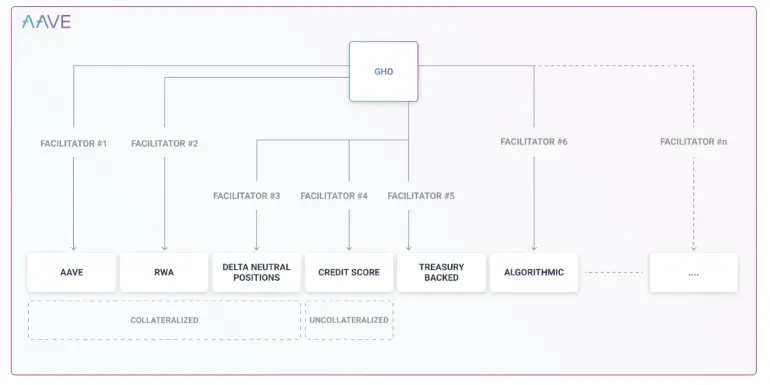
For instance, the first proposed facilitator would be Aave Protocol. Aave would be able to mint a determined amount of GHO to bootstrap its implementation into markets. An additional point of emphasis here is on the potential usage of portals.
GHO Scalability and Portals
Portals on Aave allow assets to be moved across its multichain network, meaning users on Polygon and Avalanche could access tokens native to Ethereum. The GHO token would also inherit this ability, allowing GHO to be distributed trustlessly across blockchain networks without having to worry about potential issues with bridges. This is conducted through message passing on Ethereum.
The initial implementation of GHO would not include this immediately. There is also an expectation that the Ethereum market will need to be upgraded to the very latest V3 Aave version to facilitate all of the necessary upgrades for GHO.
The main point of emphasis with the GHO token is found in its revenue model. GHO accrues interest when it is supplied to a liquidity protocol; how much interest is decided by Aave governance. Rather than having the interest paid back on GHO go directly to liquidity providers (LPs), Aave has instead proposed that all of the generated revenue from GHO be moved directly to the Aave DAO itself.
The Aave DAO would have full custody over the new revenue, have the ability to fund community projects and initiatives, increase the protocol treasury, and more. This would give the Aave DAO a potentially substantial boost to its overall revenues as GHO’s utility could span far beyond just Aave protocol.
While GHO will provide the most immediate benefit to Aave, it could also be utilized by other DeFi protocols like Curve, Uniswap, and Bancor to provide an additional on-chain stablecoin option to users. This would assist in expanding the overall market cap of stablecoins as an asset class.





