
You are reading an excerpt from our free but shortened abridged report! While still packed with incredible research and data, for just $20/month you can upgrade to our FULL library of 50+ reports (including this one) and complete industry-leading analysis on the top crypto assets.

Becoming a Premium member means enjoying all the perks of a Basic membership PLUS:
- Full-length CORE Reports: More technical, in-depth research, actionable insights, and potential market alpha for serious crypto users
- Early access to future CORE ratings: Being early is sometimes just as important as being right!
- Premium Member CORE+ Reports: Coverage on the top issues pertaining to crypto users like bridge security, layer two solutions, DeFi plays, and more
- CORE report Audio playback: Don’t want to read? No problem! Listen on the go.
Uniswap V3
There are two significant differences that V3 introduces in its design: concentrated liquidity and multiple fee tiers. On Uniswap V2, users provide liquidity evenly along all of its markets’ price curves. This is somewhat inefficient since there does not need to be equal amounts of liquidity for ETH at $1 vs $2500. The concentrated liquidity gives individual liquidity pools control over what price range their funds are allocated to. This allows for individual positions to be fused together into a single pool to make one combined curve for traders to trade against. Liquidity pools can focus capital within a custom price range so pools can provide larger amounts of liquidity at desired prices. This mechanism allows for individualized price curves. In doing so, traders can trade against the combined liquidity pool of all curves with no gas increase per liquidity provider. Trading fees are then collected and dispersed at a given range appropriately.
Multiple fee tiers allow for liquidity pools to be compensated for taking risks. There are three fee tiers per pair: 0.05%, 0.30%, and 1%. These options make sure that liquidity pools are customized to their margins according to certain pair volatility of the tokens. This may lead to some liquidity fragmentation, but the Uniswap team believes that most pairs will calibrate to an appropriate fee tier. Uniswap expects liquidity pools to take more risk on non-correlated pairs like ETH/DAI and to take on less risk in correlated pairs like USDC/DAI. Correlated pairs are expected to sit at around 0.05% fees and .30% fees for pairs like ETH/DAI. 1% swap fees will be more appropriate for riskier pairs. Fees in V3 are more flexible and can be turned on by governance for each pool; these fees can be between 10% and 25% of liquidity pools fees.
In Q3 2021, after months of anticipation, Uniswap launched Optimism, a layer 2 (L2) scaling solution for Ethereum with six assets. Transactions on Optimism are (practically) instant and ~90% cheaper than on the Ethereum mainchain. Since then, V3 is now live on Arbitrum (L2) and Polygon (L1 sidechain) scaling solutions. The Uniswap team expects cross-chain experiences to be a large catalyst for growth and improvement in the user experience. More bridges will be developed and or updated to support bridging governance actions from Ethereum Mainnet.
Liquidity Providers (LPs) will also benefit from the price reduction. The cost associated with withdrawing funds from the pool has gone from $20+ to nearly free on Optimism. This, in turn, opens up the LP market to more retail users and potentially makes it more profitable for even the smallest LPs.
Decentralized exchanges (DEXs), not just Uniswap, have seen enormous growth from 2019 onward. In 2022, they now process 10% of what centralized exchanges (CEXs) process in terms of the number of transactions as opposed to just < 1% two years ago. Uniswap, between v2 and v3, makes up for approximately 50-60% of all trading volume on DEXs.
The V3 upgrade also introduces more characteristics to make Uniswap one of the most flexible and efficient automatic market markers in this space. The liquidity pools can give liquidity with up to 4000x capital efficiency relative to Uniswap V2 so providers can earn higher returns. By concentrating liquidity, users can acquire the same increases as V2 within a certain price range while putting down less principal. V3 also offers a way for low slippage trade execution compared to centralized exchanges and stablecoin AMMs. In order to help protect pool providers, changes were made to increase exposure to preferred assets and to reduce the risk taken. V3 liquidity pools can sell one asset for another by adding liquidity to a price range above or below the market price as needed.
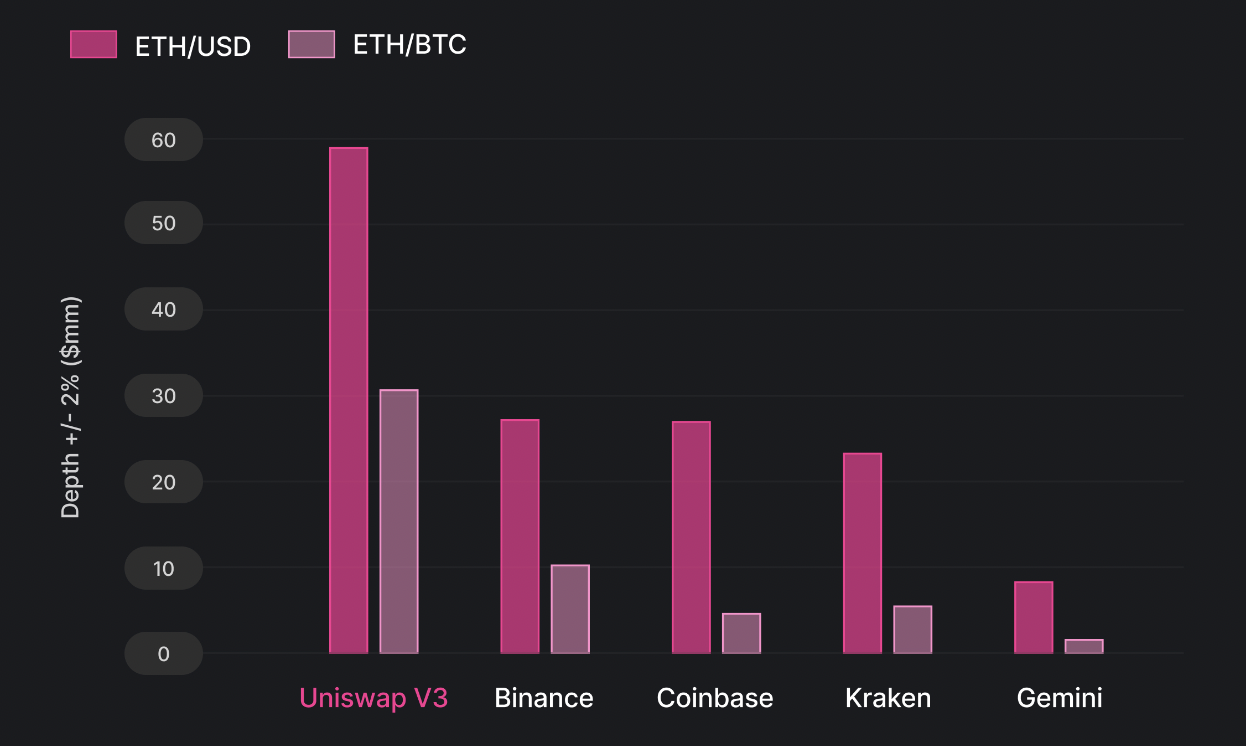 Note: The figure shows the daily average +/- 2% spot market depth in $millions for the sample period from June 2021 to March 2022 for ETH/USD and February 2022 to March 2022 for ETH/BTC. Source
In addition to the greater capital efficiency, v3 also boasts lower fee pairs which bring in users. This can be seen in the USDC/ETH 0.05% pool, which has the highest volume throughout Q3 2022. With the launch of Uniswap on L2s, total fees incurred to trade could even further decrease from 0.05%. As fees decrease, trading volumes on L2s are expected to rise. This is the positive feedback loop Uniswap is looking to ignite: lower trading costs attract more users, increasing LP returns, which drives more liquidity and lower costs.
Another new feature in V3 is that liquidity providers receive non-fungible tokens (NFTs) that represent their Uniswap V3 liquidity positions. In Uniswap V1 and V2, users receive fungible ERC-20 tokens representing their liquidity position in the pool. The reason for issuing NFTs is explained in the V3 mainnet post:
“The pool interface now supports the creation of Uniswap v3 positions with multiple fee tiers and concentrated liquidity ranges. Each position is represented as an NFT and comes with a unique piece of on-chain generative art.”
Uniswap V3 is now the dominant DEX, however, it now also has greater complexity than its predecessors. The downside of increased complexity is that liquidity mining now requires somewhat advanced technical skills. V3 was released a year after V2 and its main goal was on increasing capital efficiency via concentrated liquidity. With the introduction of concentrated liquidity, the liquidity providers can specify a price range for which they would like to provide liquidity and adjust this range based on current market supply and demand. Liquidity providers are compensated with more fee revenue for “actively” managing their positions. This keeps the Uniswap AMM highly capital-efficient but requires active management i.e. constant oversight. Because of this, V3 is seen as a tool for more sophisticated and advanced users. This is also supported by the average transaction size in V3. It is ~30x higher than that in V2!
The high average transaction on V3 can also be attributed to the protocol’s higher market depth across all price levels. This makes it advantageous for users to execute larger trades on Uniswap v3 relative to centralized exchanges because the ultimate price for the transactions is cheaper.
Introduction to V4
Uniswap V4, an anticipated iteration of the celebrated decentralized exchange, incorporates a powerful feature dubbed 'hooks.' Hooks are code segments triggered during various stages of a liquidity pool's life cycle — at inception, when liquidity providers adjust their contributions, or in the swap process's before and after stages. These hooks imbue Uniswap with a versatility hitherto unobserved in its previous versions, sparking a revolution in pool customization capabilities.
Whereas older Uniswap versions allowed static swap fees, hooks provide the wherewithal to design pools with dynamic swap fees, fluctuating in response to market conditions. This dynamism not only ushers in an era of flexibility but also augments the platform's adaptability. The new hooks can manage a broad spectrum of order types, such as limit and Time-Weighted Average Price (TWAP) orders, presenting traders with more nuanced transaction strategies.
A significant departure from Uniswap's traditional approach, hooks enable liquidity to be leveraged differently. Mirroring Balancer's 'boosted pools,' hooks permit the deployment of a pool's out-of-range liquidity into alternate protocols like lending platforms, to accrue additional yield. The true beauty of hooks lies in their accessibility — they can be conceived, developed, and deployed by anyone without any prerequisite permissions.
Uniswap V4 heralds another transformative change in the form of the 'singleton.' A lone contract housing all of Uniswap V4's pools, the singleton diverges from its predecessors, which used separate contracts for individual pools. The singleton model augments the V4 version's gas efficiency as complex swaps can now be directed through a single contract instead of multiple contracts, significantly reducing gas usage. The deployment cost for a new pool, or a trading pair, is predicted to plunge by a staggering 99% with the singleton.
The singleton also employs what Uniswap Labs terms as a "flash accounting system," which further slashes gas costs in trading on the decentralized exchange by transferring only the net balance of tokens out of a pool post a swap. In contrast, Uniswap V3 moved all assets involved in a trade into or out of a pool during the swap, incurring higher costs.
Governance for Uniswap V4 remains with the Uniswap Decentralized Autonomous Organization (DAO) and UNI token holders. The protocol continues to feature a fee-switch, allowing Uniswap governance to activate it on a per pool basis, thus capturing a portion of the fees generated by liquidity providers. The release of V4 is slated under a Business Source License 1.1, effective for four years, restricting the protocol's use to only those entities approved by governance.
However, the introduction of Uniswap V4 is not immediately forthcoming. According to Hayden Adams on a recent podcast, the V4 code is still undergoing the finalization and auditing stages. Consequently, the wait for its debut continues.





