

If you want more cryptocurrency analysis, including full-length research reports, trading signals, and social media sentiment analysis, use the code "Publish0x" when subscribing to CryptoEQ.io to make your first month of CryptoEQ just $10! Or simply click the button above!
Multichain
Formerly Anyswap, Multichain is a cross-chain bridge aiming to enhance interoperability between disparate and previously siloed blockchains and dapps. Multichain has a simple wrapped bridge that works like Wormhole but also recently developed a cross-chain router that takes away some of the depegging risks. It can do this using 'single-sided liquidity pools' for native assets on different blockchains.
Bridge
Multichain has two mechanisms to bridge assets: cross-chain bridges and routers. Cross-chain bridges first lock tokens in a secure multi-party computation (SMPC) address, then a smart contract mints the equivalent amount of wrapped assets on the destination chain into the user's wallet (lock-and-mint method). Withdrawing assets is the exact opposite: burn the wrapped assets, and then the SMPC address releases the native tokens back to the user on the original chain. Importantly, no humans are involved in this process.
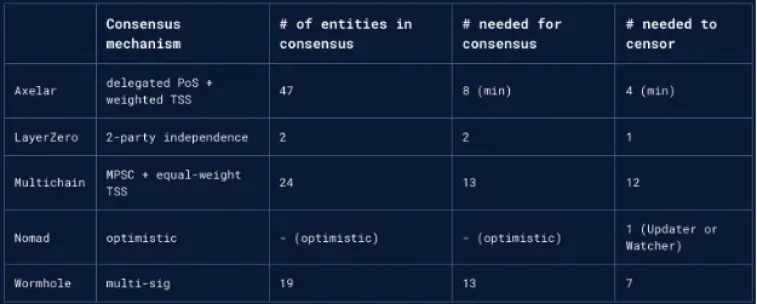
The decentralized SMPC node network runs the distributed signature algorithm, albeit just 26 of them. This process means Multichain is a de facto multi-party custody system with federated validators. Each of these 26 nodes independently verifies the source chain’s status and reaches consensus together using the threshold distributed signature algorithm on the verification results. No complete private key is shared at any point in the bridging process because nodes don't share their private keys with each other. All nodes can not reach a consensus unless each node singularly agrees. As a result, Multichain’s SMPC network guarantees correct results and can provide fast finality.
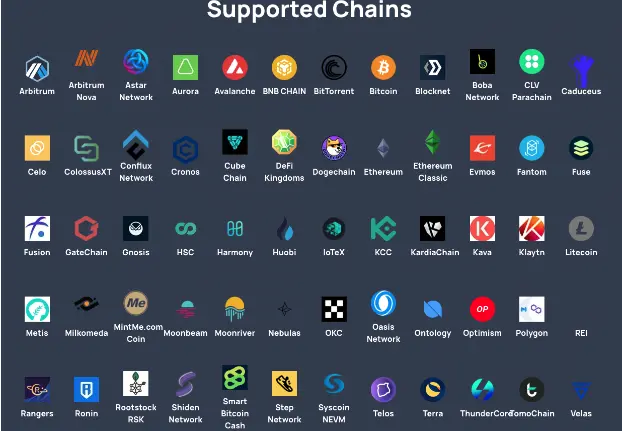
Due to its many integrations and supported blockchains, Multichain has become a major bridging solution as seen by the metrics below.

Router
Multichain’s router works a bit differently, enabling any asset to be transferred, whether a native token or a token created using Multichain’s bridge infrastructure. The router is more akin to a liquidity pool; hence liquidity drives a user’s ability to bridge (as well as the overall UX) in the Multichain pools.
To bridge tokens from chain A to chain B using the router:
- You deposit 10 ETH (as an example) to a Multichain pool on chain A
- 10 "multi-ETH” (a wrapped version of ETH) are then minted on chain A
- The SMPC node network then mints 10 multi-ETH on chain B while at the same time burning 10 multi-ETH tokens on chain A
- As long as the number of ETH tokens in the Multichain pool on chain B is greater than the multi-ETH tokens created, then those ETH tokens are sent to your wallet on chain B and the multi-ETH tokens are burned
To the extent there aren’t enough multi-ETH tokens in the pool on chain B, you’ll be left with residual multi-ETH that can be later redeemed for ETH when they become available.
As mentioned, you must pay close attention to liquidity in Multichain pools. Otherwise, your experience could suffer. A potential router user must ensure sufficient depth in the Multichain pool to obtain the native asset; otherwise, they’ll have to wait for other users to refill the pool, and they can swap out of the wrapped asset.
But what happens when liquidity doesn’t exist on the other side of the bridge? To solve this, Multichain created a function that mints a token called “multiUSDC.”
Let’s say we’re trying to move $100 USDC from Ethereum to Fantom, and only $50 of liquidity currently exists in the Fantom USDC pool:
- Deposit USDC into the bridge on Ethereum
- Receive multiUSDC on Fantom
- $50 of our multiUSDC would be burned and swapped for real USDC, and the remaining $50 'multiUSDC' would stay in our wallet. The multiUSDC still acts as an I.O.U from the protocol

Access the full report here.
Security and Trust Assumptions
Issues arise for Multichain if people stop using it or protocols don't provide sufficient liquidity. In these cases, the router would become useless, and the classic lock-and-mint bridge would be the only option.
Another potential failure point relies on the 26 nodes’ trustworthiness in verifying transactions. Multichain economically incentivizes validators' behavior, but they still represent “trusted third parties.” The nodes in Multichain's SMPC control individual externally-owned accounts with public addresses correlating to the ultimate private key. There are 26 nodes in total, operated by various institutions in the crypto industry. These accounts can transfer assets to the destination chain, which only verifies the sender's address and not the message itself.
Consensus requires the majority of nodes to come together to verify the messages.
The security of this protocol, therefore, depends on the reputational security of the SMPC nodes, which presupposes an honest majority of more than half of all nodes. 13 signatures are required for cross-chain data transmission, and 12 nodes must collaborate to censor communications.
Additional cons include the following notable examples:
- 81.4% of supply is locked in a contract, and those tokens could come onto the market in the future
- Future utility for MULTI token is up to a governance vote
- Without liquidity, it offers no competitive advantage over wrapped asset bridges
Multichain, like all bridges, is also vulnerable to smart contract bugs. In January 2022, multiple hackers exploited flaws in Multichain's smart contracts to steal ~$3 million across six token pairs on the project's router. Due to a flaw in the coding for these tokens' contracts, an attacker was able to steal any users' funds that had previously created approvals for any of the six coins.
Ironically, the Multichain team uncovered this issue first and issued a public statement asking users who may be susceptible to revoke the approval. However, this notice also alerted the attackers to the issue. Multiple attackers targeted Multichain users who had approved these tokens and stole almost $3 million worth of tokens from the project.
Multichain has undergone numerous public audits and also offers a $2M bounty program with Immunefi.





