If you want more cryptocurrency analysis, including full-length research reports, trading signals, and social media sentiment analysis, use the code "Publish0x" when subscribing to CryptoEQ.io to make your first month of CryptoEQ just $10! Or simply click the button above!
Access the full report here.
Overview
Connext is a non-custodial, cross-chain bridge that currently connects 13 EVM-based chains and L2s in a joint partnership with LayerSwap. LayerSwap lets you send crypto from CEXs directly to L2s networks such as Arbitrum, Optimism, and zkSync without paying high gas fees.
Launched in 2021, Connext is an interoperability network focusing on fast, fully non-custodial token transfers or contract calldata. It specializes in data transfers between Ethereum Virtual Machine (EVM)-compatible chains or rollups using its trustless base protocol, NXTP. Similar to the standard Internet Protocol (IP), Connext’s NXTP can run the full Ethereum multi-chain ecosystem.
Connext uses a pool of liquidity networks managed by 53 routers to validate cross-chain transactions. Because of this, you can't lose your funds due to the lock/unlock mechanism that constrains the routers. Additionally, the assets provided by the routers are native to the destination chain rather than being derivative assets, making them more fungible and liquid.
Technology and Amarok upgrade
The NXTP, the base protocol facilitating cross-chain transfers, is simply a smart contract. Rather than introduce an external set of validators to manage user funds, NXTP uses a lock/unlock mechanism, making it impossible for user funds to get stolen even if the transaction validation mechanism defaults.
In a typical NXTP transfer:
- User broadcasts transaction
- The transaction is auctioned off to a network of routers competing for the best price and speed
- Once the auction’s won, the funds and proof of auction are locked on the original chain
- The router, submits the same transaction to the destination chain, ensuring sufficient liquidity
- (Essentially) the transaction is cross-checked by another router (relayer) and the user can claim funds on the destination chain
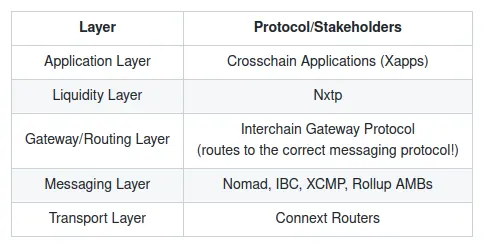
In April 2022, Connext announced its first major upgrade, Amarok, enabling generalized communication between chains without introducing trusted counterparties. Amarok modularizes the Connext stack (image below), enabling it to pass messages between chains using Nomad and includes an off-chain sequencer for coordinating with routers.
Security and Trust Assumptions
Bridges' trustlessness is never absolute. However, user funds can never be lost or stolen in Connext as its security equals the underlying protocol it's bridging. Connext achieves scaling and performance by having its sequencer compute everything off-chain and match routers to transactions. These routers are used to provide liquidity and relay calldata between chains, introducing some added risk/centralization. For this service, routers earn a fee for each transaction they facilitate.
Unfortunately, the state of the routers is centralized. The Connext team currently whitelists routers that only they can update. Connext is on record as stating this approach is temporary, and in the future, Connext plans to implement a slashing mechanism to allow more permissionless onboarding of routers.
Usage
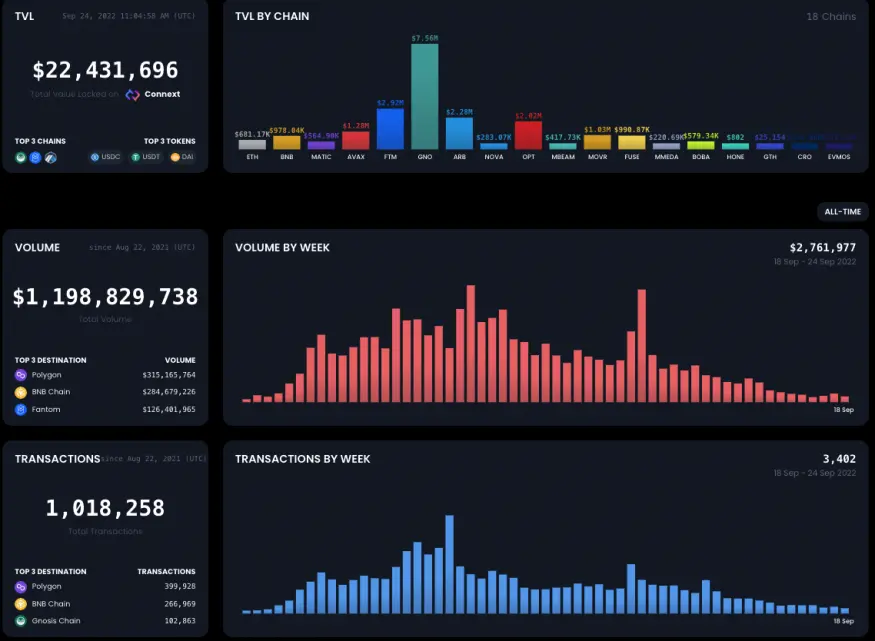
In 2021, Connext was the first fully trust-minimized bridge in the Ethereum ecosystem and has transacted over $1 billion in volume across 18 chains since its inception. Since launching its liquidity bridge, Connext has facilitated $1 billion+ in volume spread across ~1,000,000 transactions.