
You are reading an excerpt from our free but shortened abridged report! While still packed with incredible research and data, for just $20/month you can upgrade to our FULL library of 50+ reports (including this one) and complete industry-leading analysis on the top crypto assets.

Becoming a Premium member means enjoying all the perks of a Basic membership PLUS:
- Full-length CORE Reports: More technical, in-depth research, actionable insights, and potential market alpha for serious crypto users
- Early access to future CORE ratings: Being early is sometimes just as important as being right!
- Premium Member CORE+ Reports: Coverage on the top issues pertaining to crypto users like bridge security, layer two solutions, DeFi plays, and more
- CORE report Audio playback: Don’t want to read? No problem! Listen on the go.
Hot Wallet
Hot wallets are the most popular and widely utilized wallet form in the crypto economy. Hot wallets allow users and investors to actively use their crypto assets in trading, swapping, staking, and any other DeFi-related mechanics. Hot wallets include popular options like MetaMask. These wallets have the capability to stretch across ecosystems (Ethereum, Avalanche, Polygon, etc.) and access numerous decentralized applications.
The vibrant access that hot wallets enjoy also comes with extensive attack vectors. While cold wallets store keys completely offline, hot wallets can be stored directly on a PC or a cellphone. This means any security breaches to the device can result in the loss of keys (potentially funds).
Popular hot wallets in specific sectors include:
- Ecosystem-specific wallets - Phantom and Glow on Solana, Braavos and Argent X on StarkNet, Electrum for Bitcoin, etc.
- Mobile - Rainbow wallet, Brave, Metamask, and Trust
- DeFi - Zerion, DeBank, and Zapper
- NFT - Castle and Genesis
- Teams or institutions - Squads, Gnosis, and Fireblocks
Software or “Hot wallets” are wallets connected to the internet and kept in a downloaded software/app on your computer, phone, or tablet. This method of storing your crypto adds a bit of convenience but at the risk of potential hacking and malware. It is usually recommended you only store a small amount of the BTC you intend on using in a “hot wallet” and the rest in a “cold wallet.” This is similar to how one does not walk around with their entire life savings but rather lets a bank hold onto the majority.
 Source: Binance
Hot wallet attack vectors
- Computer hacks
- Copy + paste bug
- Screen tracking
- Keyboard tracking
- Malware from plug-ins
- Phishing (email and Twitter)
- Give-away scams (typically Twitter)
- Fake URL/website
- Social engineering
- Exploiting customer help to obtain personal information or bypass security
- SIM swapping
- Fake re-sellers or tampered devices
- ONLY buy DIRECT from the retailer. No Amazon, eBay, Facebook, etc.
MetaMask
MetaMask is a cryptocurrency wallet that supports the Ethereum blockchain, Layer 2 networks, and standalone EVM-compatible blockchains. It is a non-custodial solution that enables users to interact with decentralized applications and manage their crypto assets. Developed by Consensys, it is widely supported by the Ethereum developer community and has gained significant popularity, with over 30 million monthly active users as of Q1 2023.
One of the key advantages of MetaMask is its flexibility in supporting EVM blockchains. In recent years, there has been a proliferation of EVM-compatible blockchains; each offering improved efficiency and cost-effectiveness over the original Ethereum blockchain. MetaMask's technology allows for easy integration of these new networks, enabling users to switch between them and access decentralized applications on any network. This is particularly useful for investors who are always looking to explore new projects and ecosystems.
Another advantage of MetaMask is its ease of access and user-friendly interface. The wallet is available for all smart devices, and the interface is designed for basic transactions, making it accessible for even casual investors with minimal knowledge of the technology. Additionally, MetaMask can be used in conjunction with hardware wallets such as Trezor and Ledger, providing users with the option to store their crypto assets in a more secure manner for long-term holding.
One of their popular offerings is the MetaMask swaps, which was processing $3B-$5B of volume per month at its peak and generating close to $0.5B in revenue since its launch in late 2020. MetaMask charges a 0.875% swap fee on top of the 1-30bps DEX fees the user is already paying, which is considered a rather high fee by some.
 Source: Delphi Digital
MetaMask's second app was the bridge product which supports 4 EVM L1s and has three levels of fee extraction taking place. However, the bridge volume saw a drop of ~80% due to market conditions and EVM rollups gaining share from the L1s. MetaMask recently launched liquid staking in-app, which allows users to stake their ETH for an LSD without going to the protocol and reduces the attack surface.
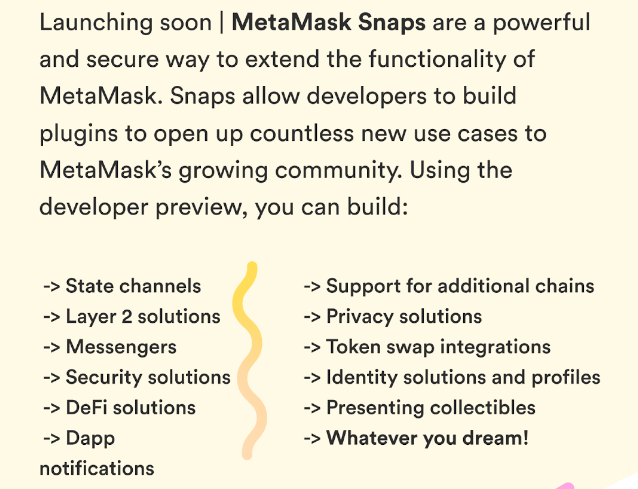
MetaMask's latest development is their product "Snaps," which is still in its pre-release phase. Snaps allow external developers to build apps on top of MetaMask's functionality, similar to the App Store or Microsoft's Windows. Snaps are JavaScript files that can be installed by users to increase the functionality of MetaMask. Some potential snaps already being showcased include StarkNet for contract accounts on L2, Web3Auth to turn MetaMask into an MPC wallet, ZK-Nullifier to create pseudonymous apps, smart accounts to access smart contract wallets directly from MetaMask, and more. Snaps is an exciting development from the MetaMask team as it allows them to scale their wallet and increase its functionality in a way that is not possible with a closed development loop.
However, MetaMask also has certain limitations that make it less suitable for certain investors. One limitation is its maximalism towards the Ethereum blockchain and EVM blockchains, which means it only supports these types of crypto assets and doesn't have plans to support other blockchain networks. This can be inconvenient for investors who hold assets across multiple chains and are looking for a single wallet solution. Additionally, the process of manually adding custom blockchains can be time-consuming and less convenient for some investors.
In summary, MetaMask is a popular and versatile cryptocurrency wallet that supports EVM blockchains and enables easy access to decentralized applications. Its flexibility and user-friendly interface make it accessible for a wide range of investors. However, its maximalism towards the Ethereum blockchain and the process of manually adding custom blockchains can be limiting factors for some investors.
TrustWallet
Trust Wallet is a multi-chain cryptocurrency wallet that is designed to securely store crypto assets. Since its launch in November 2017, the wallet has reportedly been downloaded over 15 million times on both the Google Play and Apple stores. Trust Wallet has gained a significant reputation, in part due to its association with the Binance Exchange, which is currently the largest cryptocurrency exchange in terms of daily trading volume.
One of the key features of Trust Wallet is its multi-chain support, which enables it to be used across various different cryptocurrency networks that operate in different ways. As of July 2021, Trust Wallet was confirmed to support over 33 chains, ranging from payment solution blockchains to enterprise-level smart contract blockchains. This makes it an attractive option for investors who wish to diversify their portfolio and hold all their assets in a single wallet while still maintaining the option to use just a single chain.
In addition to multi-chain support, Trust Wallet also provides access to decentralized applications (dApps) via its in-built browser and the "WalletConnect" protocol. This allows users to connect to decentralized applications for their EVM blockchains and non-EVM chains like Cosmos, all from a single point of access. Furthermore, Trust Wallet is also available for personal computers and users can install the Trust Wallet extension on desktop browsers.
One of the key benefits of using Trust Wallet is the ability to manage assets from a single point, making it easier for investors to coordinate their portfolios and quickly check the status of their wallet. Additionally, Trust Wallet offers extra features such as staking programs, a decentralized application browser, and centralized exchange integrations, which can further enhance the user experience. The staking feature allows users to access staking programs of supported cryptocurrencies directly from their wallet without needing to navigate to another site.
However, there are also some limitations to using Trust Wallet. For example, at present, users of Trust Wallet and hardware wallets cannot use their hardware wallets in combination with their Trust Wallet as Trust Wallet does not currently have a hardware wallet support system. Additionally, Trust Wallet does not currently have the infrastructure for installation on custom networks, meaning that users will have to stick to using the networks installed by the developers or use Walletconnect (where available) to connect to applications on these networks.
In conclusion, Trust Wallet is a robust and secure multi-chain wallet that offers a wide range of features and support for various cryptocurrency networks. However, it is important to note that there are some limitations to using the wallet, such as the lack of hardware wallet support and the inability to install it on custom networks, which may be important factors to consider for some investors.





