
Binance and Binance Smart Chain are a more centralized alternative to Ethereum. Everyone knows that. Nothing earth-shattering. But when you stack up ALL the issues with Binance, BNB, and BSC it becomes impossible to ignore. Read for yourself below and make your own decisions. The content below are excerpts from a longer, full CORE report on BNB and BSC at CryptoEQ.io. (If you want more Binance content as well as other top 30 coins, use the code "Publish0x" when subscribing to CryptoEQ.io to make your first month of CryptoEQ just $10! )

Overview
Binance Coin (BNB) hosted on Binance Chain is an exchange-based cryptocurrency facilitating Binance’s ecosystem of products, both centralized and decentralized. BNB has many use cases, but within the Binance ecosystem it is primarily used as a utility token that allows users to receive discounts when paying for trading fees.
Binance Coin Strengths
- BNB has clear utility and benefits within the Binance exchange ecosystem in the form of trading fee discounts.
- BNB’s parent company, Binance, is one of the largest and fastest-growing companies in the crypto industry which has translated to growing BNB adoption and price appreciation since inception.
- As Binance rolls out more features like staking, leveraged tokens, and DEXs, there will be more utility for BNB.
- Recent growth in the Binance Smart Chain (BSC) blockchain has generated a new wave of users into the Binance ecosystem which could translate into more BNB users.
Binance Coin Weaknesses
- BNB is a centralized token controlled by a for-profit company with little utility outside the Binance ecosystem.
- Binance has already demonstrated questionable character on several occasions when dealing with BNB and customer’s funds.
- BNB is exposed to greater catastrophic downside risk due to more than 80% of BNB being either owned or custodied by Binance.
- Binance has engaged in “regulatory arbitrage”, claiming to have no permanent headquarters, in an unprecedented attempt to avoid restrictive regulatory laws.
- Binance is currently under investigation by the U.S. Internal Revenue Service as well as the Department of Justice for money laundering as well as dealing with inquiries from the Commodity Futures Trading Commission (CFTC) over whether Binance allowed U.S. residents to trade on its exchange.
- The BNB token could be subject to US security laws as it is solely controlled by a private company.
Technology
Binance Chain (BC) is a closed-source, digital asset blockchain hosting Binance’s DEX which is based on Tendermint and has instant finality. BC has three components: the cross chain module, the oracle module, and the consensus mechanism, which is Proof of Stake and Tendermint BFT.
Binance Smart Chain (BSC) is an Ethereum clone. It is a direct copy of Ethereum's code and EVM with slight changes to make the chain cheaper and faster but at the expense of decentralization and censorship-resistance. BSC enables faster transactions and cheaper fees by increasing the gas limit in each block (40M versus 15M in Ethereum) and having faster block times (5 seconds versus ~15 seconds in Etherum). The combination of these two things improves performance in the short term (at the expense of decentralization) but also means that, over time, the blockchain state size becomes so large that only a few mega-corporations can afford to run a node due to the hardware constraints (discussed further in Vulnerabilities). The active state size of the chain (state that smart contracts need access to) and hardware computer performance have physical limitations and can create a bottleneck if BSC continued to grow at their 2021 rate. For now, Binance just continues to increase the gas limit whenever the chain gets congested but there could come a time when that is not an option. The chain's demands could surpass even what the most powerful servers are capable of computing.
BSC allows for a dApp smart contract environment with three components, including a Proof of Staked Authority consensus mechanism, an Ethereum Virtual Machine, and the Build-In System Smart Contract. A key component to BSC is that it is compatible with Ethereum’s EVM, enabling BSC developers to easily create slightly-altered forks of popular Ethereum projects.
BNB holders govern the BSC network by holding validators accountable, a model that becomes more effective the more the user base grows. Development of the BSC Github peaked in 2015, remained steady up until 2020, and has since seen almost no developer activity in 2020-21.
Proof of Staked Authority is a Delegated Proof of Stake and Proof of Authority crossover where blocks are produced by a limited quantity of validators. The validators take turns and are elected via staking. Binance selected this mixup due the desirability of Proof of Authority’s strength against 51% attacks, and Delegated Proof of Stake’s decentralization. This combination resembles architecture similar to EOS, which is controlled by just 21 nodes. Like most altcoins, BSC trades true decentralization for a more performant blockchain and cheaper fees. BSC's 21 nodes are primarily controlled by Binance/Binance affiliates and cost hundreds of thousands of dollars to operate making it extremely centralized and quite vulnerable to regulatory attacks considering Binance is currently facing legal scrutiny on multiple fronts (Regulatory section).

Economics
BNB is a utility token facilitating Binance’s centralized and decentralized products.
The BNB initial coin offering (ICO) occurred mid-2017 with a sale of 100,000,000 BNB tokens of 200,000,000 sold at about $0.15 USD/token. An all time high in mid-2019 gave ICO participants a return of greater than 250x. Matthew Roszak, Roger Ver of Bitcoin.com, and Da Hongfei of NEO were notable ICO participants.
BNB enjoys some notoriety as a speculative token, fueled by its role in the Binance ecosystem and an equity-like buyback and burn system. Binance originally, in its whitepaper, committed to buying back 20% of profits and burning the tokens, creating a deflationary nature, until the token supply reaches 100,000,000 from the current 179,000,000. The current supply reduction is tracking at about 6,000,000 tokens per year. However, in March 2019, Binance discreetly edited the original wording in the whitepaper to remove the “20%” benchmark without publicly disclosing the change. The new wording now says “"Every quarter, we will destroy BNB based on the trading volume on our crypto-to-crypto platform until we destroy 50% of all the BNB." Many investors shrugged at this change, as the same amount of BNB will be burned. But the lack of transparency surrounding the changes to the monetary policy highlight the trusted nature in an exchange token and should serve as a red flag for future investors.
The buyback program is a useful promise, as Binance’s profits as a private company are then estimable. By the end of 2019, Binance’s lifetime profits might have exceeded $1 billion USD.
Binance does not literally repurchase BNB, rather burning the equivalent value from tokens held in Binance’s treasury, the same treasury of BNB tokens fueling the rapid ascendency and product growth.
The Binance team notably contributed their ICO allocated tokens to the burn, worth at the time $2.4 billion USD, in a display of commitment to the “freedom of money.” The team was initially allocated 40% of ICO tokens. Binance team members are still significant BNB holders, given they only gave up tokens allocated as BNB development rewards. As a result, the BNB tokens allocated to the team will remain illiquid until all 80,000,000 BNB are burned. This reduces BNB's overall liquidity but it also reduces the potential inflation/selling pressure that could have come from team members eventually selling their allotment.
Binance itself seems to still hold over 80% of BNB, with only one individual account holding greater than 1%. The majority of Binance’s BNB is “frozen” with a vesting period highlighted in the whitepaper.
From the whitepaper:
BNB Vesting Plan for the Team
Initial release: 20% (16MM)
After 1 year: 20% (16MM)
After 2 year: 20% (16MM)
After 3 year: 20% (16MM)
After 4 year: 20% (16MM)
Vulnerabilities
Binance supports blockchain development with significant funding and team resources. As a fairly centralized tool facilitating the financial products for a for-profit company, many of the challenges inherent in decentralized blockchains are not relevant to BNB. The opposite is also true. BNB is not an open-source blockchain and is controlled by a private company. There is no argument that BNB users incur extreme centralization risk when holding BNB. BNB’s future is ultimately tied to the Binance’s success as a profitable company, including financial, cryptocurrency, and Binance-specific regulatory risk. With greater than 80% of BNB either owned or custodied by Binance, potential catastrophic downside risk for the token becomes even greater. Exchange hacks are an ever constant threat as are failed crypto businesses. The BNB token is exposed to both of these (regular) downside events unlike a traditional cryptocurrency like Bitcoin or Ethereum.
Highlighting BNB’s centralization risks was the discovery in January 2020 that Binance discreetly edited the original wording in the BNB whitepaper to remove the “20%” burn benchmark without publicly disclosing the change. Binance made the publicly unannounced edits back in March 2019. The new wording states "Every quarter, we will destroy BNB based on the trading volume on our crypto-to-crypto platform until we destroy 50% of all the BNB."
Many investors shrugged at this change as the same amount of BNB will be burned, but then again, that, too, is at Binance’s discretion. The lack of transparency surrounding the changes to the monetary policy highlight the trusted nature in an exchange token and should serve as a red flag for future investors.
In another example of Binance going back on their own word, in May 2020, Binance reneged on their original stance concerning the controversial Justin Sun-supported Steem hardfork and began supporting the fork essentially controlled solely by Justin Sun. Binance originally declined to support the network upgrade, saying they “do not condone this type of behavior,” and then only to announce support a few days later.
As described above, Binance has proven itself to be untrustworthy on at least two occasions, confirming its willingness to devalue its own customers in the pursuit of profit. It remains unlikely that these two events were the exception rather than the rule. In a similar distrustworthy vein, Binance recently purchased the industry's top visited website for coin prices, daily price changes, and amongst other things, exchange rankings. Just two months after the purchase, the now Binance-controlled CoinMarketCap.com lists Binance as the top exchange in the industry.
Who will Binance first protect if Binance winds up in legal trouble for playing “regulatory arbitrage” or if BNB is deemed a security?
Additionally, hackers stole $40 million USD in a single transaction from high net worth accounts on Binance in May 2019. The funds were not recovered. Additionally, a hack of Binance’s former third party Know Your Customer (KYC) provider leaked 60,000 user’s sensitive personal data including photos, physical addresses, and crypto amounts putting many in potential harm’s way as future targets for theft, cyber or physical. In response to the negligence, Binance gave lifetime VIP memberships to those affected for their very site that just proved itself irresponsible and unsafe to use.
Beyond Binance, the exchange, being hacked the BSC chain, due to its unsophisticated user base and ease of deploying centralized projects, has become a playground for scam coins, hacks, exploits, and "rug pulls", a term used for when founders run off with user's money. As of Q2 2021, several BSC DeFi protocols have suffered major exploits raising a debate around whether the low fees are worth the lack of security. Examples include Venus Protocol, in which over $200 million was lost due to price manipulation associated with its native XVS token, Pancake Bunny losing $50 million in a flash loan attack and the token price falling 95%, $11 million lost in bEarn, $30 million in Spartan protocol, and a $1.8 million on Uniswap clone, PancakeSwap. The low gas fees on the BSC chain are a double-edge sword. They bring in users who cannot afford to use Ethereum but also mean that launching attacks on BSC protocols is far less expensive than on Ethereum.
BSC's approach to scalability also has its limitations. BSC enables faster transactions and cheaper fees by increasing the gas limit in each block (40M versus 15M in Ethereum) and having faster block times (5 seconds versus ~15 seconds in Etherum). The combination of these two things improves performance in the short term (at the expense of decentralization) but also has long-term consequences. Over time, the blockchain state size becomes so large that only a few mega-corporations can afford to run a node due to the hardware constraints. The active state size of the chain (state that smart contracts need access to) and hardware computer performance have physical limitations and can create a bottleneck if BSC continued to grow at their 2021 rate. For now, Binance just continues to increase the gas limit whenever the chain gets congested but there could come a time when that is not an option. The chain's demands could surpass even what the most powerful servers are capable of computing and chain performance will suffer with no real solution.
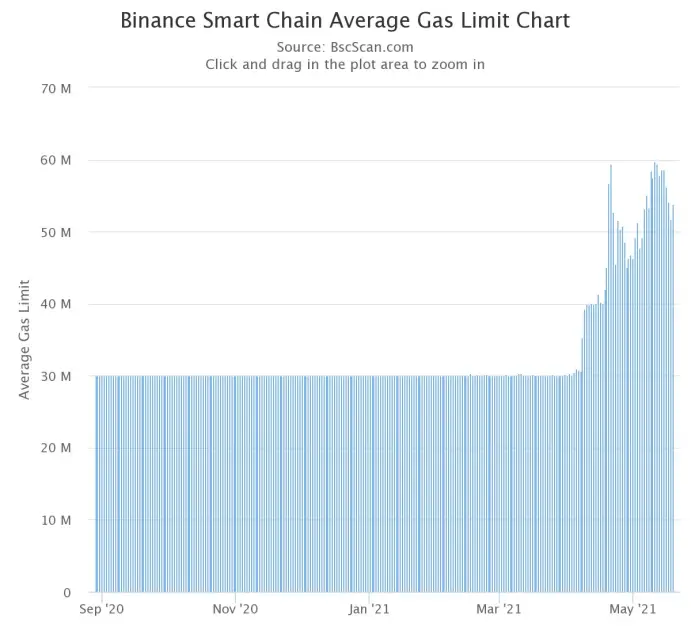
Image credit: BSCscan
Another key risk variable when discussing BNB is regulatory risk from governments. Binance, in its short ~4 year history, has moved headquarters from China to Japan to Malta in an attempt to avoid regulation. Most recently, Binance has taken the stance that there is not a Binance headquarters after news broke that Malta denied their application under its jurisdiction. There are also reports that Binance is legally headquartered in the Cayman Islands and Seychelles. This represents an inordinate amount of regulatory risk as businesses must fall under some jurisdiction. It is unprecedented for a legitimate business to not submit to some regulation scheme. This ambiguity, lack of transparency, and game of regulatory “musical chairs” should be worrisome to BNB token holders — the music always ends eventually. Decentralized cryptocurrencies like Bitcoin and Ethereum do not suffer from the same problem. In addition, the BNB token could be susceptible to US security laws, discussed in greater detail in the Regulation section.
In regards to technical risk, Binance selected a mixup of Delegated Proof of Stake and Proof of Authority for the Binance Smart Chain (BSC) due to the desirability of Proof of Authority’s strength against 51% attacks, and Delegated Proof of Stake’s decentralization.
Slashing logic in the Proof of Staked Authority governance model aims to penalize Byzantine validators for double signing or unavailability. This exposes malicious activity and reduces the incentive for a Clone Attack.
Binance Chain (BC) has a Tendermint Byzantine Fault Tolerant (BFT) 7 consensus mechanism. The initial Binance Chain validators were “trusted members of the Binance community,” rather than selected through a decentralized consensus mechanism. Future validators will participate in the consensus procedure.
Regulation
BNB’s future is tied to the Binance’s success as a profitable company, including financial, cryptocurrency, and Binance-specific regulatory risk.
Binance’s extensive financial product suite places considerable scrutiny on the business, as the finance industry is heavily regulated in most countries. Binance’s efforts to launch regional or country-specific exchanges and roll out products according to regulatory approval seem to indicate Binance is cognizant of the risk.
Binance has moved headquarters from country to country to avoid regulation, most recently seeming to indicate there is not a headquarters after Malta denied Binance under its jurisdiction, the last known location of Binance’s headquarters. This represents a regulatory risk as businesses must fall under some jurisdiction. It is unprecedented for a legitimate business to not submit to some regulation scheme.
Binance is currently under investigation by the U.S. Internal Revenue Service as well as the Department of Justice for money laundering as well as dealing with inquiries from the Commodity Futures Trading Commission (CFTC) over whether Binance allowed U.S. residents to trade on its exchange. It is important to note that of Q2 2021, "[t]he federal agencies haven’t accused Binance of wrongdoing." However, over the course of 2021, Binance hired a slew of high-profile individuals to join its regulatory advisory team including former U.S. senator Max Baucus as a regulatory advisor and two former members of the Financial Action Task Force (FAFT) to its advisory team.
Additionally, Binance's legal issues are not isolated to the US. in 2020, Binance faced regulatory pushback in Europe for providing stock token trading on its exchange.
The BNB token launched in an initial coin offering, which the United States Securities and Exchange Commission has viewed unfavorably and has yet to rule broadly. Some ICOs have been retroactively penalized for violating US securities law.
BNB can be deemed a security if it satisfies certain properties based on the common definition and interpretation of the Howey Test, the most common legal test applied to securities. The four component questions of the test are listed below:
- Is there an investment of money?
- Is there an expectation of future profits?
- Is the investment of money in a common enterprise?
- Do any profits come from the efforts of a promoter or third party?
Many digital assets lack clear utility and thus have no purpose other than for retail investors to speculate on price (e.i. invest). BNB, however, has clear utility on the platform if for nothing else than to receive discounted trading fees. This appears to be BNB’s best argument for not being classified as a security as Binance US CEO Catherine Coley reaffirmed recently on a podcast.
The biggest argument for BNB being classified a security according to the Howey Test is its dependency and centralization around the “common enterprise” and “third party” company, Binance. Other tokens created by large centralized companies have recently run into opposition from the US regulators, such as Telegram abandoning its project entirely after a multi-year battle with the SEC.
Additionally, the buyback and burn procedure creating a deflationary nature uses language indicative of an equity buyback. While the actual buyback is not actually a buyback, the use of the word buyback could bring unwanted regulatory scrutiny.
Due to BNB’s original ICO-type fundraising, its multitude of potential uses cases, and unclear jurisdiction, teasing apart the legal standing of BNB is fraught with challenges until more guidelines become clear.





