
You are reading an excerpt from our free but shortened abridged report! While still packed with incredible research and data, for just $40/month you can upgrade to our FULL library of 60+ reports (including this one) and complete industry-leading analysis on the top crypto assets.

Becoming a Premium member means enjoying all the perks of a Basic membership PLUS:
- Full-length CORE Reports: More technical, in-depth research, actionable insights, and potential market alpha for serious crypto users
- Early access to future CORE ratings: Being early is sometimes just as important as being right!
- Premium Member CORE+ Reports: Coverage on the top issues pertaining to crypto users like bridge security, layer two solutions, DeFi plays, and more
- CORE report Audio playback: Don’t want to read? No problem! Listen on the go.
Intro
The Osmosis decentralized exchange (DEX) has emerged as a pivotal liquidity hub within the Cosmos ecosystem, setting a benchmark for inter-blockchain communication (IBC) volumes and connectivity. As the preeminent DEX in Cosmos, Osmosis boasts the highest total value locked (TVL) and trading volume, providing users with unparalleled liquidity and a diverse array of trading pairs. Over the past year, Osmosis has facilitated transactions exceeding $6 billion, alongside a notable uptick in user engagement.
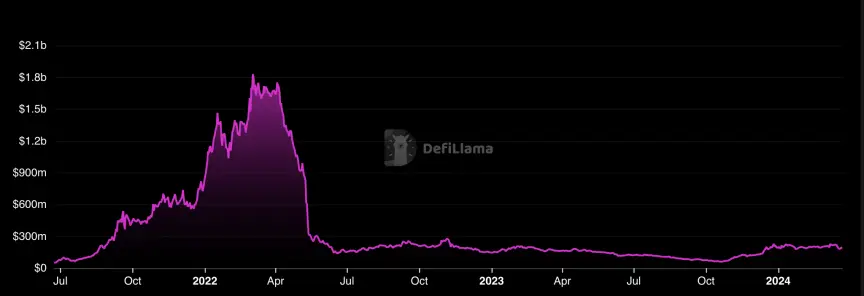
Osmosis DEX TVL. Source
Osmosis is its own sovereign, application-specific blockchain (its own zone) in the Cosmos ecosystem that serves as an Automated Market Maker DEX with more than ~$200 million in TVL. As an L1 AMM built on Cosmos, it’s interoperable with every other zone in the Cosmos ecosystem. The main feature of Osmosis is customizability. The Osmosis team describes itself as a platform for “modular, customizable AMMs.” Most other AMMs have hard-coded parameters/formulas where the bonding curves, fee structures, tiers, etc., are pre-determined. Osmosis enables users to create their own AMM pool with maximum customizability, including bonding curves, multi-token asset pools, fees, and more.
The OSMO token functions similarly to $ATOM in the Cosmos Hub: it secures the network via its Proof-of-Stake (PoS) mechanism, is used in protocol voting and serves as the network's base transaction currency. The vast majority of IBC volume occurs on Osmosis. The incentive system relies heavily on inflationary compensation. In fact, the present real APR (yield on investment via inflation) is close to -20%. This circumstance has led to a low staking ratio of approximately 43%, which is detrimental to the chain's security.
Osmosis Use Cases
Osmosis allows for the creation of highly customizable, multi-asset pools while also incorporating elements from other AMMs like “self-governing” liquidity pools that have governance rights over their parameters. Like Curve, LPs must lock their tokens to participate in governance, with voting power and boosted liquidity mining rewards proportional to the length of the lock period. Osmosis also enables transactional privacy (helps prevent front-running) with cross-chain AMM functionality and has IBC implemented for bridging with other chains.
Liquidity Providers (LPs) are incentivized to commit assets to the protocol to earn a portion of transaction fees on the trades they’ve facilitated in virtue of making their assets available. In many DeFi AMMs, the weighting of token pairs deposited to Liquidity Pools is required to be equal (a 1:1 ratio of value), whereas this is a configurable parameter for Osmosis.
A significant milestone in Osmosis' development is the introduction of Supercharged Liquidity, Osmosis's adaptation of concentrated liquidity, alongside the ongoing development of OSMO 2.0. This latter initiative represents a comprehensive overhaul of the platform's existing token economics, with a focus on sustainability.
Launchpad
The platform also serves as a vital launchpad for a variety of notable decentralized applications (dApps) within the broader Cosmos ecosystem. Following the collapse of Terra, both the Mars money market protocol and the Levana Protocol, a perpetual DEX, migrated to Osmosis, where they have since experienced substantial growth. Additionally, Milkyway, a liquid staking protocol for Celestia's $TIA token, chose Osmosis for its launch, drawn by the DEX's significant on-chain TIA liquidity and its support for CosmWasm contracts, bringing approximately $40 million of $TIA to the platform.
Superfluid Staking
A standout feature of Osmosis is its Superfluid Staking mechanism, a novel staking solution that allows users to simultaneously earn swap fees from liquidity pools and proof-of-stake (PoS) staking rewards. This three-stage process begins with liquidity providers depositing tokens into pools, followed by the locking of received liquidity pool (LP) tokens through Superfluid Staking, culminating in the accrual of both fees and rewards. This innovation marks a significant milestone, being the first instance where liquidity providers can contribute to both DEX liquidity and network security while earning rewards, thereby enhancing capital efficiency and the attractiveness of participating in the Osmosis network.
Mesh Security
Another noteworthy initiative is Mesh Security, announced on May 18, 2023, and supported by the Osmosis Grants Program (OGP) with backing from key partners such as ATOM Accelerator, Akash, Axelar, and the Osmosis Foundation. Mesh Security, developed through a collaborative, bottom-up approach across the Cosmos ecosystem, introduces a novel security model. It allows token delegators, with tokens staked on one Cosmos chain, to restake them on a different partner chain, with the caveat that misbehavior by their chosen validator on the partner chain results in slashing on both chains. This model, which offers staking rewards in exchange for the assumed risk, presents three main distinctions from Replicated Security: bidirectional or multilateral security flows, no additional node requirements for validators, and suitability for appchains seeking to enhance economic security and ecosystem integration. Thus, Mesh Security is seen not as a competitor but as a complementary and potentially superior option for appchains as they mature.
In conclusion, Osmosis stands at the forefront of the DeFi movement within the Cosmos ecosystem, driving innovation through features like Supercharged Liquidity, Superfluid Staking, and Mesh Security. These developments not only enhance the platform's functionality and economic sustainability but also foster a more interconnected and secure blockchain ecosystem. As Osmosis continues to evolve, it remains a critical node in the expanding universe of decentralized finance, offering valuable insights into the future of blockchain interoperability and security.





