

Overview
Cosmos, a project often described as the Internet of blockchains, connects sovereign blockchains using the Inter-Blockchain Communication (IBC) protocol. The IBC Protocol standardizes communication across disparate blockchains, connecting them via the Cosmos Hub, and making them interoperable. Data and value (tokens) can be transferred from one “zone” (one blockchain) to another (a separate blockchain) in a secure and trustless manner by routing all transfers through the central Cosmos Hub.
The ATOM token underpins the Cosmos Hub which utilizes a Proof-of-Stake (PoS) consensus method. Users stake ATOM to help secure the network and receive compensation via inflation and transaction fees. Cosmos is attempting to create a decentralized, easy-to-join, interoperable meta-layer for blockchain that improves scalability, security, and liquidity across the blockchain space.
ATOM Strengths
- The Cosmos SDK is a modular framework that simplifies creating secure blockchain applications on top of Tendermint making it extremely easy for developers to onboard onto the Cosmos blockchain.
- With the Inter-Blockchain Communication (IBC) now live, 150+ Tendermint-based blockchains are now interoperable and able to send tokens from/to one another.
- Standout blockchains and dApps with real adoption like Binance Chain, THORchain, Luna, and Kava have integrated with the Cosmos network demonstrating the advantages of interoperability that Cosmos provides.
- Plans to create an opt-in shared security model amongst zones in the network will create even more flexibility, freedom, and incentives to join Cosmos for projects and developers looking to build their own blockchains.
ATOM Weaknesses
- Because the IBC only launched in February 2021, adoption remains quite low. As of Q2 2021, there are only ~40 zones and less than 35,000 monthly active users across the entire IBC. Additionally, even though there are currently 40 zones, 95% of all activity happens in just two zones.
- Cosmos faces serious competition from a number of angles. Polkadot is a direct competitor with considerable brand awareness. Ethereum is far and away the ecosystem leader that may reduce the need for interoperability projects. Finally, bridge projects like Badger and Ren, as well as side chains like Polygon, while not direct competitors, do introduce solutions that could steal market share from Cosmos.
- Regulatory concerns exist around Cosmos due to its ICO whereas the SEC has already commented on competitor blockchain, Ethereum, (twice) saying that they do not believe it fits the definition of a security.
Important Links
If you want more Cosmos analysis as well as other top 30 coins, use the code "Publish0x" when subscribing to CryptoEQ.io to make your first month of CryptoEQ just $10!
Use Case
Cosmos, a project often described as the Internet of blockchains, connects sovereign blockchains via a “hub and zone” model using the Inter-Blockchain Communication (IBC) protocol. A central Cosmos Hub, utilizing Proof-of-Stake (PoS), is the native chain on which the ATOM token lives. Stakers of this primary hub secure the network and route/execute transactions across disparate blockchains. Cosmos is also sometimes called “Blockchain 3.0” (as opposed to Bitcoin and similar Proof-of-Work (PoW) blockchains being nicknamed “Blockchain 1.0” and Ethereum and other blockchains focused on smart contracts being nicknamed “Blockchain 2.0”). Cosmos Network is a solution to three main issues which surround connecting blockchains together.
- Scalability - Cosmos adopts a proof-of-stake (POS) consensus mechanism through Tendermint's BFT (Byzantine Fault Tolerant) consensus engine.
- Usability - Cosmos fixes the steep learning curve for developers creating blockchain applications for the first time through their Cosmos SDK, a modular framework design for building interoperable blockchains.
- Interoperability - Crypto currently has a "competitive island" atmosphere. Every project is fighting for attention with every other project, with the rare partnership. Cosmos enables projects through the IBC protocol, cross-chain swaps, and other interblockchain actions and communication.
Currently, the blockchain space is rather siloed, with projects developing and operating completely independently of each other. IBC would allow blockchains to send information to or between each other if they so desired.
Interoperability-type protocols like Cosmos are quickly becoming a crowded space, and despite Cosmos' lead, it has quite a few competitors. The biggest competitor is Polkadot, which despite launching only a few months earlier, has quickly climbed in market capitalization.
Technology
The Cosmos network is secured with the Tendermint BFT consensus. Tendermint Core Byzantine Fault Tolerance (BFT) is a consensus algorithm designed by the Tendermint team that aims to create a general-purpose consensus layer on which developer-specific applications can be built atop. Tendermint Core’s primary function is to ensure all transactions are recorded in the appropriate sequence on every machine.
The whitepaper goes on to highlight many advantages, including:
- Strong safety guarantees.
- Scalability, with a mechanism able to handle >1000 transactions per second (TPS) in bad conditions (validators crashing/maliciously sending false votes).
- Streamlined light clients, making Cosmos suitable for mobile/IOT applications.
- Mitigates attacks like long-range-nothing-at-stake double spends and censorship.
- When implemented in the Tendermint Core, allows blockchains programmed in any language to be secured via this consensus mechanism.
Proof-of-Stake
Cosmos originally launched in March 2019 with 100 validators but as of Q2 2021, has ~160 validators with a total of ~300 planned. Block times are seven seconds and the network is theoretically able to handle over 1000 tx/s. The upper limit has never been tested and thus any claims beyond current usage remain untested.
In PoS systems, validators serve as consensus nodes. In Cosmos, stakers (sometimes called delegators) assign their stakes to validators. A validator’s voting power is determined by the proportional amount of stakes allotted to it. In Cosmos, validators are chosen to propose the next block by their voting power - i.e., a validator that holds 15% of the voting power will get to propose the next block 15% of the time.
Such a system allows stakers or delegators to contribute to the project without needing substantial computing power of their own. For the average user, staking is not risk-free as delegated ATOM can be slashed if a validator acts maliciously or against consensus. Slashing refers to when staked tokens are burned and the user/validator cannot get them back. Validators can be slashed if they are offline for long periods of time (minor offense and small stake slashed) or have ~5% slashed if they sign two different blocks (malicious activity).
Application Blockchain Interface (ABCI)
Another feature of Tendermint that is present in Cosmos is the Application Blockchain Interface (ABCI), an engine that contains both the networking and consensus layers of a blockchain. Developers can then build the application layer, such as a dApp, on top of the ABCI. The Tendermint ABCI is compatible with any programming language, able to be used for both public and private blockchains, and has a block time of approximately 1 second.
Connecting Blockchains
The Cosmos ecosystem, unlike Ethereum, is not a single blockchain that facilitates state and transaction transfers but rather, a decentralized network of chains built using the shared Cosmos SDK toolkit. Cosmos SDK allows new developers to choose from a selection of pre-built modules based on their specific needs when designing a new blockchain.
In addition to relying on a PoS mechanism that is not encumbered by the nothing-at-stake problem, Cosmos also displays other novel features, such as the idea and technology behind its nickname, “the Internet of blockchains.” Inter-Blockchain Communication (IBC) protocol allows users to send information between two sovereign chains by allowing those chains to relay their headers to one another, also known as running a light client on one another.
Stargate, the name of the upgrade which launched IBC, was implemented in February 2021. With it, 150+ Tendermint-based blockchains now are interoperable as well as allowing Cosmos SDK blockchains to communicate with other blockchain protocols. With IBC live, previously siloed blockchains can now send tokens from/to one another.
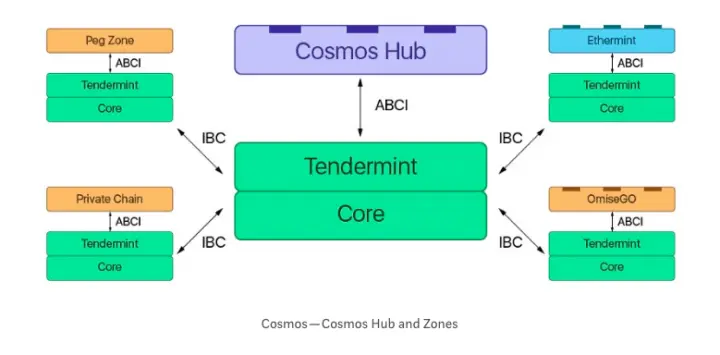
Image credit: Cosmos blog
The “Internet of blockchains” takes this one step further by creating a hub and zone model. The Cosmos Hub is a Proof-of-Stake (PoS) chain that serves as the primary hub for routing transactions and data between blockchains. Using the hub and zone model, any zone (i.e. blockchain) can send information to a connected hub and then that hub can send the information to any of the other connected zones. Zones plug into hubs, which route and validate the transactions passed between different zones in exchange for fees. The multiple hubs and zone architecture enable more communication throughput between zones, reducing the need for all data to route through the Cosmos Hub.
Economics
While the Cosmos protocol can support thousands of separate tokens, Cosmos’ native crypto is ATOM. There are ~261,000,000 ATOM in total, with about 210,709,121 circulating as of Q2 2021. There is no capped maximum supply of ATOM like in the Bitcoin network.
ATOM’s primary functions in the Cosmos ecosystem are:
- Staking to secure the network and maintaining consensus
- A means for paying transaction fees
- Chain governance
ATOM tokens can be staked to participate in the Cosmos PoS consensus mechanism. ATOM holders who stake their ATOM may receive additional ATOM as a reward. Keep in mind that the rewards that users earn for staking Cosmos are not the same as the inflation rate, though they are informed by the inflation rate. Gavin Birch explains how an inflation rate of 7.5% could correspond to a rewards rate of approximately 10.61%.
Aside from inflation and newly created ATOM, staking rewards are primarily funded by transaction fees. Staking ATOM does involve risks, as misbehaving, double-signing, or offline validators may face punishment by having some of their ATOM slashed or burned.
A user can stake ATOM by delegating the ATOM in their wallet to validators and starting a staking transaction. Staked ATOM is locked, so it can’t be traded or transferred; however, staked ATOM can be unstaked if a user wishes to transfer it. The unstaking or undelegating process, however, takes 21 days.
ATOM stakers also have the opportunity to participate in the governance of the Cosmos Network, which is discussed in more detail in the Governance section.
ICO Details
Cosmos conducted their ICO over a 2-week period in 2017, with the fundraiser beginning on April 6, 2017. The chain genesis occurred later that year in Q2 2017.
For exact details, the Cosmos Plan can be referred to, but generally, the token distribution is as follows:
- 10% of all ATOMs were allocated to the Interchain Foundation (ICF), a Swiss non-profit with a mandate to research, develop, and promote Cosmos SDK
- 10% to Tendermint development
- Initial Donors received 5%
- Pre-Fundraiser + Fundraiser Donors received 75%
While the primary purpose of ATOM is to secure the Cosmos chain, ATOM can be traded when not staked and is available for exchange on numerous platforms, including Coinbase, Kraken, Binance, and Poloniex, among others.
Governance
Complimenting their PoS mechanism is robust on-chain Cosmos governance that relies on community members to submit proposals to the blockchain in order for continuous upgrades.
Lunie, a non-custodial staking platform, has an in-depth guide about how the process works, but at a high level:
- Users submit a proposal and must pay the transaction fee to discourage spam.
- A deposit period of two weeks opens, and at least 512 ATOM must be deposited for the proposal to move into voting.
- Once in the voting stage, only staked tokens are allowed to vote yes, no, or abstain. Note that Cosmos uses a supermajority in their consensus mechanism, so at least 2/3 of the group must vote affirmative for an action to pass.
- If more than 40% of all staked tokens vote, with more than 50% voting yes, and less than 33.4% voting now, then the proposal will be successfully propagated to the network.
After a proposal passes, the first step is for validators to download this new version. Once 2/3 of validators download the new version, the rest of the network is expected to follow, which ushers an upgraded version of Cosmos Network.
Similar to MakerDAO’s structure, ATOM holders have the right to vote on future governance decisions and the future development of the protocol. Each individual project within the Cosmos ecosystem has different needs which makes easy, open, and permissionless governance critical for coordinating across projects. Voting participation among the ~154 active validators remains high relative to other blockchains, with some proposals garnering over a 57% turnout. Voting activity has overall increased since Q4 2020.
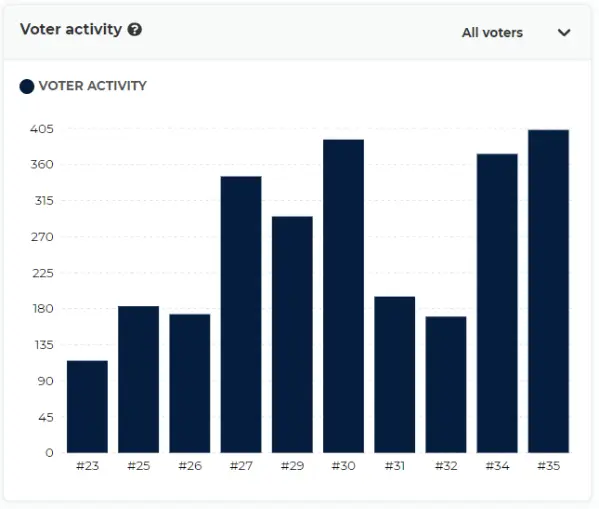
Image credit: Mintscan
Token allocations were designated during the ICO, and 75% of tokens were distributed to investors, meaning that the community holds lots of power, despite there being an Interchain Foundation that informs operations.
Cosmos Network, like many cryptocurrencies, is open-sourced with development available for viewing on their Github.
Developer activity has been fairly consistent as well, besides what seems to be like a team-wide break around Christmas/New Years’ time.
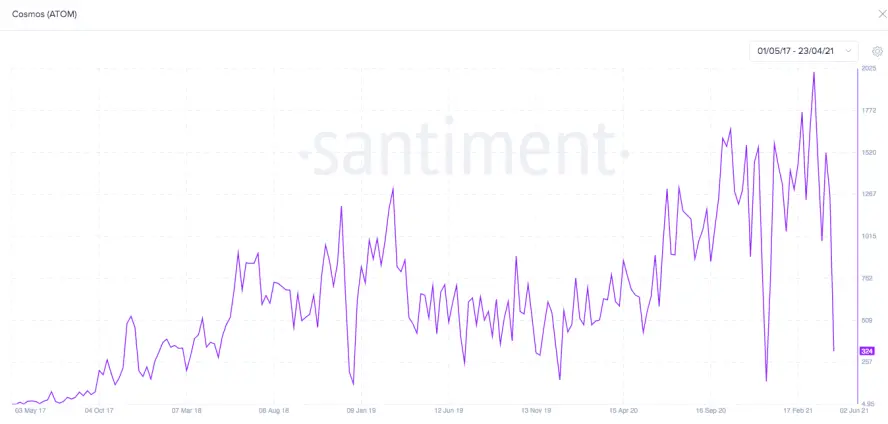
ATOM developer activity has generally increased since 2017. Image Credit: Santiment
Vulnerabilities
While Cosmos Network was one of the earliest protocols to target the interoperability niche, their first-mover advantage (in terms of market capitalization) may have ceased to exist. Many newcomers, like Polkadot and Avalanche, have gained popularity and name recognition. With many DeFi applications trying to bridge other siloed blockchains, such as Badger and Ren, it seems the middleware market is becoming more competitive.
The IBC protocol is the centerpiece of the Cosmos network and allows for cross-blockchain interoperability. As an example, a project like THORChain could facilitate bridging assets like bitcoin and ether into the Cosmos ecosystem which then could be used in any Cosmos app like a DEX or DeFi on Kava. However, while all this is possible, it still is not as frictionless or trustless as if all components were built on one chain i.e. Ethereum. One of Ethereum’s current advantages to its competitors is the amount of composability it provides builders in the space. It is far easier for a new developer to integrate an existing Ethereum DeFi application with their project if they build it on Ethereum rather than Cosmos.
When it comes to vulnerabilities within the technology itself, thus far, Cosmos has been rather transparent. Security and vulnerability updates are regularly posted by team members to the Security category on the Cosmos forum. As of Q2 2021, at least 8 vulnerabilities or incidents had been shared with the forum by Cosmos or Tendermint team members. Cosmos and Tendermint team members also share how vulnerabilities were addressed and often share detailed retrospectives.
At least two vulnerabilities have received attention from the press. In 2019, a security vulnerability in the staking module of the Cosmos SDK was discovered and patched via a system-wide upgrade. In early 2021, a critical security vulnerability that could have resulted in a chain halt was discovered and fixed via an update.
Finally, there are concerns around the token value accrual associated with ATOM. While the token has had tremendous success early on, this is almost entirely due to unsophisticated speculation and not driven by any real-world value accrual like fees. It remains possible that Cosmos SDK becomes widely used, connecting many blockchains. However, those blockchains (generally) have their own native token which may limit ATOM’s ability to capture that value created.
Network Effect
Given Cosmos' high market capitalization and years of development, it comes as no surprise their social media channels are of equally impressive standing. Here's the high-level overview:
- Subreddit with 20,000+ members.
- Twitter page with ~140,000+ followers.
- Telegram channel with nearly 12,000 followers and often 1,700+ members online.
- The Cosmos forum with frequent community participation and hundreds of members.
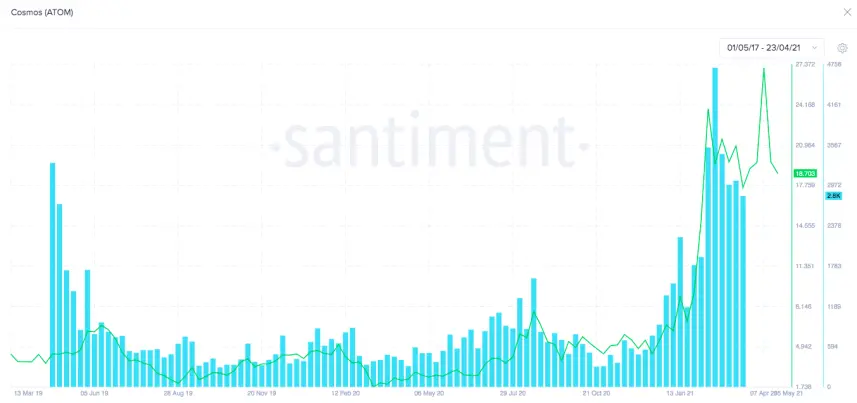
ATOM price spiked in Q1 2021 alongside its social volume across different platforms. Image credit: Santiment
Users have a plethora of exchanges and trading pairs to choose from when buying or selling ATOM. The top exchanges in terms of ATOM daily volume include Binance, OKex, Huobi, Coinbase Pro, and Kraken.
Cosmos has shown popularity among developers and announced various partnerships. Reportedly, over 100 projects have been integrated with Cosmos, with some of the most significant including:
- Binance Chain
- Secret Network
- Terra Luna
- OKChain
- Band Protocol
- Aragon
There are ~250 apps and compatible blockchains built with the Cosmos SDK and currently in the Cosmos network. The simplicity of utilizing the SDK and its flexibility are what have driven projects like Terra and THORChain to integrate into the Cosmos network.
However, as of Q2 2021, there are only ~40 zones and less than 35,000 monthly active users across the entire IBC. Additionally, even though there are currently 40 zones, 95% of all activity happens in just two zones.
Team
In late 2020, the Cosmos founding team broke up and created separate teams focused on different aspects of the protocol. However, the project continued despite the disruption among the team.
At the heart of the Cosmos project is the Interchain Foundation, a Swiss non-profit that supports the development of the Cosmos Network.
Interchain’s foundation council consists of:
- Jae Kwon, President
- Ethan Buchman, Vice President
- Pascal Schmid, Council Member
- Fernando Pedone, Council Member
- Brian Crain, Council Member
At first, a substantial amount of the Cosmos project’s software development was completed by the Tendermint team, but the Cosmos FAQ claims that the development has become decentralized over time. Tendermint is a blockchain consensus project and company founded in 2014 to bring projects which used the Tendermint consensus algorithm to market. In 2017, Tendermint, the company, was contracted by the Interchain Foundation to help bring the Cosmos network to market.
Over a dozen teams have contributed to the Cosmos ecosystem, including Althea, IRIS, and Regen, among others. Interchain GmbH, also known as Interchain Berlin, is the team most focused on the core infrastructure of Cosmos like IBC and Tendermint. It, along with Iqlusion, was a new team created after the split in 2020. Iqlusion is headed by Zaki Manian and provides infrastructure as well as run a validator on the Cosmos network.
It's also unclear if Kwon is still president at ICF as the official website claims that he is, but Kwon's personal Twitter claimed he stepped down last month:
Formerly known as Jae Kwon on Twitter: "I am stepping down from AIB and the ICF to focus on the Gno language and GnoLand projects, to bring next-generation smart contract programming to the Cosmos ecosystem, ultimately to create next-generation commons infrastructure projects. Long live Cosmos.”
User Experience
Within the Cosmos ecosystem, ATOM is used for, in part, governance activities. Users can also choose to pay transaction fees on the Cosmos network with ATOM, but this is not required as users may also use other tokens to pay the transaction fees.
Users are able to stake ATOM, which allows users to earn rewards and vote on proposals. Currently, Cosmos lists the typical APY of staked ATOM at 9.7%. New users can begin investigating their staking options on the Cosmos website. Users will need to pick a wallet and validator with which they are comfortable. It is suggested that users delegate to multiple validators with favorable reputations and uptime statistics to hedge their risk. A full list of validators can be found here.
A strong indicator of user presence is hardware wallet support - if there are enough users to warrant the demand for a hardware wallet solution, then there's significant demand for a particular cryptocurrency.
In ATOM's case, Ledger allows users to send or receive ATOM on their wallet just like any other asset. Beyond hardware wallets, Cosmos boasts 32 wallet choices ranging from IOS to android to desktop.
Just like what you'd expect with any other cryptocurrency with an established ecosystem, there's also:
- Block explorers - https://cosmos.bigdipper.live/, https://atomscan.com/, and https://hubble.figment.network/cosmos/chains/cosmoshub-3
- Additional full-featured wallets like Cosmostation and Keplr wallet.
- Cosmostation is a native desktop wallet but is also cross-platform compatible with both Android and ioS.
To follow along with project governance or vote on proposals, Mintscan allows users to easily track individual proposals.
Regulation
Cosmos Network is fortunate to not have received any regulatory scrutiny specifically targeted towards ATOM and thus doesn't have any specific views nor contradictory statements from governing bodies.
Many digital assets lack clear utility and thus have no purpose other than for retail investors to speculate on price (i.e. invest). ATOM has an obvious utility case on the platform in the form of staking and paying for transactions. ATOM performs the role of a utility in the form of allocating computational resources on the network.
One potentially problematic feature of ATOM is its POS mechanism which results in validators being rewarded through inflationary measures. While one could argue that ATOM is necessary as a sort of "digital oil" to process transactions on the network (thus not being classified as a security and failing the Howey Test), receiving a dividend, of sorts, walks the line of an investment vehicle.
The SEC has already commented on Ethereum (twice) – in conjunction with Bitcoin – saying that it is not a security. In addition to those preliminary comments, the previous CFTC Chairman publicly stated in October 2019 that ether is viewed as a commodity by the U.S. regulatory body. While there are numerous differences between the Cosmos and Ethereum ecosystem, it is likely that, from a legal standpoint, the projects would be viewed through a similar lens from governing bodies given their structures, goals, and fundraising histories. ATOM will likely still be subject to any blanket regulation imposed on cryptocurrencies.
Cosmos was rated by the Crypto Rating Council (CRC) in October 2019 and currently has a rating of 3.75. The scale runs from 1 to 5, with lower scores being less likely to be similar to a security, and higher scores being more likely to be similar to or considered a security, according to CRC’s framework. As of the time of writing, CRC has rated 28 cryptocurrencies, with XRP having the highest rating at 4.0 and Bitcoin, Dai, Litecoin, Monero, and USD Coin tied for the lowest rating at 1.0.
Road Map
Since launching Cosmos Network in 2017 with the private and public token sales, Cosmos has since rolled out an MVP of their hub, launched the mainnet on March 13th, 2019, launched the IBC, and has onboarded several noticeable projects like Kava and Band protocol. Users can stay up-to-date on the latest developments by following the Cosmos newsletter.
Early 2021 was dominated by developments around the Stargate, the name of the upgrade which launched IBC. Stargate was implemented in February 2021 and allows previously siloed blockchains to send tokens from/to one another. With it, 150+ Tendermint-based blockchains now were interoperable as well as allowing Cosmos SDK blockchains to communicate with other blockchain protocols.
Gravity DEX, which will allow users to swap digital assets across the network, is anticipated to be released in 2021 with a testnet launching in Q2 2021. The Gravity Dex Upgrade will create an Automated Market Maker (AMM) on the Cosmos Hub, similar to Uniswap on Ethereum.
Gravity Bridge, an Ethereum-Cosmos bridge, is also planned for 2021. Ethermint is a layer that runs atop Ethereum and is compatible with both the Cosmos and Ethereum ecosystems. Interchain Staking is planned for late 2021. A chain name service (CNS) is also planned for 2021. Staking derivatives are expected to be introduced in 2022.





