
You are reading an excerpt from our free but shortened abridged report! While still packed with incredible research and data, for just $20/month you can upgrade to our FULL library of 50+ reports (including this one) and complete industry-leading analysis on the top crypto assets.

Becoming a Premium member means enjoying all the perks of a Basic membership PLUS:
- Full-length CORE Reports: More technical, in-depth research, actionable insights, and potential market alpha for serious crypto users
- Early access to future CORE ratings: Being early is sometimes just as important as being right!
- Premium Member CORE+ Reports: Coverage on the top issues pertaining to crypto users like bridge security, layer two solutions, DeFi plays, and more
- CORE report Audio playback: Don’t want to read? No problem! Listen on the go.
Sequencers in a Rollup
Sequencers are critical to Ethereum rollups. Sequencers collect L2 transactions, batch them (create L2 blocks), and then propose the batch as a valid L2 transaction.
 Proof-of-efficiency sequencer batch proposal process. Source
Unfortunately, they are also one of the most centralizing aspects of rollups and thus are the target of scrutiny amongst the community. For almost all rollups today, the sequencer is run by one company/foundation that is associated with the rollup. Since it is just one company/entity running the sequencer, the usual questions around a single point of failure arise:
- Do we have to trust the company?
- What if the company acts maliciously?
- Can they steal funds? Censor people?
- What happens if they have a bug? Or close down business?
This has led companies like L2Beat to create an entire risk metric around rollups, even taking into account sequencer risk (column five in image below).
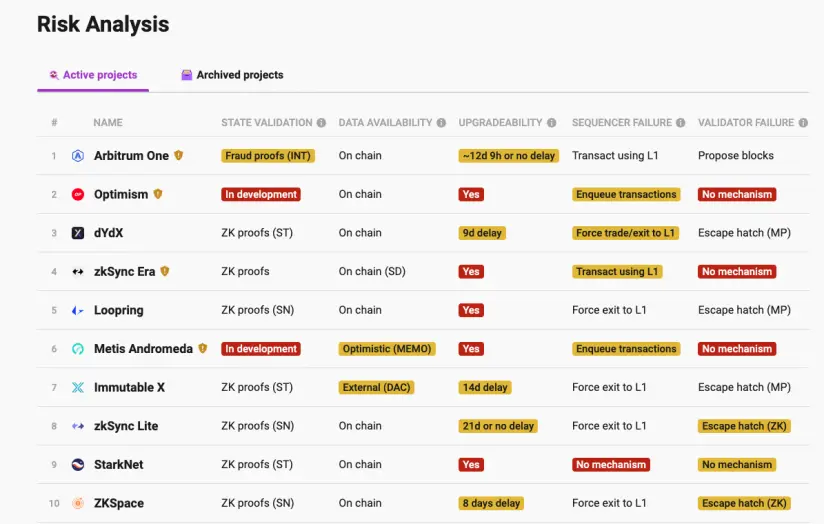
However, nearly all have stated plans to "decentralize the sequencer" in the future. What does that mean and what are the benefits?
Shared Sequencers = Solution?
Shared sequencers are a new approach to rollup design that decentralizes the role of sequencer. In a traditional rollup, a single sequencer is responsible for collecting transactions, assembling them into blocks, and submitting them to the Layer 1 chain. This can lead to a number of problems, including:
- Centralization: If the sequencer is not decentralized, it can become a single point of failure for the rollup. If the sequencer is malicious, it could censor transactions, block users, or even steal funds.
- Censorship: A centralized sequencer could potentially censor transactions or block users from participating in the rollup. This could be done for a variety of reasons, such as to prevent users from participating in certain DeFi protocols or to censor certain types of content.
- MEV extraction: A centralized sequencer could extract value from the rollup by collecting transaction fees or by frontrunning transactions. MEV (Maximum Extractable Value) is the profit that can be made by strategically reordering transactions before they are included in a block. A centralized sequencer could use its position to frontrun transactions, meaning that it could place its own transactions ahead of other transactions in order to collect higher fees.
Shared sequencers address these problems by decentralizing the role of sequencer. Instead of a single sequencer, a shared sequencer network is responsible for collecting transactions, assembling them into blocks, and submitting them to the Layer 1 chain. This network is made up of a large number of nodes, which are randomly selected to perform these tasks. This decentralization helps to improve censorship resistance, MEV extraction, and security.
Shared sequencers also offer a number of other benefits, including:
- Increased scalability: Shared sequencers can scale more easily than traditional rollups because they do not require a single sequencer to process all of the transactions. This is because the load can be distributed across the network of nodes.
- Reduced costs: Shared sequencers can reduce the costs of running a rollup because they do not require a single sequencer to be paid for their services. This is because the costs can be shared across the network of nodes.
- Improved efficiency: Shared sequencers can improve the efficiency of rollups by reducing the amount of time it takes to process transactions. This is because the transactions can be processed in parallel by the network of nodes.
Overall, shared sequencers offer a number of potential benefits over traditional rollups. They are more decentralized, secure, scalable, efficient, and cost-effective. As a result, they have the potential to become the dominant rollup architecture in the future.
Here are some of the challenges that need to be addressed before shared sequencers can be widely adopted:
- Incentive alignment: It is important to ensure that the incentives of the sequencer network are aligned with the interests of the rollup ecosystem. This can be done by using a variety of mechanisms, such as bonding, staking, and rewards. For example, nodes in the sequencer network could be required to bond a certain amount of tokens in order to participate. This would ensure that they have a vested interest in the success of the network.
- Security: Shared sequencers are more complex than traditional rollups, and they may be more vulnerable to attack. It is important to carefully design and implement shared sequencers to ensure that they are secure. For example, the network could be designed to be resistant to Sybil attacks, which are attacks where an attacker attempts to control a majority of the nodes in the network.
- Adoption: Shared sequencers are a new technology, and it may take time for them to be adopted by the wider rollup ecosystem. It is important to educate developers and users about the benefits of shared sequencers to encourage adoption. For example, developers could be incentivized to build on shared sequencer rollups by offering them grants or other forms of support.
Despite these challenges, shared sequencers have the potential to be a major step forward in the evolution of rollups. By addressing the shortcomings of the current model, shared sequencers could help to make rollups more decentralized, efficient, and secure.





