
You are reading an excerpt from our free but shortened abridged report! While still packed with incredible research and data, for just $20/month you can upgrade to our FULL library of 50+ reports (including this one) and complete industry-leading analysis on the top crypto assets.

Becoming a Premium member means enjoying all the perks of a Basic membership PLUS:
- Full-length CORE Reports: More technical, in-depth research, actionable insights, and potential market alpha for serious crypto users
- Early access to future CORE ratings: Being early is sometimes just as important as being right!
- Premium Member CORE+ Reports: Coverage on the top issues pertaining to crypto users like bridge security, layer two solutions, DeFi plays, and more
- CORE report Audio playback: Don’t want to read? No problem! Listen on the go.
Lido
Lido staking is an Ethereum derivative that issues users/participants a synthetic ETH token, stETH (commonly referred to as “staked ETH” or “staked Ethereum”) in exchange for deposited ETH tokens, which Lido stakes against Validator nodes in the Ethereum network. The main value proposition is that users are able to gain interest on their deposited ETH via a proportion of the (Proof of Stake) block creation rewards allocated to validators, while also holding a liquid token, stETH, which can be traded on the market. This can be thought of as allowing users to have their ETH and stake it (have one’s cake and eat it).
Lido staking originally operated on the Beacon chain prior to Ethereum’s long-anticipated full transition from Proof of Work to a Proof of Stake consensus mechanism.
stETH gained new importance and relevance once it occurred to the market, broadly, that ETH staked towards consensus generation in the post-merge Ethereum contracts is unreleasable until after a future upgrade; it is yet to be determined when exactly this upgrade will be announced.
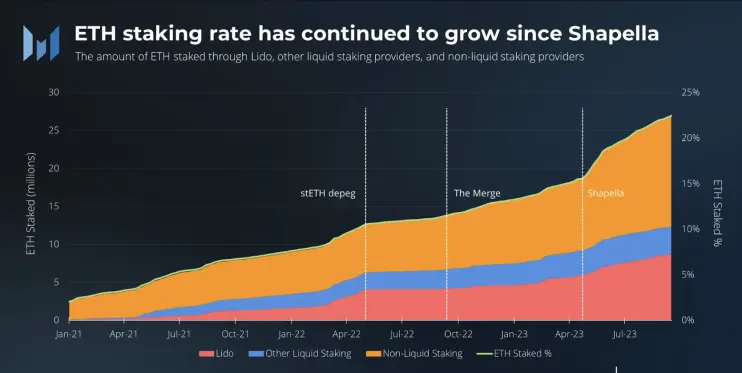
Ethereum's Shapella Upgrade and the Rise of stETH
The Shapella upgrade allowed Ethereum users to stake and unstake their ether (ETH) freely. This change significantly mitigated liquidity risks associated with staked ETH, leading to a surge in newly staked ETH.
Source: Messari
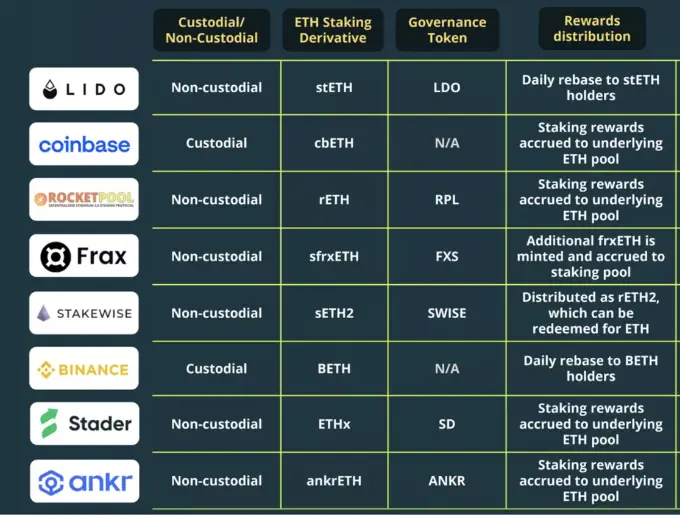
Prior to Shapella, the staked ether was largely perceived as an unstable collateral asset, primarily due to its inherent illiquidity and fluctuating discounts. However, with the upgrade in place, stETH emerged with diminished risk, soon outpacing ETH to become the go-to collateral asset in the DeFi world. The rise of stETH as a yield-bearing, native-to-crypto, and decentralized collateral has profound implications for DeFi. Offering yields competitive with bond yields, hovering between 4%-5%, stETH presents protocols with an alternative devoid of the censorial risks tied to bonds.
Source: CoinGecko
Lido's staked ETH (stETH) has been pivotal, serving not only as a secure pillar for the Ethereum network but also as a vital form of collateral, adding layers of economic utility to staked ether. But Lido's supremacy in the staking sphere isn't without its critics. Concerns loom regarding the risk associated with a sizable cohort of stakers potentially falling under the purview of a singular entity. Such a scenario could pave the way for orchestrated attacks that leverage their dominant presence on the Ethereum network, including time-bandit assaults, especially those amplified by Miner Extractable Value (MEV).

However, this trepidation is often magnified by the misconception that Lido operates as a monolithic entity. In reality, Lido is an amalgamation of multiple staking operators, each operating nodes independently, yet adhering to Lido's stipulated criteria. These standards encompass safeguarding measures against potential collaborative attacks, fortified further by Ethereum's correlation penalty.
Lido currently utilizes a cohort of ~30 node operators. These operators have undergone a meticulous review by the Lido Node Operator Subgovernance Group (LNOSG) and have gained the approval of Lido token (LDO) holders through governance votes. Entrusted with this significant responsibility, they act as validators for all Ethereum (ETH) staked through Lido.
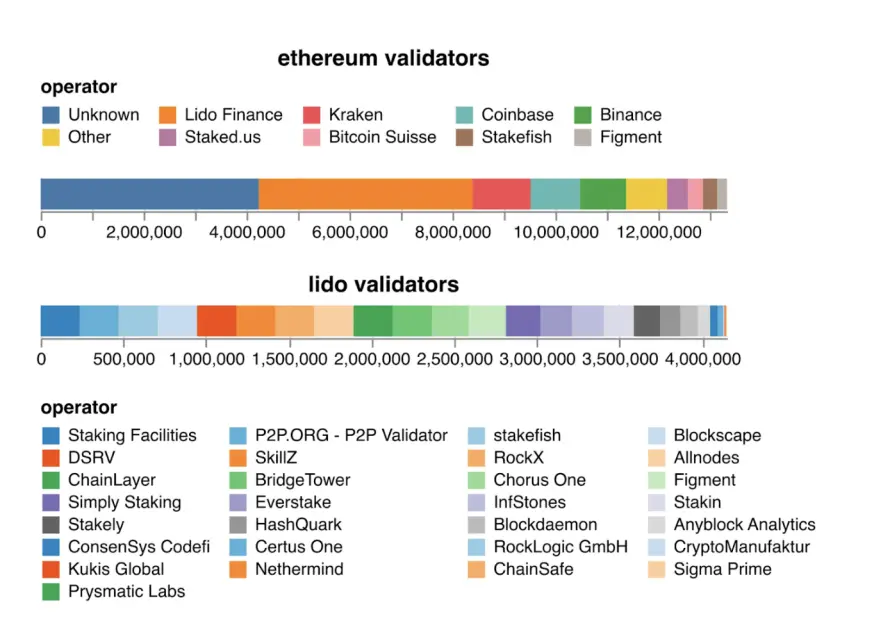
However, such a model, with the LNOSG at its core determining the node operator selection, raises concerns for the future. As articulated by Lido, reliance solely on peer review will, in the long run, inevitably lead to a cartel formation, an outcome deemed undesirable for the broader Ethereum ecosystem.
Balancing Centralization and Decentralization
It's essential to acknowledge Lido's origins. Its validator set was conceived through a centralized process. Although every validator's induction required a favorable governance vote, the Lido team held the prerogative to finalize the list of validators that the DAO could then accept. Admittedly, the initial stages of Lido's Node Operator onboarding leaned towards centralization. Such a model isn't intrinsically problematic; numerous protocols commence with a centralized structure to solidify their liquidity, incentive mechanisms, and network influence.
However, the crux of the matter lies in evolution. As networks mature, the pivot from centralized pillars to decentralized structures becomes paramount. Lido's trajectory, from its inception to its ambitious future plans, embodies this principle.





