

If you want more cryptocurrency analysis, including full-length research reports, trading signals, and social media sentiment analysis, use the code "Publish0x" when subscribing to CryptoEQ.io to make your first month of CryptoEQ just $10! Or simply click the button above!
SushiSwap Overview
SushiSwap is a Uniswap 2020 fork by the (at the time) anonymous developer Chef Nomi that launched on the Ethereum network. SushiSwap launched via a controversial “vampire attack” in which it copied/forked Uniswap’s code, added a token to pay Liquidity Providers (LPs) more than on Uniswap, and thereby pilfering many of Uniswap’s users and TVL. Chef Nomi found himself personally in hot water when he, shortly after launching the project and garnering millions, withdrew his liquidity. Ultimately, after fervent community backlash, Nomi returned the funds and turned over control of the project to a new team.
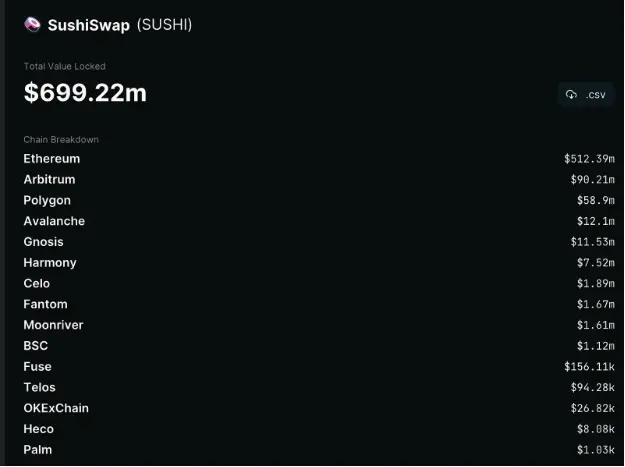
Today, SushiSwap still remains an Ethereum DeFi staple and leader that continues to update and innovate its DEX product. It’s consistently a top-20 DeFi product in terms of TVL, has over 1M total users as of August 2022, and boasts over $188 billion in total volume. As of August 2022, SushiSwap maintains over $600 million in TVL.
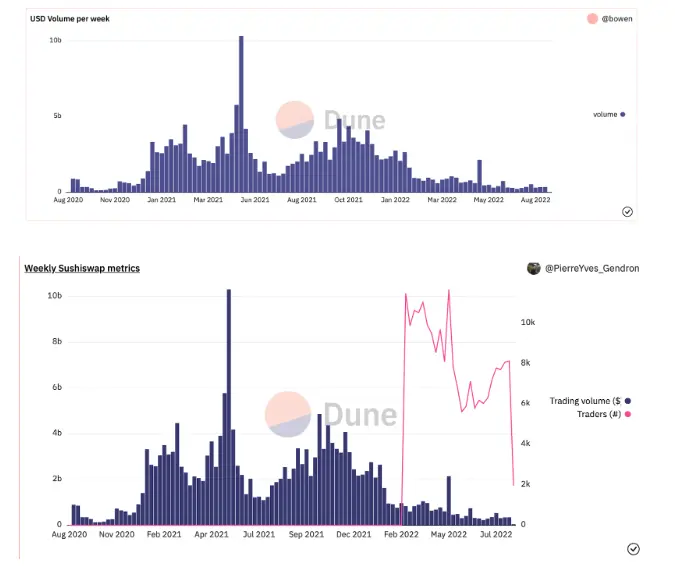
Though SushiSwap would regularly facilitate $1-2B + in weekly volume during the crypto bull market of 2021, its volume during 2022 mostly remains below $1B per week due to the overall reduced activity in the crypto market during this time.
However, as seen by the image below, whale transactions over $500,000 make up a very small portion of its volume distribution. This is in stark contrast to Uniswap and Curve, which regularly deal with whale trades.
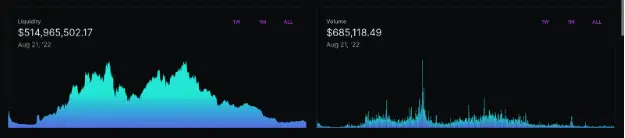
SushiSwap’s liquidity and volume peaked with that of the overall crypto market in November of 2021. As of August 2022, SushiSwap maintains $1.58 billion in total liquidity, $225.09 billion in total volume, and has over 15,000 total trading pairs. The protocol supports over 20 wallets, 14 blockchains, and has over 25,000 Discord community members. Supported chains for the DEX and their associated TVLs include the ones shown in the photo above.
How SushiSwap Works
Like Uniswap, SushiSwap also adopts the AMM model for its DEX. There is no order book for SushiSwap, and instead, the buying and selling of crypto is facilitated by smart contracts. The price of the swap is determined by an algorithm. The main differences SushiSwap introduced after being forked from Uniswap included its rewards being distributed in SUSHI tokens. Liquidity providers on SushiSwap are rewarded with the protocol’s SUSHI tokens which also act as a governance token for these token holders to participate in having a say in protocol changes. SUSHI holders can also continue to earn rewards after they stop providing liquidity, unlike UNI holders.
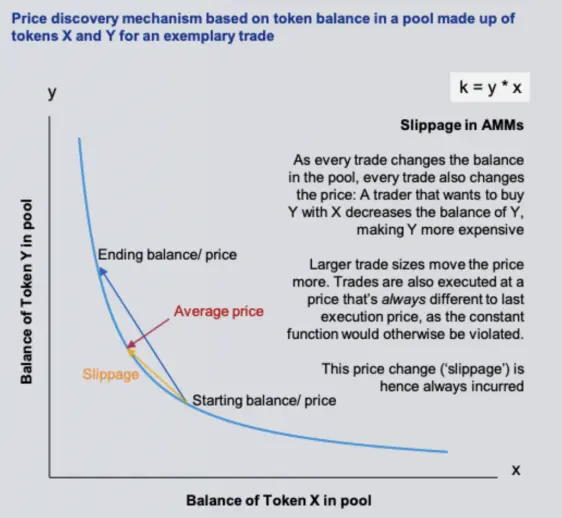
Users provide tokens through the liquidity pool and funds into this pool in token pairs, which provide the funds needed to complete swaps. Like Uniswap, SushiSwap LPs are rewarded for providing liquidity via a percentage of swap revenue. SushiSwap also offers a range of other DeFi services that are indicative of the SushiSwap team’s innovative outlook.
SushiSwap vs. Uniswap
Unlike Uniswap’s sole concentration on their DEX, the decentralized SushiSwap community is also more focused on products that go beyond just the DEX, such as Shoya, its planned NFT marketplace, and BentoBox, a token locker for dApps.
While Uniswap is a more widely used exchange and maintains a much higher TVL as of August 2022, SushiSwap has been more innovative with experimenting with new features since its launch. SushiSwap also offered a different incentive system for liquidity providers. LPs on Uniswap would earn fees from trading fees, and smaller LPs were at risk of being overtaken by larger entities and whales also providing liquidity.
On Uniswap, 0.3% of a pool’s liquidity is shared equally among LPs. On SushiSwap, 0.25% of the pool’s trading fees go to LPs in a ratio, and an additional 0.05% is converted into SUSHI and spread to token holders. Uniswap’s liquidity mining program to incentivize liquidity providers is also no longer active at this time, while that of SushiSwap continues to be online.
Uniswap v3 offers concentrated liquidity to allow users to form larger swaps, while SushiSwap does not offer this feature. Finally, Uniswap does not offer any extra rewards to new tokens on its platform, while SushiSwap offers what’s called the “Onsen Program.” This is a liquidity provision strategy for new tokens.
SUSHI Tokenomics
SushiSwap added an incentive structure to its ecosystem with its own governance token, SUSHI. During the initial days of the protocol, this made the DEX popular for token holders who wanted to have a say in changes to the protocol.
SUSHI is a governance token, and its maximum supply of SUSHI tokens is 250 million SUSHI. As of August 2022, it has a circulating supply of ~193M SUSHI tokens in circulation and a market capitalization of $240 million. While SUSHI initially had an infinite supply, a proposal that suggested capping the supply at 250M SUSHI was adopted by the community. The current expected date for this supply cap to be reached is November 2023.
As far as initial token distribution, SushiSwap LPs have been able to start earning SUSHI rewards starting from August 28, 2020. For the first 100,000 blocks following the SUSHI distribution launch, SushiSwap minted 1,000 SUSHI tokens per block to the stakers of each supported pool. This was all happening during Sushi’s liquidity drain from Uniswap. After the 100,000th block, rewards of SUSHI dropped to 100 SUSHI per block. Rewards are set to decrease until the max supply cap of SUSHI is reached. 10% of all emissions go to the SushiSwap multi-sig development fund.
SUSHI holders can use their tokens to vote for platform proposals as well as to further ecosystem initiatives. The SUSHI token can also be farmed by participating in SushiSwap’s yield farming program. SUSHI can be staked in return for xSUSHI, which receives voting rights as well as fees, including 0.05% on swaps. 2/3rd of SUSHI earned via staking in xSUSHI pools is time-locked for six months. When a user withdraws their SUSHI, they receive back whatever fees they earned during the time they were holding xSUSHI. The SUSHI token can also be staked across various platforms and used as collateral across other Ethereum DeFi platforms such as on Aave.





