
CryptoEQ and 7Investing discuss the intersection of cryptocurrencies and the traditional stock market. This month they discussed the crypto market cap reaching $2 trillion, the always controversial Bitcoin S2F, and Chainlink's value accrual. You can read further about Bitcoin's place in the wider global macro world here, Bitcoin fundamentals here, Chainlink comprehensive analysis here, or use the code "Publish0x" to make your first month of CryptoEQ just $10!
Bitcoin vs Gold
Simon Erickson, 7Investing: “Cryptocurrency markets globally have now reached $2 trillion in market capitalization. More than half of that is dedicated exclusively to Bitcoin, which is now worth more than $1 trillion market cap at the highest level. What's your take on $2 trillion? And how that factors into global assets at a higher level?”
Spencer Randall, CryptoEQ: “Bitcoin's narrative that's really dominating is Bitcoin is digital gold. And if you look at the gold narrative, and the analog there, that's about a $10 trillion market, speaking loosely. And so Bitcoin at a trillion dollars is digital gold emerging and absorbing a lot of potential new buyers of gold as a gold alternative.”
Bitcoin is often compared to gold and for good reason: they are both scarce, store-of-value bearer instruments that cannot be controlled/manipulated by one central entity. That said, gold has many downsides when compared to bitcoin (see chart below). In one sentence, bitcoin is an emergent gold-like asset with all the valuable properties of gold while also having near zero storage costs, more accessible liquidity, is more seizure-resistant, and can be digitally transported instantly at low costs.
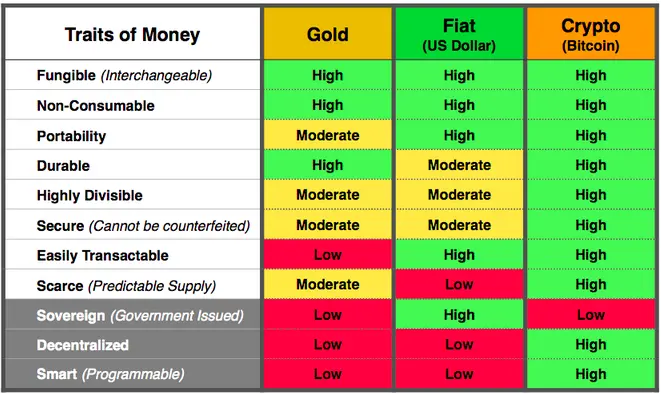
Gold’s one (and arguably only advantage) is that it has been a trusted store of value for over 5,000 years i.e. its Lindy Effect. Gold’s history makes it reliable while bitcoin’s nascency makes it riskier with more upside. As younger, more digitally-native generations grow up and comprise more of the investing class, it is certainly feasible that they turn to bitcoin rather than gold for a fiat/inflation hedge rather than burdens of physical gold. In fact, this could already be occurring as seen in the BTC vs gold performance over the last 6 months (chart below).
 Image credit: CoinDesk
Bitcoin Stock-to-Flow Model
Simon Erickson, 7Investing: “Can you tell us a little bit more about the stock-to-flow model?”
Spencer Randall, CryptoEQ: “The stock-to-flow model is a ratio of what (bitcoin) is available to purchase on the market and Bitcoin supply relative to the rate of issuance of new Bitcoin. And so what's unique about Bitcoin is the supply is known to increase at a certain rate. And we know that the hard cap of supply that finite amount of Bitcoin that can ever exist is currently 21 million. And so because the supply and the issuance is so predictable, the stock-to-flow model is also serving as a great tool for price analysis.”
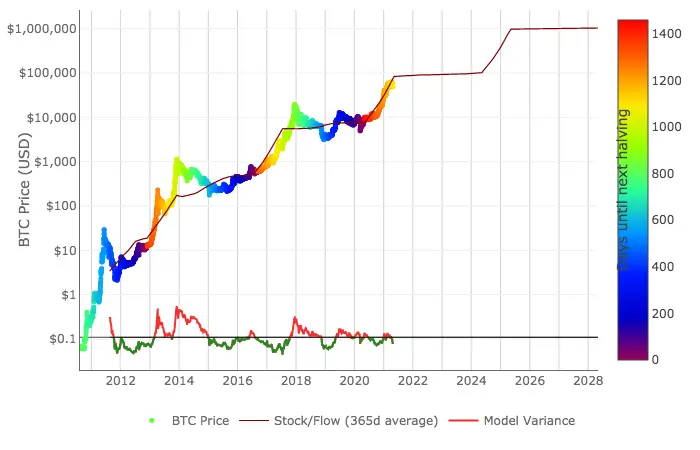
Bitcoin’s stockto-flow model. Image credit: LookIntoBitcoin.com
The Stock-to-Flow (S2F) ratio for any asset is the current supply of said asset already in circulation divided by the amount produced annually. In laymen’s terms, it is a quick ratio to showcase how much supply enters the market relative to the existing supply each year. A higher S2F ratio means lower yearly supply inflation i.e. more scarce. An asset with a high S2F value (gold) should hold its value better than one with a lower S2F value (silver).
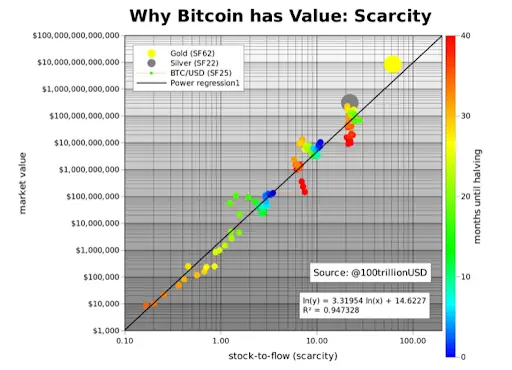
Bitcoin vs gold vs silver S2F. Image credit: @100TrillionUSD
The current circulating supply of Bitcoin is approximately 18.7 million bitcoins, while the new supply is approximately 0.33 million per year. At the time of writing, Bitcoin’s Stock To Flow ratio is hovering at around 56.
Interestingly, as one can see from the first chart above, the actual price of BTC has tracked the S2F chart with astonishing accuracy. In fact, as of 4/26/21, the actual BTC price and the predicted S2F price were within 2% of each other!
However, all models are wrong eventually and should never be taken as fact. The S2F model is no exception. The model has many critics/criticisms but the strongest and simplest argument against the model is that it only takes into account an asset’s scarcity while ignoring the demand side. The S2F model has no way to account for the demand of BTC which is half the equation in price. Just because something is scarce, like your own fingerprint, does not make it valuable to anyone else or inclined to create a market around it. That said, the S2F model has been spookily accurate so far and created tons of discussion. We are excited to see how it performs into the future!
Chainlink’s Value
Simon Erickson, 7Investing: “But I think that the one that I'd like to hear your perspective on is Chainlink, we're getting a lot of questions about Chainlink right now, what's your take on this topic?”
Rayven Moore, CryptoEQ: “I think Chainlink's best feature, in my opinion, is interoperability. It's very agnostic when it comes to which blockchain is going to be the winner in the (smart contract) space. So Chainlink works well with all the other blockchains. That connectivity will be very important going forward with this technology.”

Chainlink is a decentralized oracle network built on Ethereum designed to connect off-chain data sources to on-chain smart contracts. “Oracles” can be thought of as the bridge on which on-chain smart contracts access, retrieve, and verify data originating outside of a blockchain. They also relay data and instructions from smart contracts to other off-chain systems.
The primary use case is bringing trust-minimized and secure third-party data to blockchains via its secure middleware solution without interfering with the blockchain’s consensus. Chainlink is a highly secure and highly flexible oracle network interfacing the legacy world and real-world data to blockchains.
For example, the Ethereum network is only aware of the transactions, blocks, and ether that live within its closed Ethereum Virtual Machine (EVM). It has no way of “knowing” the current price of oil, who won the Yankees game, or if the stock market dropped 5% this week. However, for Ethereum (or any blockchain) to disrupt traditional finance and provide greater value to its users, it will need a way to incorporate these kinds of data in a trustless, decentralized way. The ideal oracle should provide perfect accuracy, be manipulation-resistance, and sufficiently decentralized from a security standpoint.
The challenge of getting off-chain information on-chain in a reliable, trust-minimized manner is generally known as the "oracle problem," and has remained largely unsolved since the creation of Bitcoin. Utilizing information sourced outside the native blockchain introduces new potential attack vectors -- i.e., how accurate is this data? If the data provided to the smart contract could ultimately be used to exploit the system for tens of millions of dollars, then an attacker has the incentive up to tens of millions of dollars to manipulate that data. Because of this, the oracle network must be designed to reduce the impact of a bad actor(s), reduce their incentive to provide inaccurate data, and minimize trust around one data point.
Chainlink puts forth its solution to the “oracle problem” by connecting different blockchains to the off-chain world while providing “reliable tamper-proof inputs and outputs for complex smart contracts on any blockchain.” As an oracle network, the solution it offers is trustless connectivity to any API endpoint. That is, it connects non-deterministic off-chain data sources such as Web APIs, data and price feeds, sports data, IoT, or biometric sensors to a blockchain by retrieving and verifying data originating outside the network.





