
You are reading an excerpt from our free but shortened abridged report! While still packed with incredible research and data, for just $20/month you can upgrade to our FULL library of 50+ reports (including this one) and complete industry-leading analysis on the top crypto assets.

Becoming a Premium member means enjoying all the perks of a Basic membership PLUS:
- Full-length CORE Reports: More technical, in-depth research, actionable insights, and potential market alpha for serious crypto users
- Early access to future CORE ratings: Being early is sometimes just as important as being right!
- Premium Member CORE+ Reports: Coverage on the top issues pertaining to crypto users like bridge security, layer two solutions, DeFi plays, and more
- CORE report Audio playback: Don’t want to read? No problem! Listen on the go.
Primary Use Case
The Filecoin network’s primary function is to generate a market for data storage on the Internet. Digital storage is an essential part of modern computing infrastructure. As data are created each day, the need for reliable, efficient, and cost-effective storage continues to grow. Despite being the largest network within the blockchain ecosystem, Filecoin joins a growing space of highly valued entities.
Data Storage Market
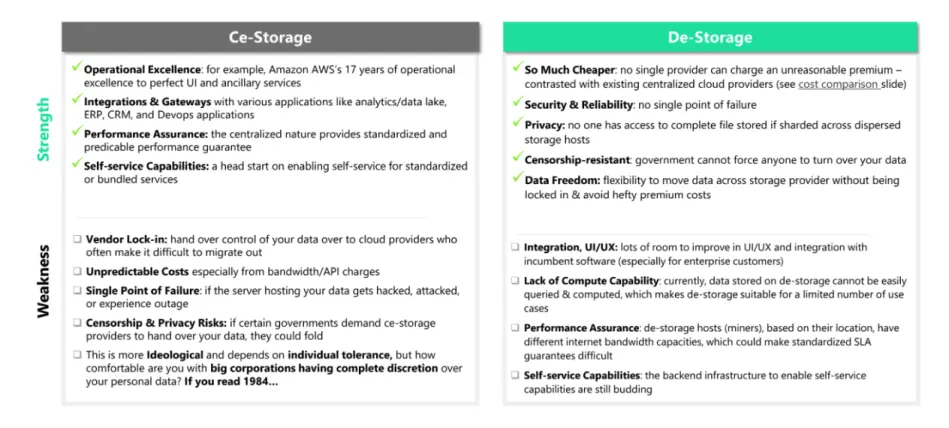
There are two broad categories of digital storage: centralized and decentralized. Centralized storage is provided by large cloud services providers, such as Microsoft, Google Drive, Amazon Web Services, and others.
Decentralized storage is a blockchain-based approach that involves storing data on a network of nodes instead of a centralized server. Decentralized storage offers several advantages over centralized storage. First, it provides greater data sovereignty, as users can maintain control over their own data. Second, it's more resilient to cyberattacks and outages, as the data is distributed across a network of nodes. Finally, it can be more cost-effective, as users only pay for the storage space they use.
Decentralized vs. Centralized: Costs
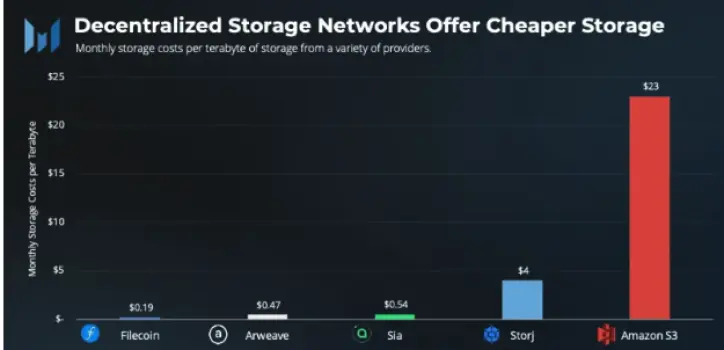
Decentralized storage providers have begun to compete with centralized providers on several metrics, including cost. For example, AWS charges $23/TB/month for up to 50 TB of data stored using its standard S3 storage product. In contrast, decentralized storage networks offer a lower price point.
Source: Catrina Wang, Penn Blockchain
In relative terms, decentralized storage networks are generally cheaper than their centralized counterparts. Decentralized storage networks, such as Storj, range from 70% to 99% cheaper than Amazon S3. Sia and Filecoin achieve lower costs by leveraging an open marketplace model where the price of storage is a function of supply and demand cycles. Storj, however, uses fixed pricing for storage use on its network. Arweave, which guarantees perpetual storage, prices its storage with a ~200-year time horizon, making its upfront costs higher than those of its decentralized competitors.
In contrast to cloud storage, which relies on huge data centers located far from end users, Filecoin helps storage providers to offer decentralized storage services through unused space on computers and hard drives. The growth of data generated globally has created an industry valued at over $46 billion in 2019. Content delivery networks (CDNs) are valued at over $12 billion, as they provide data storage closer to users and improve content delivery speed.
The current market for cloud storage is highly concentrated, with the top-five providers controlling 77% of the global IaaS market, making it difficult for new entrants to compete. Small entities face challenges in competing with established providers due to their reputation, infrastructure, and network effects.
In addition, the data stored on Filecoin vary in terms of access frequency. While some data is accessed frequently and needs to be readily available with low latency, most data is rarely accessed, and users only require assurance that it's available when needed.
Access layers, such as Filebase for Sia and Bundlr for Arweave, abstract away the complexities of interacting with the underlying storage provider. However, some providers may charge a premium for ease-of-use services, while others may choose to subsidize costs to grow their user base and increase demand.
Providers also compete on bandwidth prices, which vary between each network. For example, Storj charges $7/TB to download data (egress), but uploading data (ingress) is free. Sia's bandwidth pricing fluctuates due to its marketplace structure. Currently, egress is $1.05/TB and ingress is $0.20/TB. Sia's prices were trending downwards in 2022, with egress falling 38% and ingress down 57%.
Filecoin handles data retrieval off-chain, and its retrieval costs and pricing can be managed on a contract-by-contract basis. Storage providers have a privileged position, as they control access to the underlying data.
Source: Messari
Digital Storage Market Growth
The digital storage market has experienced significant growth in recent years, driven by the increasing amount of data generated and the growing adoption of cloud-based storage solutions. The global data storage market size was valued at $217 billion in 2022 and it's projected to reach over $770 billion by 2030, exhibiting a CAGR of 17.8% during the forecast period. This growth is expected to continue in the coming years due to the increasing demand for data storage solutions across different industries.
Decentralized storage competitors, such as Filecoin, Storj, and Arweave, are gaining popularity due to their unique approach to data storage. As of March 2023, Filecoin's market capitalization stands at $2.3 billion, with a circulating supply of nearly 400 million coins. Of all decentralized options, Filecoin’s network is the most robust, supporting over 330 projects.
While decentralized storage solutions are gaining popularity due to their unique approach to data storage, they still face challenges in terms of adoption and scalability. Decentralized storage networks can be more difficult to use and set up than centralized storage services, which can be a barrier to adoption. Additionally, the scalability of decentralized storage networks can be a challenge, as the number of nodes and storage capacity is limited. Despite these challenges, decentralized storage solutions are gaining traction due to their unique approach to data storage and increasing demand for data sovereignty.
Traditional centralized storage solutions have long been the norm for most internet users, but they come with significant drawbacks. To address these issues, decentralized storage and cloud services have emerged using peer-to-peer networks and new protocols, one of which is Filecoin.
Filecoin Storage Market Creation
Storage deals on the open market are negotiated as service-level agreements (SLAs) that are enforced on the Filecoin blockchain. Users pay fees to storage providers to store their data, with the cost of the service being determined by supply and demand rather than fixed pricing.
The storage segment has yet to be massively adopted by the majority, and the number of projects built on or with storage protocols appears to be small. One potential upgrade in the storage segment is the addition of computing capabilities, and Filecoin's FVM (Filecoin Virtual Machine) is a step in that direction. Stratos is also working towards a more inclusive and complete solution with multiple modules, including database storage, static storage, computation, and consensus. Overall, while the storage segment's growth has slowed in 2022, it remains a critical pillar of Web3 and may see further innovation and growth in the future.
Although storage-based solutions have not yet seen massive adoption, the industry is seeing upgrades and innovations focused on adding computing capabilities to distributed storage networks. Currently, most storage solutions only function as "decentralized hard drives" without the ability to process data. This is where storage-based computing comes in, allowing for data stream insertion, extraction, and local development environment rendering for Web2 applications.





