
You are reading an excerpt from our free but shortened abridged report! While still packed with incredible research and data, for just $20/month you can upgrade to our FULL library of 50+ reports (including this one) and complete industry-leading analysis on the top crypto assets.

Becoming a Premium member means enjoying all the perks of a Basic membership PLUS:
- Full-length CORE Reports: More technical, in-depth research, actionable insights, and potential market alpha for serious crypto users
- Early access to future CORE ratings: Being early is sometimes just as important as being right!
- Premium Member CORE+ Reports: Coverage on the top issues pertaining to crypto users like bridge security, layer two solutions, DeFi plays, and more
- CORE report Audio playback: Don’t want to read? No problem! Listen on the go.
Context Matters
Inarguably, Bitcoin mining utilizes electricity to power its PoW mechanism. Whether it is a lot or a little depends on your frame of reference. But remember, PoW is essential to a decentralized consensus, network security, and the issuance of new BTC (i.e., Bitcoin’s predictable monetary policy). Bitcoin is not Bitcoin without PoW.
In absolute terms, Bitcoin mining used an estimated 82 TWh of electricity in 2021, a 9% increase from 2020, according to CoinShares’ 2022 report on the Bitcoin mining network. As of December 2021, the current annualized draw is 89 TWh. To put this in perspective, the Bitcoin network consumed 0.05% of the total global electricity consumed in 2019, essentially a rounding error when it comes to global energy consumption. For comparison, NYDIG reported in Q3 2021 that domestic tumble dryers and data centers used 108 TWh (0.07%) and 204 TWh (0.13%), respectively, in 2020.
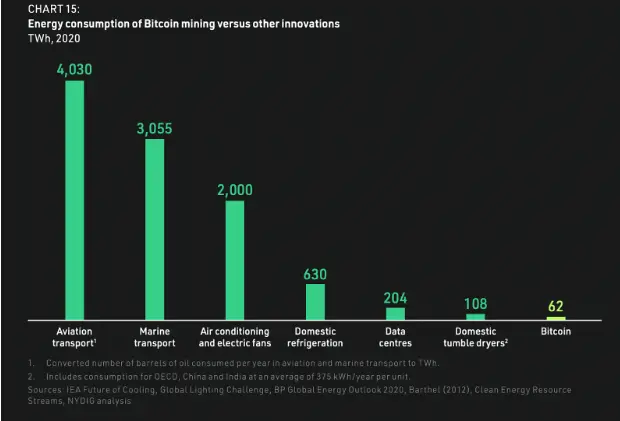
Bitcoin energy use versus similar products. Source: CoinShares
Therefore, yes, Bitcoin consumes approximately the same amount of energy as a small nation-state, such as Finland with its ~5 million inhabitants…. Or clothes dryers. Both are true. But strangely, there aren’t many (any?) campaigns targeting clothes dryers, data centers, cruise lines, video games, gold mining, etc. In fact, when Bitcoin’s electricity consumption is plotted against major polluting countries, the popular argument appears tenuous.
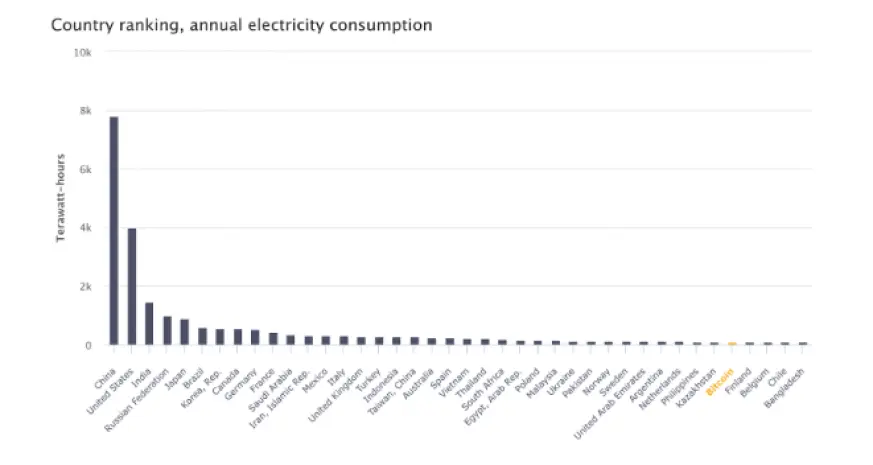
As for 2022, the Bitcoin network is projected to consume an estimated ~114 TWh/yr in total. Meanwhile, the global annual electricity generation is ~27,000 TWh/yr or 237x that of the Bitcoin network. Of that, ~27,000 TWH/yr, the amount of electricity lost in transmission each year is ~2,200 TWh/yr or 19x that of the Bitcoin network (based on World Bank and IEA estimates).
Observing Bitcoin’s energy consumption to be similar to that of a small nation makes sense when one sees the utility Bitcoin offers. Bitcoin is a programmable, permissionless, sound currency, something that many nations are not able to provide to their citizens. It is a top-10 base money in the world today. In contrast, the Finnish markka is not one of the top 30, nor used by anyone outside of the 5 million people in Finland.
Despite these eye-opening statistics and comparisons, Bitcoin critics remain unconvinced because they do not see the utility of Bitcoin. However, just because one person doesn’t benefit from something, does it give that person the right to try and take it away from those who do? What if this same stance was taken with the above examples? Many people do not play video games or go on cruises. Should they, therefore, cease to exist, too? The fact that these industries exist at all proves that someone somewhere values them. So, why is Bitcoin any different?
Bitcoin’s Utility
Bitcoin mining is frequently denigrated for its "wasteful" energy use, which implies that the Bitcoin network is not useful, a claim that Bitcoin’s 100's of millions of users might refute. The energy, and associated costs, required to secure the network are precisely how Bitcoin generates its security. If there were no costs, then there would be no security.
The Bitcoin network’s energy efficiency and utility are not comprehensively understood by focusing entirely on the particulars of mining; broadly, it is essential to appreciate the societal merit of non-state money. The gross and systematic distortion of price signals caused by costless and arbitrary monetary inflation creates malinvestment, economic inefficiencies, and waste on a scale that would dwarf Bitcoin’s approximate 0.05% share of global energy consumption.
The Bitcoin network provides a globally-inclusive, censorship-resistant, incorruptible, self-sovereign monetary network for the entire world. Within that context, the amount of energy used (again, 0.05% of the global energy) is absolutely worth the cost. Especially considering,
- nearly everyone on the globe is currently living under double-digit inflation
- Two billion+ people live under authoritarian regimes where their rights are suppressed and are subjected to capital controls
- 3 billion+ are underbanked or have no access to bank accounts
Bitcoin gives BILLIONS of people an alternative currency/savings technology where there otherwise are no alternatives. To claim Bitcoin has no utility or value is to deny the lived experience of millions of less fortunate individuals cut off from the Western world’s living standards and freedoms.
Note the chart below from Chainalysis, which attempts to rank crypto usage/adoption by adjusting for things like population, wallets, purchasing power, etc. for more representative comparison of actual adoption. This is a list almost entirely of emerging economies and countries in distress. While the citizens of Pakistan, Nigeria, Argentina, and others may not have billions to convert into cryptocurrencies, even their small purchasing power is being protected thanks to cryptocurrencies.
Source: Coinshares and Chainalysis
But My Financial System Works Great
“It is well enough that people of the nation do not understand our banking and monetary system, for if they did, I believe there would be a revolution before tomorrow morning.”
- Henry Ford
We touched on fiat money initially, but it is worth revisiting just how new and flimsy the idea of “money backed by the government’s word” really is. Historically, most currencies were pegged to scarce physical commodities such as gold or silver, but today, fiat money is backed by neither anything physical nor scarce. Since it is not linked to any physical reserves (or based on math like in the case of Bitcoin), fiat is subject to artificial manipulation, experimentation, and adulteration. One of fiat's biggest risks is becoming worthless due to hyperinflation, a scenario that has played out repeatedly in history. If people lose faith in a nation’s paper currency, like the U.S. dollar bill, the money will no longer hold any value.
Governments control fiat money and, throughout history, have frequently abused their control on the issuance of money. It is not hard to understand the consequences of a system in which a small minority controls the money for everyone. As Dergigi penned, ”If you control the money, you control the purchasing power. Which, in turn, allows you to control most other things.”
Government abuse and/or incompetence throughout history has led to the destruction of economies and money, oftentimes by hyperinflation. Infamous examples include ancient Rome, Weimar Germany, the Balkans and Zimbabwe in the 1990s, and present-day Argentina, Venezuela, Turkey, and Lebanon. Beyond that, 2B+ people across the world are considered “unbanked,” meaning they do not have access to a bank account or banking services. These people have almost no way to save their money or provide for themselves beyond the day-to-day.





