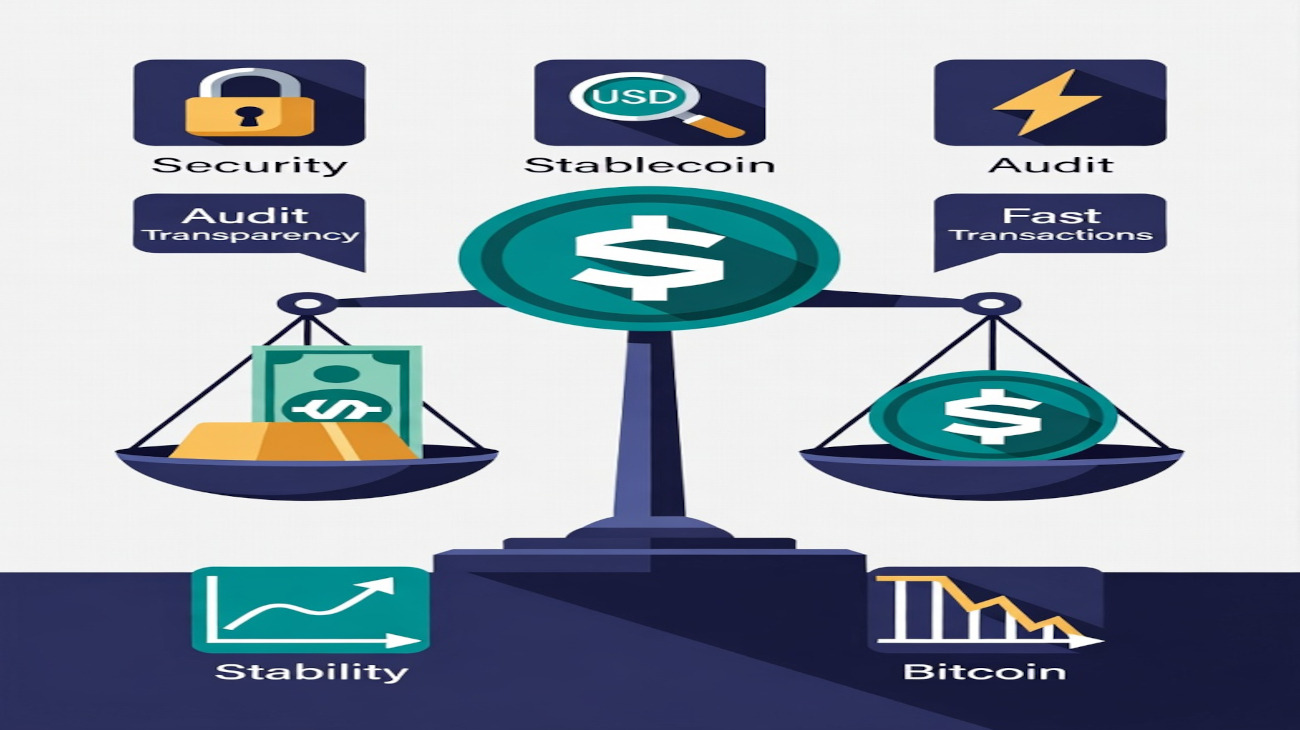
Stablecoins are tokens that, as the term “stable” suggests, are generally steady in value and do not undergo the swings typically seen with Bitcoin, because they are not subject to the same market supply-and-demand dynamics.
With stablecoins, volatility is reduced while preserving features typical of cryptocurrencies, such as transparency and fast transactions.
They are crypto assets created specifically to mitigate the uncertainties tied to the volatility of cryptocurrencies - volatility that lies outside centralized control and, in some cases, is so high that it makes them unsuitable as a medium of exchange.
The mechanism behind stablecoins is very different from Bitcoin’s.
Volatility is a financial measure expressing the magnitude and frequency of a security’s price changes over time. Applied to cryptocurrencies, Bitcoin is intrinsically volatile: given the many value swings it has experienced since its creation in 2009, its price behavior has often been likened to a roller coaster.
Bitcoin’s volatility therefore represents both an opportunity for profit and a risk of substantial losses, especially for those without appropriate tools to anticipate its movements, which always retain a degree of uncertainty.
Bitcoin’s fluctuations - its rapid rises and falls - are not only frequent but also sudden. Bitcoin’s trajectory speaks for itself: in a single decade, starting from an initial value of $0.01, it reached truly large figures, even peaking above $100,000, a rise that certainly helped increase cryptocurrencies’ global popularity.
While Bitcoin’s volatility makes it highly attractive to speculators, it is widely considered unsuitable as an effective medium of exchange or method of payment.
To understand why, it is enough to recall that the first Bitcoin transaction, on May 22, 2010, consisted of purchasing two pizzas from Domino’s for 10,000 bitcoins, worth $41 on that day.
That date is remembered by many as “Bitcoin Pizza Day” or the “Laszlo pizza” event, named after the man who bought them at the Florida restaurant.
Given the transaction’s subject, that amount was already significant at the time, but in hindsight it seems absurd considering Bitcoin’s later value: those same pizzas would have cost several million dollars.
Bitcoin’s value depends exclusively on the market - on supply and demand. Think of Bitcoin as a limited resource with a fixed maximum supply: as market demand rises, so does its price; when demand falls, its price falls, following a directly proportional logic.
Stablecoins, on the other hand, are tokens that, as the term “stable” implies, tend to be steady and do not experience the typical Bitcoin-style swings, because they are not affected by the same market supply-and-demand dynamics.
They were created specifically for this purpose, which is possible because, unlike Bitcoin, stablecoins are pegged to an asset and digitally represent that asset, tracking its value changes.
Those assets are generally themselves mediums of exchange whose value is controlled by a central authority, so price fluctuations can occur but are contained, since they follow a fixed exchange rate.
Within the broad category of stablecoins, different asset types can be identified. More specifically, stablecoins can be classified as:
- fiat-backed stablecoins;
- crypto-collateralized stablecoins;
- algorithmic stablecoins.
First, fiat currency simply means legal tender. Pegging a cryptocurrency to an official currency provides the former with value stability over time, because the latter is controlled by central banks. Typically, each token issued is backed by a unit of official currency - usually the dollar - held in reserve as collateral backing the token’s value. For example, one of the most used stablecoins is Tether (USDT), which is pegged to the dollar and maintains a 1:1 ratio.
Fiat can also be replaced by other assets, such as commodities and precious metals. The operation in those cases is similar: tokens are linked to a specific quantity of the asset, which is stored and periodically audited. For example, Digix Gold Token (DGX) is a stablecoin pegged to gold.
As seen, in principle any asset can underlie a stablecoin, provided it ensures value stability. There are projects for stablecoins backed by cryptocurrencies, where no physical asset serves as collateral but rather other cryptocurrencies act as reserves. Because cryptocurrencies are inherently volatile, such stablecoins are over-collateralized - the reserve of crypto assets exceeds the number of tokens issued to absorb potential price swings.
The stablecoins described so far rely on systems that ensure stability and security similar to those typically provided by central banks, and they require trust in that system. A major criticism of this model is the potential lack of transparency, which can enable abuses.
Algorithmic stablecoins, by contrast, are decentralized and not collateralized because they lack backing assets. Instead of a real or virtual asset controlled by an entity, they rely on an algorithm operating automatically via smart contracts. This mechanism sets a reference value - usually the dollar - so that if the stablecoin’s price rises above the target, the algorithm automatically issues new tokens.
Although algorithmic stablecoins share the same goal as traditional stablecoins - maintaining price stability relative to an official currency - their stability is governed by algorithms that themselves rely on market-based incentives.
Thank you for taking the time to read this article.
Ad maiora!