
The hypothesis that quantum computers could “break Bitcoin” has been the subject of intense academic and technical debate. While this possibility cannot be entirely ruled out in the long term, any categorical statement in this regard demands caution and must take into account multiple variables — technological, institutional, and economic. In this brief article, I will outline a few reasons why, in my view, a sensible person should not place blind faith in every conspiracy theory encountered online on this subject.
The article is divided into four main points to help you draw your own conclusions:
-
Where would Bitcoin’s vulnerability to quantum computing lie?
-
Practical limitations of current quantum computing
-
The adaptive capacity of the Bitcoin ecosystem
-
Does it make economic sense to invade the Bitcoin network?
1. Digital Signatures (ECDSA) and Vulnerability to Quantum Computing
1.1 How Bitcoin Uses Digital Signatures
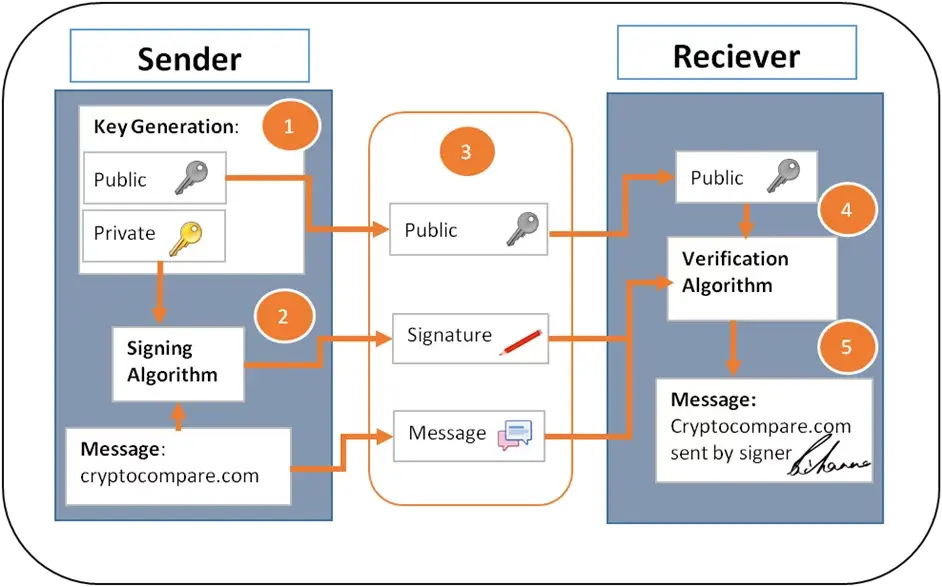
To send funds, a Bitcoin user must prove ownership of a private key associated with a given address. This is done through a digital signature algorithm — specifically ECDSA (Elliptic Curve Digital Signature Algorithm), which operates on the elliptic curve secp256k1.
Briefly:
-
The user generates a key pair: a private key (kept secret) and a public key (which can be shared);
-
When sending a transaction, they sign it with their private key;
-
Network nodes verify the transaction's authenticity using the public key;
-
The security of this process relies on the computational intractability (for classical computers) of deriving the private key from the public key — the so-called elliptic curve discrete logarithm problem.
1.2 Where Is the Vulnerability?
The vulnerability arises because quantum computing, especially via Shor’s algorithm (1994), can solve the discrete logarithm problem in polynomial time, which would effectively break ECDSA’s security foundation. In practical terms:
-
Whenever a user makes a transaction, they reveal their public key to the network;
-
A malicious agent with a sufficiently powerful quantum computer could intercept the transaction, use Shor’s algorithm to derive the private key, and create a competing transaction redirecting the funds to their own address;
-
If the network accepts this forged transaction before the legitimate one is confirmed, the attacker would succeed in stealing the funds.
This type of attack is called a “post-broadcast key recovery attack.” It is only possible because the public key becomes visible during the user’s first transaction. Bitcoin addresses that have never been used in a transaction (and thus never revealed a public key) are not immediately vulnerable.
1.3 Legacy Addresses and Historical Risk
Many early Bitcoin addresses, especially those from before 2010, used the public key directly as the address (rather than a hash of the public key, which is more common today). In these cases, even without transactions, the public keys are already exposed on the blockchain. These funds could be prime targets for quantum attacks since the public keys are known and can be exploited to extract the private key using Shor’s algorithm.
1.4 The Scale of the Problem
It’s important to emphasize that such an attack would only be feasible if quantum computing achieved realistic practical capabilities:
-
Breaking a 256-bit ECDSA key is estimated to require around 20 million logical qubits (error-corrected), which translates into hundreds of millions or even billions of physical qubits due to the overhead of quantum error correction;
-
The time required to compute the private key must be less than the confirmation time of the original transaction — typically around 10 minutes (1 block), but ideally less, to ensure that the forged transaction is accepted first.
1.5 Possible Mitigation Measures
Mitigation strategies are already known:
-
Replace the digital signature algorithm with a quantum-resistant scheme (like XMSS, SPHINCS+, etc.);
-
Avoid revealing public keys until a transaction is confirmed (which would require technical and cultural changes in wallet usage);
-
Encourage migration of legacy funds to updated address schemes.
2. Practical Limitations of Current Quantum Computing
2.1 Required Number of Physical and Logical Qubits
To attack Bitcoin, one would need to implement Shor’s algorithm to break 256-bit ECDSA keys (secp256k1 curve). Various technical studies estimate that such an attack would require:
-
Around 20 million logical qubits;
-
More than 1 billion physical qubits, considering error correction overheads of at least 1,000:1 or even 10,000:1.
Currently, the most advanced devices in the field (IBM, IonQ, Rigetti, Google) possess between 50 and 1,000 physical qubits, most of which cannot operate stably for long durations. We are, therefore, orders of magnitude away from posing any real threat to Bitcoin.
2.2 Quantum Coherence and Error Rates
Each qubit must maintain its superposition (coherence) long enough to perform complex operations. There are two major problems:
-
Limited coherence time: many devices maintain coherence only for milliseconds — insufficient for deep quantum circuits required by Shor’s algorithm;
-
Gate error rates: even the most precise gates have error rates around 10⁻³ to 10⁻⁴ per operation, which quickly accumulates. This necessitates quantum error correction, which in turn requires massive redundancy.
While progress is ongoing — including surface codes and topological qubits — no proposed method has yet scaled to the point of enabling large-scale cryptanalytic operations.
2.3 Execution Time and Parallelism
Even if a quantum computer with millions of logical qubits were built, executing Shor’s algorithm on a single ECDSA key could take hours or days. The attacker would need to complete this process in under 10 minutes — a highly restrictive requirement. Moreover, Shor’s algorithm is not trivially parallelizable, so distributing the workload among multiple processors does not solve the timing issue.
2.4 Engineering and Scalability Challenges
Building systems with millions of qubits involves unresolved engineering hurdles:
-
Large-scale cryogenic cooling (qubits must operate near absolute zero);
-
Electromagnetic and mechanical noise isolation;
-
Uniform qubit fabrication (atomic-level defect control);
-
Low-latency and stable qubit interconnect architectures — increasingly difficult as qubit counts grow.
2.5 Current Scenario (2025): Progress, but Still Far from a Threat
So far, most quantum computing demonstrations in 2025 have been:
-
Limited proof-of-concepts (e.g., factoring 15, 21, or 35);
-
Controversial “quantum supremacy” results on artificial problems;
-
Hybrid computing models (classical + quantum) focused on optimization and chemistry, not cryptography.
While some companies project reaching 10,000 physical qubits by decade’s end, error rates and lack of correction infrastructure render them unfit for real attacks on Bitcoin. Thus, although the theoretical threat exists, practical implementation remains out of reach. This grants time for technical, institutional, and social adaptation. The risk is potential — but not imminent.
3. Adaptive Capacity of the Bitcoin Ecosystem

3.1 Technical Feasibility of Migration to Post-Quantum Algorithms
Bitcoin’s architecture theoretically allows replacing the current signature algorithm (ECDSA/secp256k1) with post-quantum alternatives. This would involve modifying transaction formats and validation rules — but not Bitcoin’s foundational components (e.g., proof-of-work or UTXO model).
Candidate algorithms include:
-
Lattice-based: Dilithium, Falcon (NIST finalists);
-
Hash-based: SPHINCS+, XMSS (well-studied and formally secure);
-
Multivariate/code-based: less proven, but viable in some contexts.
Each scheme entails complex trade-offs: signature size, verification time, blockchain space, legacy compatibility. Though technically demanding, it is not insurmountable. Ethereum has tested hybrid solutions, and Bitcoin developers have proposed soft forks to incorporate alternative signatures without invalidating past transactions.
3.2 Bitcoin Governance and the Change Process
Bitcoin changes are guided by a decentralized, consensus-based governance model. No single authority can impose protocol changes. All alterations require broad discussion, voluntary implementation by nodes, and often miner/user ratification.
While slow, this model ensures:
-
Avoidance of premature reactions to speculative threats;
-
Compatibility of broad changes with stakeholder interests;
-
Extensive testing on testnets before deployment.
If a credible quantum threat emerged, proposals for ECDSA replacement — such as BIP 340 (Schnorr signatures) or hash-based alternatives — are already under discussion. Though Schnorr is not quantum-safe, its adoption demonstrates Bitcoin's ability to incorporate foundational cryptographic updates.
3.3 Coordinated User Migration Strategies
Even before protocol-level changes, users and wallets can adopt preventive practices:
-
Avoid address reuse, reducing public key exposure;
-
Transfer funds from exposed keys to more secure addresses;
-
Use multisig or complex spending scripts for added abstraction.
Should post-quantum migration become necessary, it could proceed gradually and voluntarily. For instance, a new output type could be created (e.g., a specific script accepting only post-quantum signatures), allowing migration without a hard fork.
3.4 Historical Resistance to Change and the Consensus Problem
While Bitcoin has adaptive capacity, it is limited by non-trivial political and sociotechnical factors. Historical proposals have faced strong resistance — even when technically sound. Examples include:
-
Block size debate (leading to Bitcoin Cash);
-
SegWit introduction (2017);
-
Taproot/Schnorr adoption (2021).
This conservatism, by design, slows innovation and hampers emergency responses. In the face of an actual crisis — such as verified quantum attacks — decision-making may become chaotic or fragmented.
3.5 Tooling Ecosystem and Wallet Infrastructure
A vital component of Bitcoin’s adaptability is its rich development ecosystem. Projects like Bitcoin Core, Electrum, Wasabi, and BlueWallet maintain active teams that:
-
Monitor cryptographic and security developments;
-
Develop wallets with multiple signature types;
-
Draft BIPs for integrating new cryptographic features.
This ecosystem enables distributed, gradual responses — via experimentation, testing, and UI integration — mitigating some risk. Bitcoin can indeed adapt technically, but its decentralized nature demands anticipatory rather than reactive strategies.
In other words, if quantum development progresses faster than expected, the greatest risk may not lie in the absence of technical solutions, but in the ecosystem’s slowness to reach consensus on when and how to implement them.
4. Economic and Strategic Disincentives to Invading Bitcoin

4.1 Value Self-Destruction as a Consequence of the Attack
Bitcoin derives its value from a mix of scarcity, cryptographic security, and collective trust. If a quantum attack enabled:
-
Deriving private keys from public addresses;
-
Rewriting past blocks using superior computational power;
-
Forging transaction signatures;
it would collapse the trust underpinning BTC’s value.
The immediate result would be a near-instant collapse of its price. The market is highly sensitive — even theoretical vulnerabilities can trigger crashes. A real, publicized attack would eliminate any remaining trust, rendering the asset nearly or entirely worthless. The attacker would thus face a paradox: the more successful the attack, the less valuable the asset.
In economic terms, this reflects a misalignment of incentives: the attacker destroys what they wish to acquire. Unless motivated by extra-economic factors (cyberwarfare, sabotage, etc.), such an attack would be unprofitable.
4.2 Secret Attacks Are Virtually Impossible
One might envision a stealthy attacker compromising keys from large dormant wallets. However:
-
Blockchain transparency makes any large, abrupt movement easily detectable;
-
The community constantly monitors known addresses, with anomaly detection tools;
-
If suspicious transactions from reused keys began to appear, alerts would spread within minutes, crashing the market.
Even discreet attacks carry a high risk of exposure and asset collapse — severely limiting the incentive.
4.3 Comparison with Other High-Value Targets: Banks, Governments, Industry
If a group — governmental, corporate, academic, or paramilitary — acquired a quantum computer capable of breaking RSA-2048, ECDSA-256, or similar schemes, the most rational attack surface would not be Bitcoin.
More attractive targets include:
-
Central and private bank infrastructure (SWIFT, FedWire);
-
Military and diplomatic networks (strategic communications and operations);
-
Confidential intellectual property (weapon designs, pharmaceuticals, patents);
-
Authoritarian governments (citizen data, dissident records, financial surveillance).
These targets:
-
Use public keys on exposed servers that, if broken, do not collapse the value of the target;
-
Can be exploited without destroying the institution;
-
Are harder to audit publicly, enabling prolonged stealth operations.
Hence, attacking governments or banks offers superior cost-benefit for a quantum actor, especially when repeated exploitation or espionage is possible.
4.4 Bitcoin as a Security Canary
An unintended but critical outcome is that Bitcoin may act as a “canary in the coal mine” for public-key cryptography. Due to its transparency and traceability, any realistic quantum attack would likely manifest first via anomalous blockchain transactions.
Before banks realize their networks are compromised, the crypto community might detect the emergence of practical quantum attacks. Ironically, this reinforces Bitcoin’s role as an early warning system for the fragility of modern cryptography.
Follow me for more :D






