Some sort of organized market training (Crypto Banter) will be your foundation, but real-world trading often necessitates adapting strategies to evolving market conditions. I began this journal after gaining what I believed was sufficient training to trade confidently. While I feel my initial strategies were sound, I quickly realized the need for adjustments, due to market fluctuations. I attribute my lack of success to a combination of inexperience and the challenges of trading in a sideways market. Discouraged by my trading results, I transitioned to providing liquidity on Raydium. This proved to be a profitable endeavor, particularly during the sideways market. My training equipped me to accurately identify a token's consolidated price range, making it a lucrative opportunity.
During this time, I experimented with trading bots. While I didn't track my results with any sort of vigor, I found that bots weren't the right fit for me. I also revisited my market training, deepening my understanding of strategies and ultimately designed a strategy I found effective. I intend to use this method throughout the rest of bull cycle.
LIVING IN THE CRYPT0SPHERE NFT
To identify potential trading opportunities, I use a Blofin exchange token watchlist on TradingView. I screen tokens daily, searching for those that fit my strategy criteria.
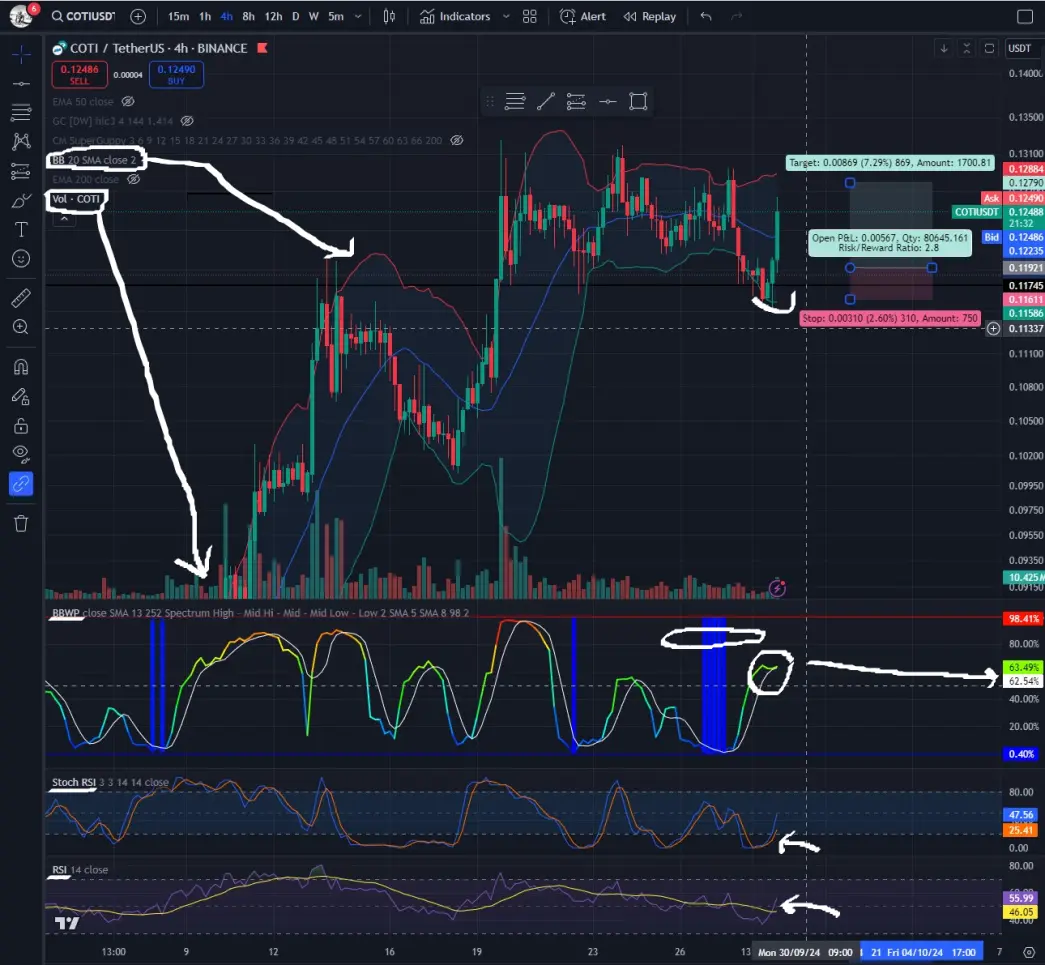
Bollinger Bands
Bollinger Bands Width Percentile (BBWP)
Volume
Stochastic RSI
RSI
I primarily focus on BBWP to assess volatility. When BBWP prints at least 3 blue lines and its two moving average lines touch at 5% or more, I evaluate the market trend's direction using stochastic RSI and RSI. For long positions, I require both indicators to show upward momentum. Lastly, I consider the candlestick position closeness to the Bollinger Bands' lower line and assess the trading volume for significance compared to previous levels. Of course determining "closeness" and "significance" is subjective. It is something that the individual has to discover by actually trading. See example below.