The rarity of an asset is not always fixed in time. It is a matter of technological capabilities and demand. It changes as technological capabilities evolve. The shells served as money as it was difficult to collect on a large scale. When larger ships were built and more were found, they lost their value. Once a commodity loses its rarity, it becomes much weaker and less reliable . Money that is easy to make is not money.
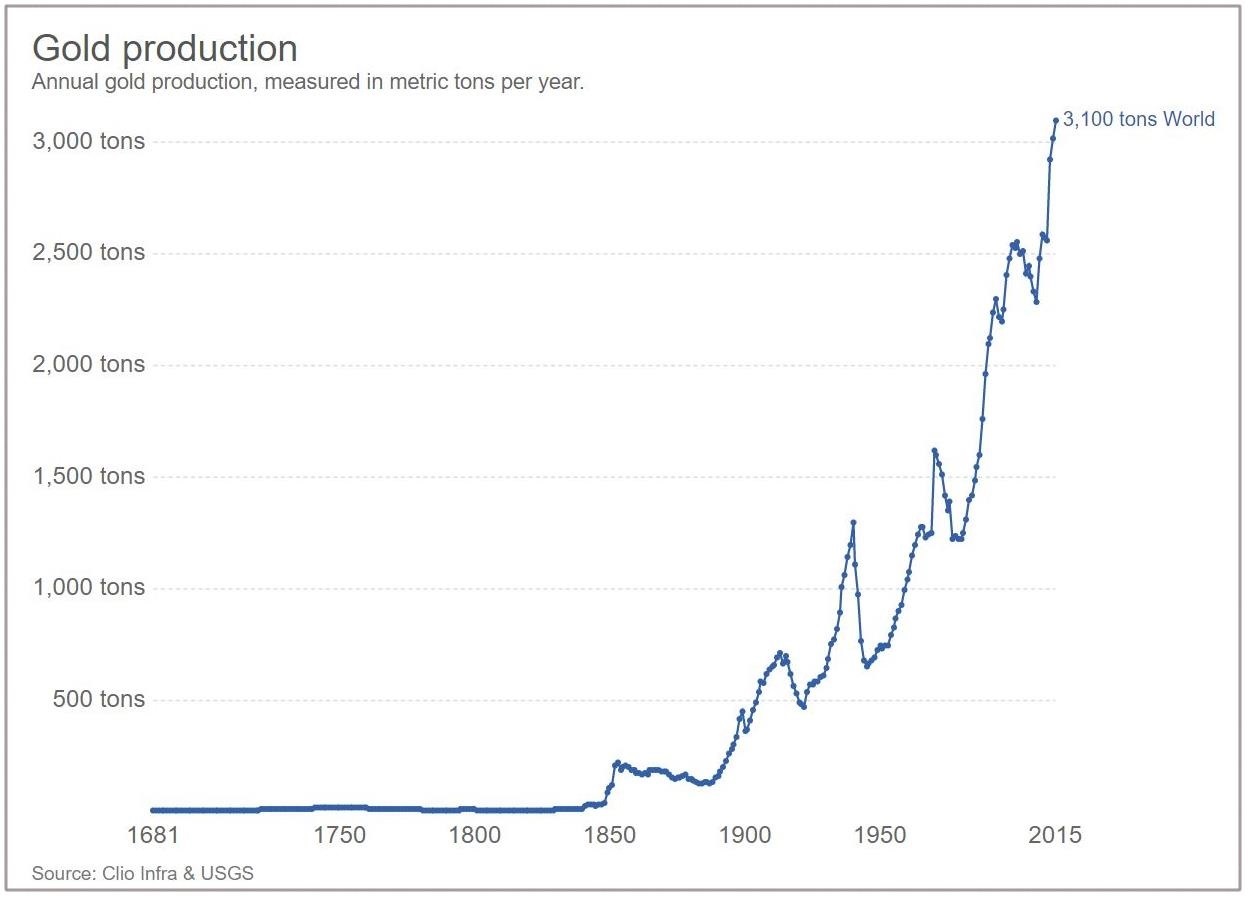
On the contrary, gold remained the top monetary value for so long because it was difficult to produce. Even when its price goes up a lot, its annual production will not increase accordingly. The largest percentage excavated in modern history, compared to the current quantity, was in 1940, with 2.6%. From 1942 to the present, it has never exceeded 2%.
Gold, one of the rarest metals on earth, has the largest reserve ratio for flow. According to the US Geological Survey , just over 190,000 tons have been mined. In recent years, about 3,100 tonnes of gold have been mined annually. Using the above numbers, we can easily calculate the ratio of reserve to gold flow: 190,000 tons / 3,100 tons = 61. In 61 years, its quantity will have doubled.
That's why copper is never going to take the place of gold. If the price goes up too much, then the incentive will be given to export more, something relatively easy and immediate to achieve, as the stocks are huge. So the increased supply will inevitably lead prices down. About as much is needed each year for industrial purposes.
In order for something to serve as a safeguard, it must face this trap. Do not increase the offer, if the prices go up enough. The only commodity that has made history is gold, which has two main advantages : first, it is resistant to time and hardship, second, it cannot be made from a mixture of other cheaper materials, and it is expensive to mine. However, gold has been mined for thousands of years without being depleted.
Throughout human history we have never been left with even a single raw material, as rare as it may seem. As technology advances and there is demand, there is always a way. For example, oil. As the need for it increased, so did the rate of production. We never ran out of oil or gold or any other natural resource. Until now, there have always been technological solutions to the issue of rarity.
When consumption increased, two things happened:
- The price was raised to motivate them to find or produce more.
- People were either making new tools or evolving the techniques of discovery, with the help of science.
The diagram below, which shows gold production over the past 500 years, shows that human time, effort and ingenuity are the only finishes. Anything else that is virtually unlimited can be produced if several resources are spent.
This highlights an amazing aspect, a unique achievement of bitcoin. For the first time, humanity comes into contact with an object, the supply of which is strictly limited. No matter how many people use the network, how much its value increases and how advanced the equipment used or is going to be used in the future, there will be only 21 million bitcoin. It does not depend on the number of coins produced by any technological innovation, no government and no legislation. Why; Because these are mathematical algorithms . No human intervention can change the immortal laws of mathematics.
As for gold, we are unaware of the amount that still exists on the planet. No one can know. Isn't this a key fact to put our money into?
Bitcoin is designed so that no matter how much the incentive is boosted by the rise in its price, no more than the strictly defined amount can be produced. The only thing that increases is the security of the network from malicious actions . As demand grows, so does the value of mining. It is in their best interest to protect the network.
When there is a huge increase in demand for bitcoin, miners cannot increase production beyond the set schedule. The only way to meet the growing demand in the market is to increase the price enough to motivate owners to sell some of their currencies.
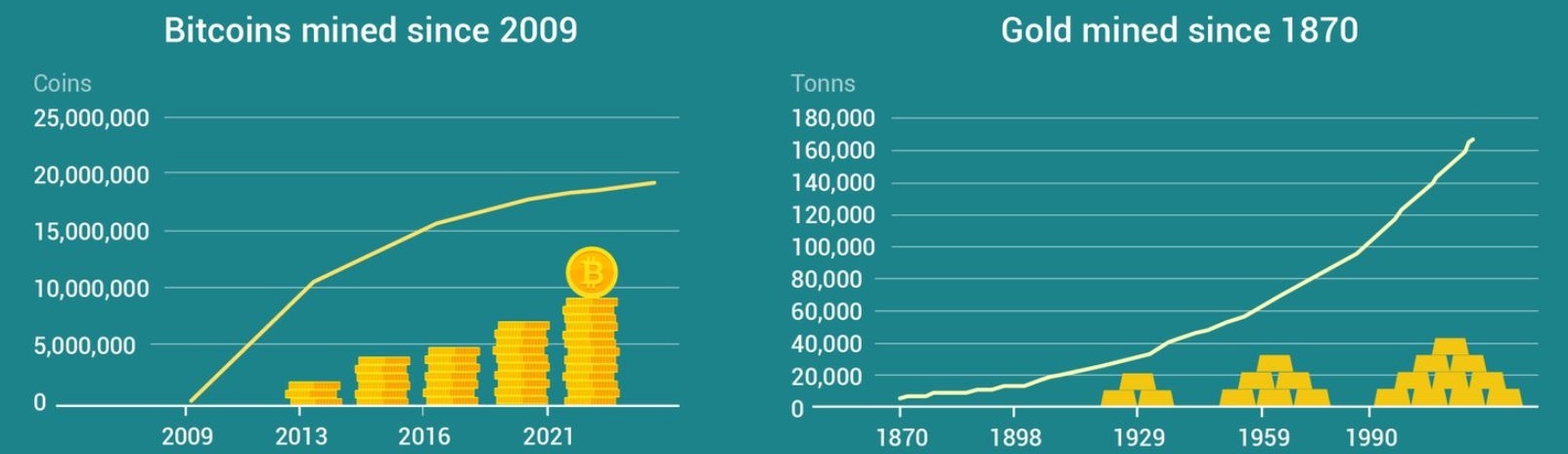
Bitcoin may not shine like gold, but as paradoxical as it may sound, it is rarer. It is planned to increase by 15% over the next 25 years, compared to the current amount, while gold is projected to increase by 52%.
Gold has another disadvantage in terms of its solvency and rarity. The quantities traded, either digitally or with paper ownership certificates , are often many times greater than the actual physical quantity. There are many gold certificates that do not necessarily correspond to real gold. If you don't own it, it's like you don't have it, many argue.
If the price goes up for any reason, some gold-based securities are unlikely to be paid. They may not actually have the underlying gold you think they own. The certificates are valid as long as there is trust in the banking institution that issues them. If they do not have it, they run the risk of being canceled .
If many people decide to get the natural amount of gold they have on paper, it will be a huge issue to meet demand. Either some will be left with the smudge in hand or its price will skyrocket to levels that to this day seem unthinkable. Maybe both at the same time.
Market news
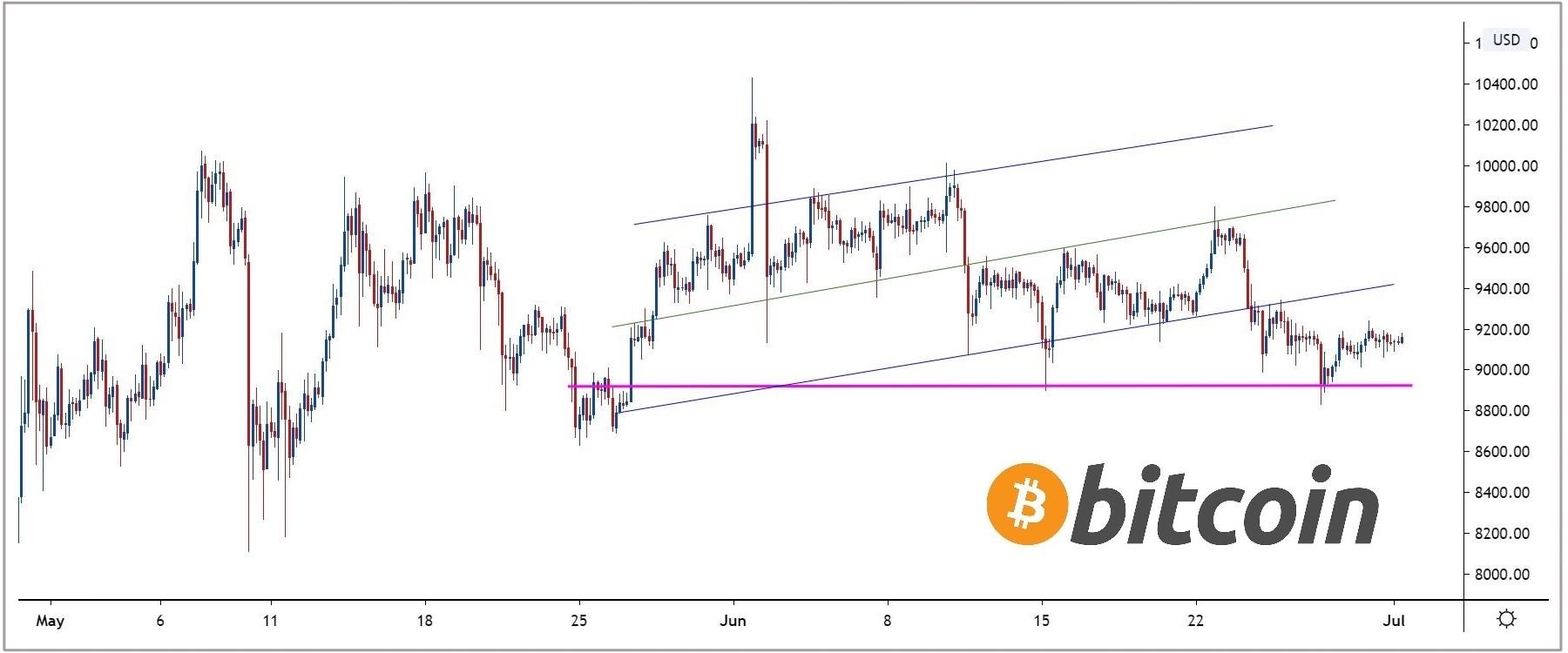
* Go, the world is ruined. Almost every change in the price of bitcoin has been eliminated. Especially in the last 4 days, she remains stubbornly stuck at $ 9,150.
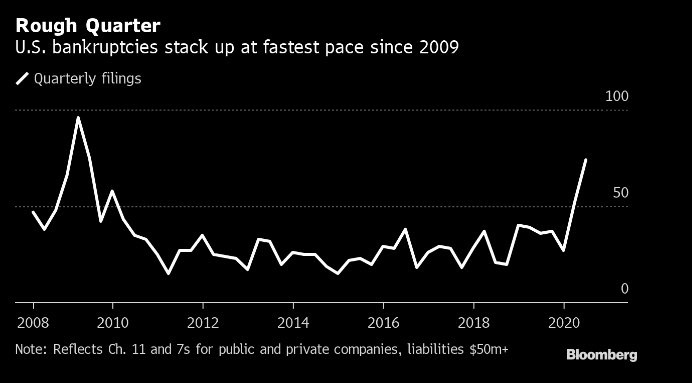
* Taking advantage of price volatility, let's take a look at the US market, where bankruptcies continue to rise, as there have been 75 entries in the last 3 months between companies with commitments of at least $ 50 million. The worst performance since 2009.
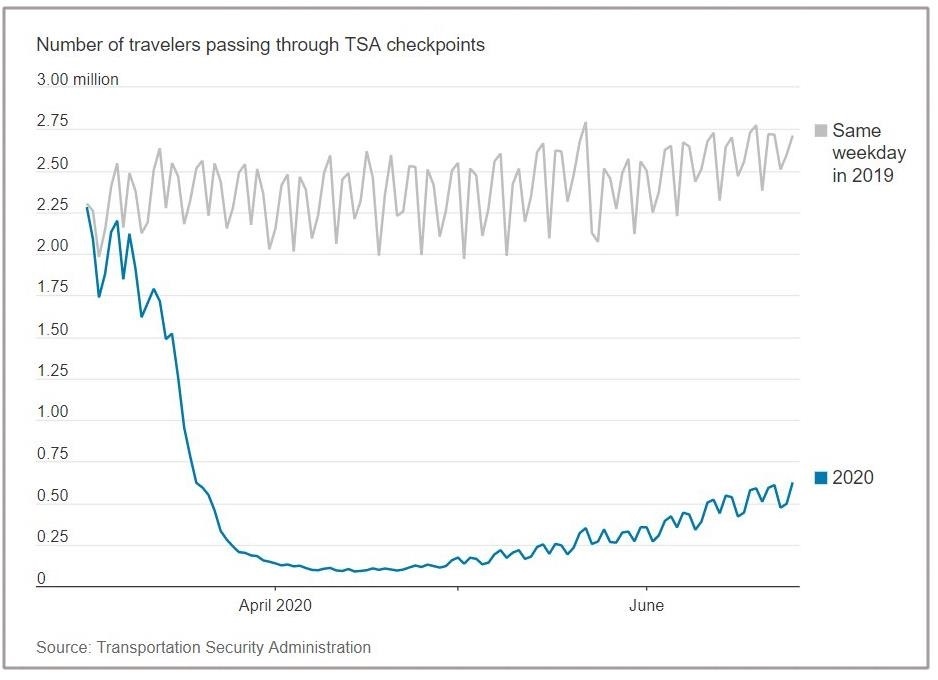
* Air travel is recovering timidly . As we can see in the diagram below, after the abrupt landing in April, there is a small but steady improvement (blue line). However, the departures are still very far from the corresponding last year's numbers (gray line).