
Linear Finance (Linear) is decentralized, non-custodial and cross-chain compatible asset protocol in which users can create, trade and manage synthetic assets. Linear allows users to build and manage a spot or portfolio using innovative digital and traditional financial products on a platform with cryptoeconomic mechanisms. $LINA is a protocol nativ token which function is to secure protocol with staking in a collateralized debt pool and provide economic incentives to users.
Interaction with the protocol is possible on the Ethereum network and Binance Smart Chain, but currently BSC is a more logical option for most users due to low gas fee costs. Compatibility with the Polkadot blockchain is also announced, however, due to the limited number of slots, it is possible that Linear will be in Kusama.
Linear's long-term vision is to provide access to all categories of investors to operate equally in a decentralized market of digital and traditional assets. Synthetization of asset are focus on cryptocurrencies, commodities, traditional assets, market indices and other thematic exposures. The goal of the project from the beginning was to build a synthetix asset exchange with additional features that would solve the main problems of the DeFi sector like impermanent loss, high slippage, high gas fee cost, slow oracle price feed update, lack of multi-chain accessability and agressive liquidations.
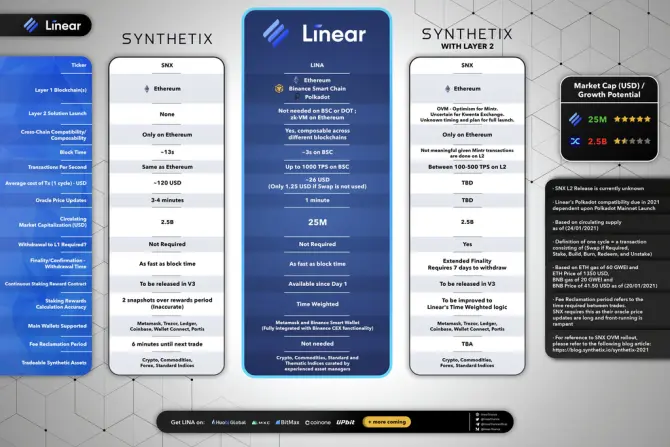
Linear vs Synthetix
Liquids creation and tokenomics
Linear protocol has DAO structure powered by LINA token - used as staking collateral to mint synthetic tokens with underlying value, for DAO governance, payments and user incentives. The created synthetic assets on the linear protocol are called "Liquids" (i.e. ℓUSD, ℓBNB, ℓETH). In order to mint new Liquids, user first need to stake LINA token. After staking LINA users are allowed to mint Liquids with 500% Pledge Ratio – that means 5x over-collateralization. The initially set high P-ratio is the reason to protect the platform from “black swan” events caused by high volatility. The P-ratio is not fixed and its change is decided by the members of LinearDAO. The protocol mechanism works in such a way that the Linear liquidity pool (staked LINA tokens) acts as a counter-party, allowing unlimited liquidity and zero slippage.
Users are incentivize to stake LINA with two rewards types:
-
Pro-rata exchange fee – transaction fees generated by by exchanging Liquids inside Linear.exchange. Fees are set to 0.25%.
-
Inflationary Reward – Linear adopts inflationary tokenomics with decreasing rate. Starting inflation rate is set to 60% and further changes in the inflation rate depend on the circulating supply and exchange volume
For example, if you stake 1000$ worth LINA tokens, you can mint(build) max. 200$ in synthetic assets. Furthermore the user needs to manage his P-ratio in order to claim rewards. Rewards are claimable on weekly basis and for the user to be able to claim they must hold a P-ratio above 500%.
LINA tokenomics:
Max Supply: 10,000,000,000
Circulating Supply: 2,476,691,266
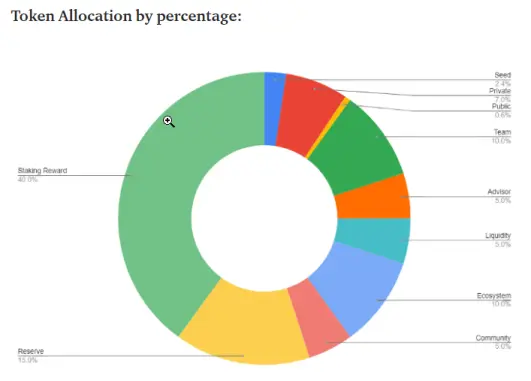
LINA token allocation by percentage
Linear tokenomics utilizes inflationary model with inflation rate initialy set at 75% that decrease 1.5% weekly until terminal floor is reached. Further changes to the protocol's monetary policy will be made by achieving consensus by Linear DAO governance.
Users can manage funds within Buildr App interface. In Buildr App, user is able to perform the following activities:
- Build (create) synthetic asset
- Claim rewards
- Manage debt postition - burning USD or staking LINA
- Swap positions between chains (i.e. between BSC Chain and Ethereum)
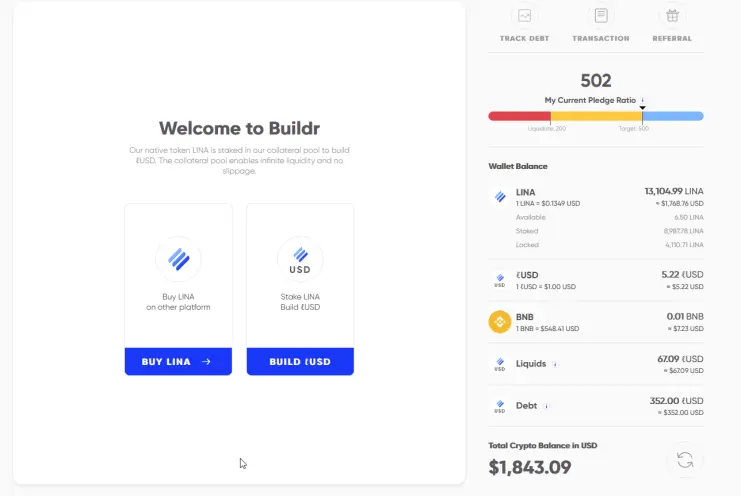
Linear Buildr Interface
Linear exchange is the second part of the Linear ecosystem, where users can exchange Liquids and create their portfolio. At the time of writing, Linear.exchange supports trading derivatives of cryptocurrencies, commodities, fiat currencies and Xangle market indicies.
- Cryptocurrenies: BTC, ETH, BNB, ADA, DOT, LINK, TRX, VET, XLM, YFI
- Fiat currencies: USD, EUR, JPY
- Market indicies: XLCI (Xangle Large Cap Index) and XBCI (Xangle Blue Chip Index)
- Commodities: XAG (Silver) and XAU (Gold)
Traders pay 0.25% fee on every trade. Collected fees from trading activities are then distributed to users whose P-ratio is above 500%. In this way, users who contribute to the stabilization of the platform are rewarded. That economic incentive protect protocol to failure due to insufficient collateral in liquidity pool.
Liquidation mechanism
The liquidation of funds on the Linear Protocol is initiated if the P-ratio is falling below 200%. However, unlike most of the DeFi platforms, liquidation mechanism is very flexible because it gives the user 72 hour time frame to deposit additional LINA or burn ℓUSD to return their account to above a 500% P-ratio. In case the user does not respond within a specified period of time mechanism bust-up only the amount of assets required to return the user P-ratio to 500%. Priority for liquidation are first staked LINA tokens and following if needed locked ones. The liquidated LINA tokens will be converted to ℓUSD and $BUSD in price determined by the oracle.
Penalty fee for triggered liquidation is 15%. Generated penalty fees will be distributed to locked Reserve account (ℓUSD) and protocol LiquidityFund ($BUSD). Use of Reserve account tokens will be determined by Linear DAO (LINA holders governance), and Liquidity Fund function is used to back ℓUSD and increase protocol stability.
To provide quality and secure price feed solution with fast update, Linear has entered into strategic partnership with Band Protocol. The main problem that partners will try to solve is front-running which is the biggest problem for all trading in general. With Linear interoperability feature that problem become even more complex.
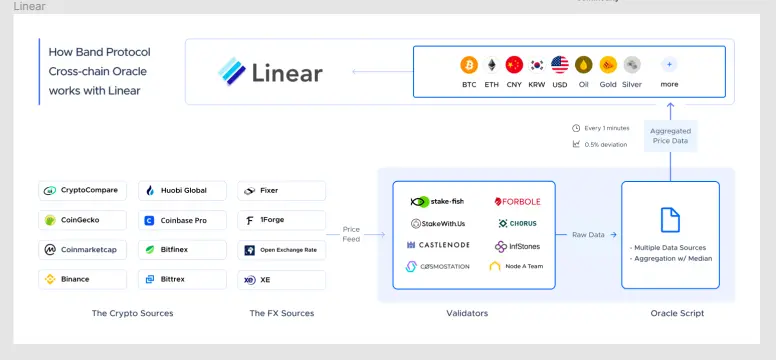
Linear and Band protocol working scheme
My opinion is that the Band protocol oracle solution is the right choice for the reason that they allow end-to-end full customization for data in real-time, oracle mechanism is fully decentralized and blockchain agnostic.
Team and Investors
Linear Finance team has a strong tech background and high working experience in traditional finance sector. Team members are very knowledgeable and transparent about platform strategies, products, advantages and problems in that niche type of market.
The big plus for project is that team is publicly known and was guests in a lot of podcasts and AMA events where you can get lot of information from "first hand".

Linear Finance Core Team
Linear Finance investors are all in a row high reputation VC funds like Alameda Research, Huobi Global, Hashed, CMS, Moonrock Capital, DuckDAO (decentralized VC fund) etc. Early investors with a high reputation in the crypto space are an important indicator when assessing the potential of a project, given that VC fund investments are based on detailed due diligence.
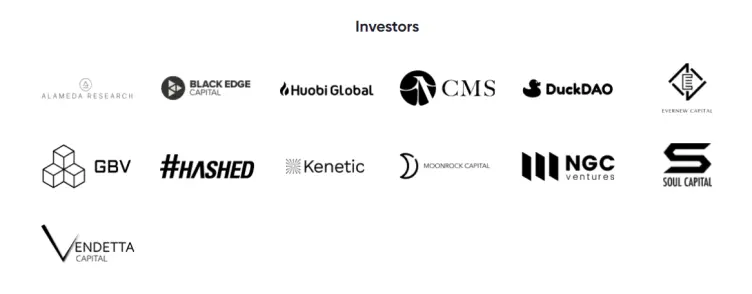
VC Investors in Linear Finance
Conclusion
Decentralized, cryptographic secure, peer-to-peer, global derivatives trading is a huge market with enormous potential. As a derivative or synthetic asset is a contract between two parties, blockchain technology will almost certainly disrupt an existing brokerage-based trading system. If we take into account that the derivatives market in the traditional exchange system is larger than $ 1 quadrillion, it can be assumed that blockchain projects in this area have the greatest chances for growth.
Compared to competitors market cap - Synthetix Network (over 3 billion $) and UMA (over 1.6 billion $) - Linear Finance seems quite undervalued (300 million $). I think the reason is the sector itself which is still in the experimental phase and the factors for fair valuation of projects are not standardized due to the high risk and unregulated market. Although is not a "first-mover" in the category of creating and trading derivatives, the Linear team was detected problems with leading protocols and offer a possible solutions.
Linear protocol has great fundamentals:
- Quality team whose members are experts with many years of experience in trading derivatives
- Team is transparent, team members are often guests in podcasts and AMA events, they are active on social networks
- Great designed cryptoeconomic mechanism based on LINA token
- Cross-chain interoperability, so users have the option which underlying blockchain to use
- Flexibility when it comes to liquidation - 72 hour time interval for user to fix collateral ratio
- Easy to use User Interface
- Protocol token LINA is listed on the largest and most liquid crypto exchanges such as Binanca and Huobi
As for criticism, I would love to see that protocol also work on Ethereum Layer-2 networks like Polygon or xDAI. Although I personally use Linear on the Binance Smart Chain, I consider it as a temporary solution because the long-term goal is decentralization.
I also think the protocol could have more contributors on the technical side and more dynamic audit approach. Because crypto-space progressing rapidly and a possible exploit can have big negative consequences for protocol.
Useful sources about project






