
A few years back around Thanksgiving time I had a number of days off and the kids were still very young. Normally being a night owl, I was up for hours at night long after everyone else went to sleep. That gave me ample time to enjoy playing Minecraft on my Xbox console as well other games. No surprise, having vacation time took me down the rabbit hole into a big Minecraft construction. I spent hours on hours playing and working on my grand plan, figuring out formulas for builds, swearing at creepers sneaking up on me when I least expected it, running out of supplies and mining for more, and generally having fun even though it seemed like work.

Image Source: Wikipedia, Fair Use License
Little did I know, I was also damaging my right thumb tendon. Given the design of the Xbox controller, my right hand generally controlled most of decision-making in the game. That meant it took on twice the work of my left hand, and most of that energy was concentrated on my thumb. While I felt nothing at the time during the gaming, I was hammering the tendons in my hand to the point that in triggered inflamation. Conveniently, or not, the morning I had to go back to work, I woke up with screaming pain everytime I tried to move my thumb. What the hell happened?
Gamer's Thumb is a nickname given to a type of tendonitis, specifically known as De Quervain's Tenosynoivits. The "itis" at the end of the name is the giveaway for inflamation. Who the hell DeQuervain was, I have no idea, but the condition is real. It comes about with an extensive exposure to repeat motions, ergo gaming for hours. The condition is realized with noticeable pain and swelling, and there can be a sensation on the thumb when moved feeling like it's snagged or popping. The usual treatment is, first off stop using the hand. The second step is RICE (rest, ice, compression and elevation) along with some anti-inflammatory medicine (I used ibuprofen but I'm no doctor, do your own research).
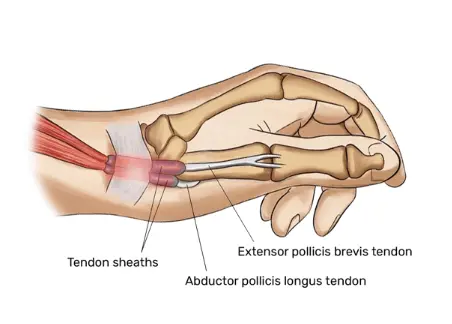
Image Source: Esports Healthcare
At a technical level, the thumb has a number of tendons attached that manage it's movement control. The one that gets the most abuse with gaming, particularly with hand controllers like those with popular consoles is the Extensor Pollicis Brevos tendon. This one runs on the top of the thumb and essentially pulls it up and away from whatever the thumb is pressing down on at the time. Think of this getting used thousands of times per hour and you get the idea. Even the best rope starts to wear down with use. Making the problem worse, that same tendon and another, the Abductor Pollicis Longus tendon which runs under the thumb, both run through a pair of tubes or sheathes. This is where the damage frequently happens. With high frequency due to the same movement type, the tendon movement inflames the sheath tube. The inflammation then leads to pain and reduced movement until the swelling goes down, which can take days.
Gaming was how I "discovered" Gamer's Thumb, but it also comes with heavy texting, sewing and embroidery, carpentry and tool work with a thumb and similar. The pain doesn't just sit in the wrist or below the thumb, it can move down the forearm as well.
So how to avoid the condition? Well, obviously don't game for hours on end, day after day (good luck during the holidays, the most prime time for trying new games and similar). If you do have to do repetitive stuff for hours, take frequent breaks and change up the hand position. Interestingly, gaming on PC doesn't trigger Gamer's Thumb for me. There are other risks, such as wrist and carpal tunnel syndrome from keyboard and mouse use, but the position is different for the thumb, so I really haven't had a problem since I moved away from console gaming controllers.
In any case, with the holidays on us again, the temptation to game for hours, as well text, is on us. So watch out for avoidable damage to your hands, or you'll be like me spending an entire December recovering from a bad Thanksgiving mistake with Minecraft.






