
Welcome to the newest (unpublished, even, as of writing this) post on my blog!
Now, if you know me, I've been shilling crypto since about 2015. Still remember reading the news about Mt. Gox going out, and when C-CEX used to be a trusted exchange. I'll go over the implications of custodianship another day, but ever since cryptocurrencies were new, they've been widely associated with scams and terrorism due to their nature of anonymity and finality. After all, any bitcoin address can send bitcoin to any other address, and once miners process the block, there's no going back (even before it's processed, but that's complicated). Except maybe traveling back in time, but let's be honest, that'd be cooler than reversing the transaction. Who knows, maybe someday we'd have a time-traveller claiming to be Satoshi Nakamoto with access to those private keys.
But, until time travel is possible, there has been another solution for simpler transactions: using in-built escrow services. Basically, a central party (acting as a gateway of sorts) determines whether there has been a scam, and refuses to forward payments to the seller of the goods/service, like in Credit Card payments. After all, whenever there is the expectation of cooperation, there's always the chance that disputes will be raised, so we always need a consumer protection system in place to handle such disputes as they arise. (If you think trust is enough, just observe the work of your local court for a day.)
It's a simplified example, but it usually consists of some kind of dispute resolution. But it's hardly consistent, costly and seldom transparent, and this is where MerchantToken (MTO), or more precisely, MerchantCoin (MEO) comes in. It aims to solve the problems while integrating with any network supporting Smart Contracts (currently aimed for Ethereum, Solana and Cardano). Backed by the Hips Merchant Gateway (it is indeed listed at top of their website), it seeks to integrate transparent, community-powered and peer-reviewed dispute resolution to consumer payments. I'll explain in a bit.
I'll be using Q&A, since that seems to be a well-liked format here. After all, it is an easy way to make sure information is presented in easily digestible pieces. My sources are the official ICO website and the whitepaper of the coin. Any dark-mode screenshots are taken using the open-source Dark Reader. Here we go:
1. What is MerchantToken/MerchantCoin?
MerchantToken (MTO) is the ERC-20 testnet equivalent to MerchantCoin (MEO), so I'll be using the names interchangeably for now. Once the ICO is over (given date at 30 June), your MTOs can be swapped 1:1 for MerchantCoins if you so desire. I find no compelling reasons for whether investors should choose to swap it sooner or later, but it is designed to take over MTO and has faster and cheaper transactions, so I'd recommend converting it as soon as you're ready to store the new token. MEO is planned to run on Hips Merchant Blockchain protocol which will be scalable with (and, at times, run on top of) Ethereum 2.0 and Solana, thus it is designed for efficiency.
Official 1-minute explainer video
2. What is the maximum total supply?
There can be a maximum of 100,000,000 Merchant Coins. If all coins are not distributed by the time the ICO is over, the community will vote on whether to extend the ICO or burn the remaining coins.
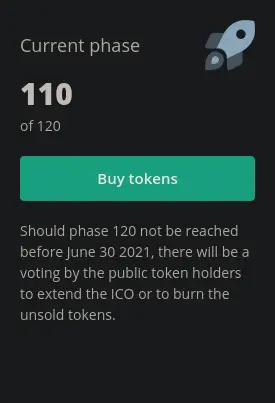
If I were to guess, they'd vote to burn the remaining tokens in case of an ongoing bullrun throughout the crypto market, and to extend the ICO if the market is crashing.
Also, at least about 18 million of the tokens are vested (owned by the team and pre-sale supporters) and will be released much later than the ICO end, so that the investors may feel confident that the team isn't going to just dump their tokens quickly. Another 17 million are locked away to be strategically given in partnerships and grants over at least 4 years. Thus, a maximum of 65 million tokens will be distributed when the ICO ends.
25% of all transaction fees are burnt, so the coin is deflationary (But then again, it seems everyone's making deflationary tokens these days). The transaction fee is 20% of the gas fee of the blockchain over which the Hips Merchant Protocol is implemented. The rest goes to the fee pool which is then used to incentivise governance for token holders. Being an engaged and informed token holder means you get to earn more tokens.
3. How did the ICO extend to have bonus rounds?
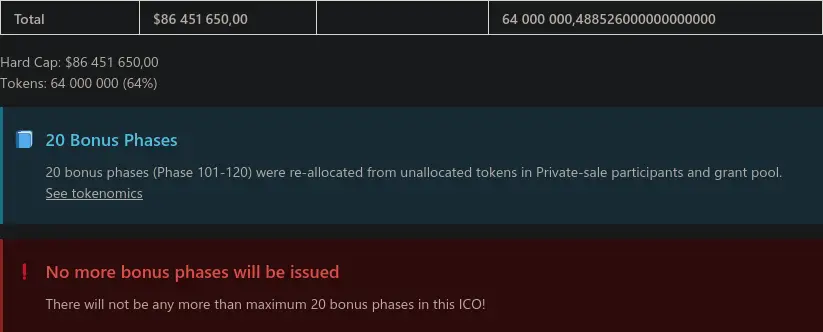
The initial ICO was planned to go until the coin reached $1.93 in late June. However, the rounds finished quickly, so the tokens were reallocated (unsold pre-ICO tokens and 13 million for strategic grants were added to ICO) so that the ICO could run for bonus rounds for more of its remaining duration. The numbers I wrote above are the new numbers of allocation.
4. Who is behind the project?
This project is backed by the Hips Merchant Payment Gateway, who will be responsible for the initial governance of the Hips Merchant Blockchain, and have been handling merchant payments since a while (it will use it in crypto payments) (this page says Hips was founded in 2015). After that, it will be governed as a Decentralised Autonomous Organisation (DAO), which means the governance decisions will be taken by votes of the engaged token holders (in dispute resolution and mining). You have to actually stake your tokens for governance decisions, but they can be anything, like:
- Addition/removal of tokens accepted on Hips Merchant Protocol
- Protocol parameters such as collateral factor, reputation algorithms, supply cap, risk limits.
- Merchant reputation voting
What does this mean? Raising a dispute (within the specified escrow time) will cost 3 MEO, out of which 1.5 MEOs go to 2 agents for solving it successfully (which can be a strategy for earning the coin if you prefer). Taking up a case costs 0.05 MEO (which gets burnt), so as a successful dispute resolution agent, you would gain 0.7 MEO per case solved. Every case is solved by 2 agents, and in case they disagree, their decision will be cancelled and the case will again be up for taking. Any agent whose work is disagreed with loses his 0.05 MEO, and thus, we get a transparent, community-powered and blind peer-reviewed system of dispute resolution for consumer protection. (Blind peer-review means that you won't know what the other agent has decided. After all, that could lead to lousy work, which defeats the purposes of this transaction.)
5. Why do we need a consumer dispute mechanism?
Ever since people started living together, they have established systems in place for fairness and order. A social contract, if you may, which enables the society to flourish, since unfair systems are beneficial for only a few and detrimental to the greater good.
However, cryptocurrency payments have been a wild west so far. Since any centralised regulations are not exactly possible, that has really hindered its potential for growth. But, with a buyer protection system in place (much like regulated fiat gateways), that block on its potential can be removed, and cryptocurrencies can get more widely adopted. If people can make payments while being confident that if the object isn't delivered, the payment will be refunded via a smart contract, they can use cryptocurrencies much more confidently.
Why smart contract? Because it is self-executing and deterministic, so your funds are never directly handled by a third party, unlike escrow services.
And the websites will show you're sending payment to a merchant that he has implemented MEO consumer protection, so you can be sure of being a beneficiary of buyer protection (even though you'll pay the fees for it. Well, think of it as an insurance like what many shopping sites now have).
6. How does dispute resolution work, exactly? What about my private data?
Dispute Resolution over Hips Blockchain can work in 2 types: Automatic, and by the Community. Automatic works using the data of how many payers have initiated the dispute before and whether the merchant's reputation falls below a required threshold, while in case of Community management random token holders investigate into your case and decide manually, not based on previous reputation. Agent reputation will decrease if they are not in consensus, though no consequences to a low agent reputation seem to have been decided.
In case of Community Dispute Management, the buyer doesn't have to worry about the agents seeing his private data, since anything has to be voluntarily given by the payer for the agents to see, and you do not have to give any private information that you believe is not relevant to solve the dispute. The platform also needs to comply with the GDPR to be able to integrate MerchantCoin.
Also, in case of Automatic Dispute Management, the decision is taken mainly on merchant reputation and needs no personal data.
7. What about merchants that frequently have disputes raised?
Such merchants will be assigned a low reputation. This would be bad for their business because, in case of a particularly low reputation, the system gets prejudiced against the merchant and initiates chargebacks more easily when a dispute is raised in Automatic Management. Thus it would be in the merchant's interest to deliver the goods/services and not get into disputes too often and deliver the goods/services smoothly.
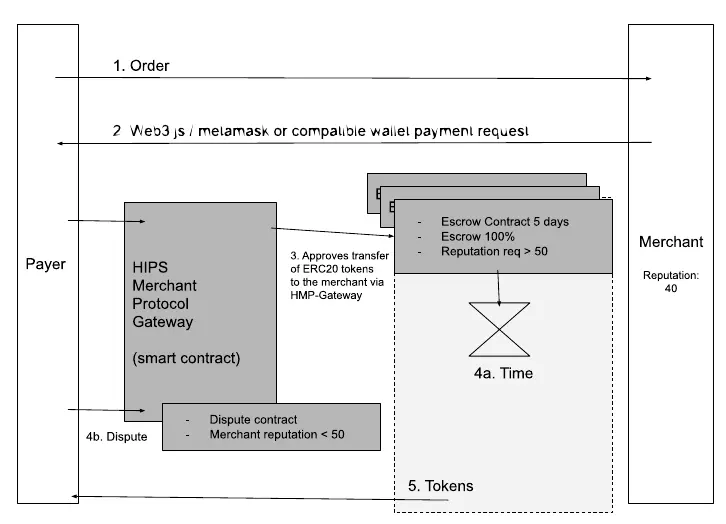
Chargebacks will be auto-initiated in case of Automatic Dispute Management and low reputation. But in case of high reputation, the merchant is considered trusted and tokens go straight to him (instead of escrow), so merchants with great track record will be at an advantage.
There are no details on whether losing Community-managed disputes lower reputation or how it is decided which way the case will go, but this is what I'd guess: Losing community disputes do not lower reputation since it is another system altogether (though they can lower the merchant reputation through their vote), and buyer decides while buying which method will be used. Buyer has to pay 3 MEO to raise a community-managed dispute, which should be an important consideration for them.
8. Where can I store it?
MerchantToken can be stored in any ERC20 compatible wallet (which can store ETH), using the contract address 0xE66b3AA360bB78468c00Bebe163630269DB3324F. MEO is planned to be native to the Hips Merchant Blockchain, which will be released with its own apps, although it should still be compatible with Metamask, a wallet where you can add custom blockchain protocols.
9. Partnerships
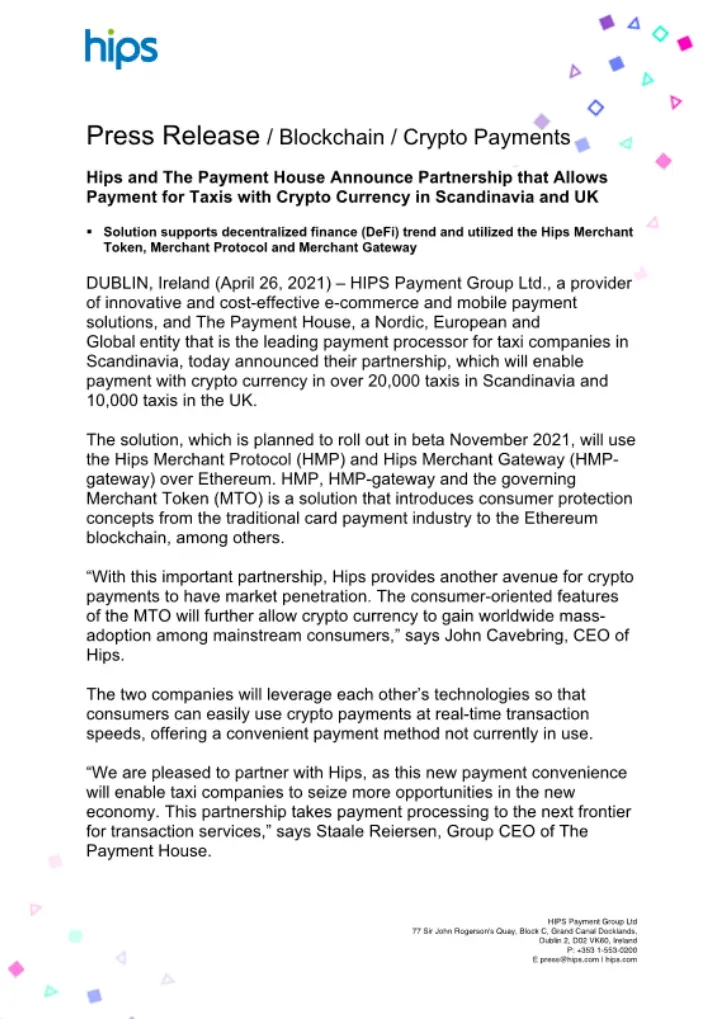
Any project needs partnerships and scenarios where it is readily usable, else it isn't useful for the community, however interesting it may be. Hips has currently partnered with The Payment Company so people in Scandinavia and UK can pay for their taxis using cryptocurrencies, and it plans to announce more partnerships in the coming days/months.
10. How do I buy/sell MerchantToken?
Interested? You can buy MTO in the pre-release ICO.
Once the ICO is over and the token is listed on exchanges, you will be able to sell or swap MTO/MEO in the offered pairs. Conversion to ETH will be enabled in your ICO account, and it will be listed on Uniswap on 12 July.
Personally, I'd say it is a viable long-term investment, especially because dispute resolution is indeed an important part in transactions where they arise, so it should not be ignored. Also, it is important to ensure that objects of cryptocurrency payments are delivered or the payment can be refunded, before they can be used as a normal means of payment. However, never invest long-term in a coin you don't agree with.
As always, do your own research. I read the whitepaper/docs, but feel free to look in detail at them and more sources, such as the twitter or subreddit.
This post brought you to Publish0x? Sign up now to comment and leave a tip for free! (Feel free to leave your feedback below, of what you like, what you don't like, and where you want to prove me wrong!)
(Affiliate disclosure: I use affiliate links in my posts when available. If you prefer non-referral links, although it'd make me sad, you may use the ClearURLs browser extension)






