
Last week negative history was written not only in the Bitcoin share price, but also in all other markets. In light of the recent financial crash, for once in this report we do not only look at the crypto market.
The corona virus has caused a huge panic. The only real "bull run" is currently taking place on toilet paper. Most canned goods and durable goods currently seem to be the hottest bet in the market. So while the supermarkets are empty, the stock market and many other assets are pushing further south, including gold. The Bitcoin price, on the other hand, has been able to catch up and is even currently moving towards the 6,000 USD. What the hell is going on here?
We will take a look at the correlation between the S&P 500, gold and the Bitcoin price. We will look at how the historical correlation has behaved during the crashes and what this could mean for the future of Bitcoin.
We look specifically at BTC, as the No. 1 is the most important and largest crypto currency in the crypto market. Altcoins often follow the Bitcoin price movement and have also been able to show their strong side in recent days. Bull run or bull trap?
Correlation of S&P 500, Gold and Bitcoin
Let's first take a look at the current correlation of the markets and explain a little bit about what happened to the Bitcoin price and why there was such a big drop. One of the main aspects is the recent strong correlation between the BTC, S&P 500 and gold.

We see the 3-month chart showing the correlation between the S&P 500 (blue), Bitcoin (orange) and Gold (light blue). The Bitcoin price has experienced a huge rally in the first half of 2020. Since February 11th, however, it has made exactly the same movements as the other two assets, which have stagnated.
From that point on, the downtrend and upswings of the Bitcoin price follow exactly the pattern of the S&P 500. It is amazing how closely the BTC price correlates. Gold has also made exactly the same movements.
Let's take a deeper look now and look at the 1-minute chart:

Even on a 1-minute basis, the correlation between the S&P 500 and Bitcoin price is exactly 1.
"Why is that? I thought BTC and Gold were "Store of Value" and when everything goes down, those assets should go up again?".
Wrong, because in a panic and irrational market like the last one, everything is correlated with 1, the "Store of Value" function is by no means destroyed here. Bitcoin is often referred to as digital gold, so let's take a look at what happened before BTC. For this we look at the years 2000 and 2008 in which there was also an enormous crash on the markets.
Correlation of S&P 500 and Gold: 2002 & 2008
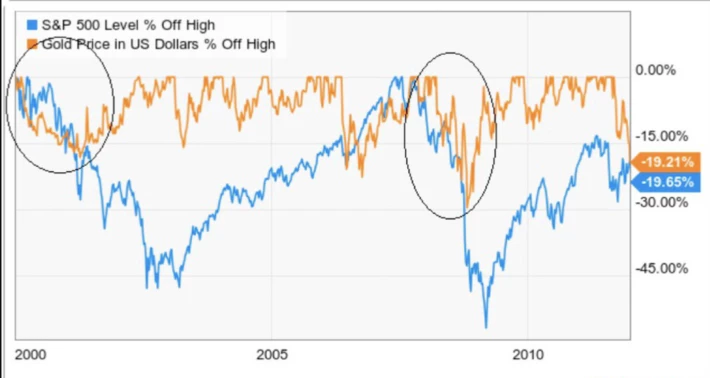
2000 was the year of the dot-com bubble. Gold showed a strong correlation with the S&P 500 in the 2000s and also suffered from the crash. In early 2001, the price of gold then bottomed out and began to recover, while the S&P 500 continued to fall until 2003. In other words, gold and the S&P 500 correlated negatively.
Then came the subprime mortgage crisis in 2008. Here, exactly the same thing happened. Gold was highly correlated in the early days of the financial crisis, then it correlated negatively again. The price of gold started to rise again at the end of 2008, just before Bitcoin was launched. The S&P 500 did not start to rise until March 2009, several months after gold.
Why does this correlation happen? Will the Bitcoin course become independent again?
There are some factors related to why gold and Bitcoin are falling in a financial crisis and panic situation like we have now.
- Investors are panicky and prefer to bet on cash rather than anything else. Everyone wants to make sure they can buy enough food and other essentials, so in a time of uncertainty, cash is king. All the above assets cannot be used for purchases (I currently include Bitcoin, although this may change in the future).
- Margin calls. This is an important aspect that is mostly neglected by many people who are not deep enough in the financial world. Traders need to increase the security deposited on margin calls to protect their position against liquidation. As a result, many traders sell other positions for cash in order to cover the margin call. Again, much liquidity flows out of other assets. This then also affects the Bitcoin price.
Bitcoin course in its first crisis
The Bitcoin share price is currently experiencing its first crisis and on March 12th showed the biggest decline in over 6 years. Here are the 3 main reasons for this:
- Many funds and individual traders trading in both the Forex and Bitcoin world needed collateral to cover their margin calls or unhedged positions. As a result, many BTCs were sold.
- The major credit companies were liquidated. In particular, the miners before Bitcoin Halving did not want to sell their BTCs, but instead used them as collateral to borrow cash. As the Bitcoin price fell, the actual value of the collateral deposited naturally fell, and so they were liquidated.
- The fund trading margin on Bitmex was liquidated, over $1.4 billion was liquidated.
All three events were related to funds and traders who needed a short-term solution to increase their deposited collateral. This is also the same reason for the sharp fall from the gold price. So in the long run nothing has changed and the decline was clearly a short-term solution for these funds and traders who had no other option and needed liquidity.
Bitcoin as a store of value did not fail - uncorrelatedness still given
Bitcoin has therefore not failed to be a possible store of value and uncorrelated to all other assets. The main reason for the recent strong correlation of the Bitcoin share price to the traditional financial markets was fear and panic. In a situation where people need money, they sell everything they have - including gold and BTC.
Another indication of the increased demand for BTC is the statement by Coinbase. According to the trading platform, 73% of users bought BTC on 12 March and 27% sold it. This is also confirmed by the search query for "buy Bitcoin" on Google Trends.

Let us also take a look at some on-chain key figures. If we look at the net unrealized gain, we can see that we have entered the next "surrender zone".

Hodler or long-term investors are increasing their Bitcoin positions. This tells us that the sharp drop in Bitcoin prices was caused by sales by investors and traders who had a short-term time horizon.

Where is the journey for the Bitcoin course going now?
This is a question that almost everyone is currently asking. People who are more deeply rooted in the financial markets fully understand that there is a general problem with the markets. We will probably not only experience a financial recession, but rather a financial depression. Liquidity will be an important issue. That is why governments will have to help out. How are they doing that?
The US Federal Reserve (FED) has already provided $2.2 trillion. That is $2,200,000,000,000. Let this figure melt in your mouth! We can follow the devaluation of the national currencies live. In addition, it has been decided in the USA that the time is ripe for "helicopter money" - 1000 USD will be distributed to every single person in the USA. The creation of money out of nothing goes into the next round and more could follow.
BTC vs. FIAT
If we now draw a comparison to the Bitcoin price, we see a strong decline due to the coronavirus panic, but the difference is that the BTC price has stabilized itself. There is no FED that can create Bitcoins out of nothing to pump them back into the market. Bitcoin is the hardest money.
In addition, the markets cannot be closed simply to force traders and investors not to sell. BTC currently represents a market that works and is used 24/7 without interruption.
Bitcoin and Gold will probably recover earlier
There is probably no question that people will continue to flee into cash if the panic continues. It is also likely that the financial system in its current form will not look good in the next 6-24 months.
The correlation of gold and Bitcoin to the rest of the market will no longer be at 1 once the panic is over. Both assets have great potential to recover faster from a crisis. In fact, the correlation has already fallen sharply both in the last 3 days and today. Surprisingly, only the correlation of the Bitcoin price to stocks, but not that of gold.
We will keep you up to date and are curious what the coming weeks and months have in store for BTC. We will hold out in any case!






