
“Blockchain is decentralized,” everyone says. But… who actually does the work that banks used to handle?
The short answer: nodes.
And yes, your laptop could be one.
What is a node in blockchain? Imagine a huge group chat where every message needs to be verified by multiple friends before it’s considered “real.” That’s how a blockchain works. And the people doing the verifying? They're not people. They're nodes.
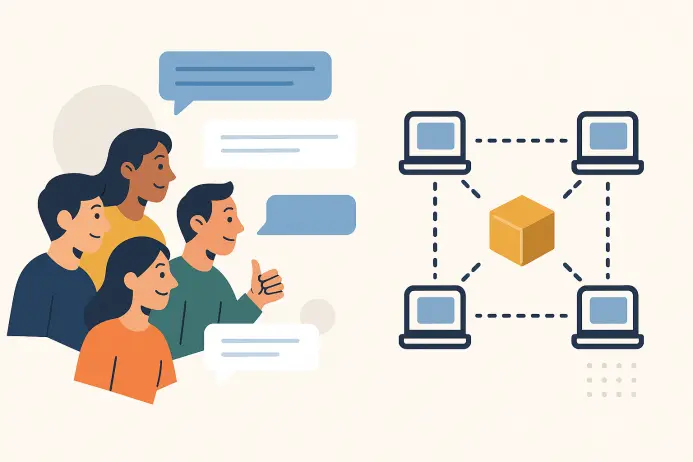
In simple terms:
A node is just a computer that's connected to a blockchain network. But it’s not just sitting there. Think of it as a super-involved librarian that doesn’t just keep records — it checks every entry, shares updates with other librarians, and sometimes even writes new chapters. Its primary role is to verify, store, and share information, like a public digital ledger that everyone can access.
But there's more to it.
A node can:
-
Validate transactions
-
Relay them to other nodes
-
Store a full copy of the blockchain
-
Participate in consensus (in some cases)
-
And in certain networks, create new blocks
A Gamer Analogy to Make It Clear
I want you to understand what is a node in blockchain. Now, imagine you’re in an online Minecraft survival session.
-
🗺️ Every player (node) has a copy of the entire map
That means that every person playing isn’t just exploring — they’re carrying the full version of the world with them. If one player disconnects, the game continues because others still have the map. That’s how nodes work in blockchain: they keep a full copy of everything that’s ever happened, so the network doesn't depend on a single player. -
👀 When someone builds something, everyone else sees it
Let’s say one player builds a house or finds diamonds — instantly, all other players’ maps update to reflect that. Just like in blockchain: when a transaction happens and is approved, all nodes update their copy to match. Everyone stays in sync. -
🤝 No one owns the map, but everyone helps keep it accurate
There’s no single admin or "boss" in the game — it’s decentralized. The accuracy of the map depends on cooperation. If someone tries to cheat or add fake blocks, the other players will reject it. Same in blockchain: nodes validate what’s true and reject anything that looks off.
That’s exactly how a blockchain works:
Each node sees, validates, and stores the same information. No central server, just a collective effort to keep everything honest and updated.
Types of Nodes (with Examples)
Not all nodes play the same role. Just like in a team, every member has a different job. In blockchain, there are several types of nodes — each one essential in its own way.
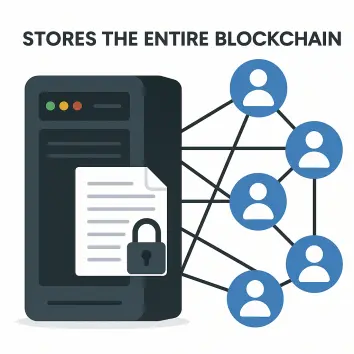
Full Node
What it does:
Stores a complete copy of the entire blockchain and helps validate transactions and blocks.
Think of it as the official archivist of the network — it keeps all records and checks everything for accuracy.
Real-life example:
A desktop computer running Bitcoin Core, with over 500GB of storage. These nodes are critical for decentralization and network integrity.
Light Node
What it does:
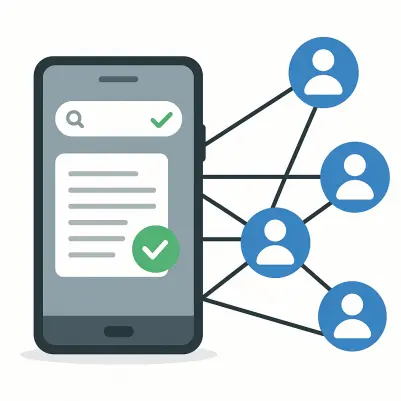
Verifies only recent transactions, without storing the full blockchain.
It relies on full nodes for complete information.
Think of it as asking Google for what you need, instead of carrying the entire encyclopedia.
Real-life example:
Mobile wallets like MetaMask or Electrum. They’re fast, lightweight, and perfect for everyday use — but they don’t do the heavy lifting.
Validator / Miner
What it does:
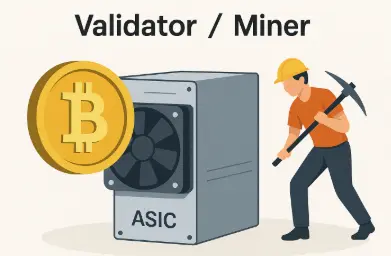
Adds new blocks to the blockchain and gets rewarded.
Depending on the network, they use computational power (Proof of Work) or stake crypto (Proof of Stake).
They’re the builders of the blockchain.
Real-life example:
-
In Bitcoin, miners use ASIC machines to solve complex puzzles and earn BTC.
-
In Ethereum 2.0, validators stake ETH and get selected to propose/validate new blocks.
How Many Nodes Are There?
According to bitnodes.io:
-
Bitcoin has around 15,000 active full nodes
-
Ethereum has over 8,000 active validators in its PoS network
-
These numbers fluctuate, but the takeaway is clear:
A global network of individual computers keeps the system running
Can You Run a Node from Home?
Yes. And you don’t need to be a millionaire to do it.
What You’ll Need:
-
A decent computer (ideally one you can dedicate)
-
A reliable internet connection
-
Time to sync the blockchain
-
Enough disk space (Bitcoin needs over 500GB, Ethereum is also large)
To run a Bitcoin full node, download Bitcoin Core.
For Ethereum, check out Geth.
You can also run lightweight nodes through wallets on your phone or desktop.
Why Are Nodes So Important?
In traditional systems like Visa or PayPal, a few central servers do all the work — they validate transactions, store data, and keep everything running.
But if one of those servers goes down… the whole system can freeze.
Now, here’s where blockchain changes the game:
In a blockchain network:
-
🔁 Thousands of nodes support the system
Instead of one central point, there are copies of the data everywhere — so the system doesn’t depend on a single machine. -
🔐 Data can’t be faked without being caught
Any change would have to be accepted by all the other nodes. If something doesn’t match, it’s rejected. No cheating allowed. -
👀 Anyone can verify the data
It’s public and transparent. You don’t need to “trust” a company — you can check it yourself. -
🧩 All nodes agree on what’s true
Through a process called consensus, nodes vote on what gets added to the blockchain. It’s like a team decision — no one has the final say alone.
Bottom line:
🛑 No nodes = No decentralization
🛑 No nodes = No blockchain
They’re not just important — they are the blockchain.
What Happens If Nodes Disappear?
The network becomes weaker. Fewer nodes = lower security = higher risk of manipulation.
This is why more nodes means more resilience.
You Can Be Part of It
Now that you know what is a node in blockchain. Nodes are not reserved for programmers or massive data centers.
They’re just computers running software with transparent rules.
And yes, you can run one.
In a world where power over information is increasingly centralized, blockchain nodes give digital sovereignty back to the people.
Would you run one?
If your friend doesn´t know what a node is, you can explain with apples.
Frequently Asked Questions
Q: What is the purpose of a node in blockchain?
A: Nodes validate, store, and distribute blockchain data. They are critical for decentralization.
Q: Can a phone run a blockchain node?
A: Yes, as a light node. Apps like MetaMask function this way.
✍️ Written and revised by El Salvador CopyBiker — Crypto Content Specialist.
Helping your audience actually understand your Web3 product (no PhD required).
💬 DM me on Telegram: t.me/Elsalvadorcopybiker369
💬 Message me on WhatsApp: https://wa.me/message/6OHRYSTDX2HZL1
🌐 Visit my site: subscribepage.io/crypto-fintech-copywriter





