What is it?
Chroma key compositing (the official, fancy terminology we use today for all things green screen) has been around since the early days of movie making. It has evolved a lot but the concept stays the same and fairly simple: you film actors in a way that lets you replace/add elements to the scene that are not physically there. Because you can't always shoot on location, it's all about finding ways to enhance the environment. Keying is the mathematical process of singling out a specific color and making it transparent. This is how green screens work today, but it was not always the case.
Before green screens
In the 1880s, early filmmakers were already trying to improve their shots by changing backgrounds, aka compositing. And they were able to do just this by playing on exposure. Specifically, they would shoot a scene with actors while not exposing the background at all (using cut-out cards placed on the camera), rewind the film, and shoot in another location by not exposing the foreground (using opposite cut-out cards), thus creating a completely new environment. This technique was called in-camera matte. But this still involved shooting in two different locations, and if you were to move your camera too much while filming, the difference would show as the background would be jumpy and not follow the foreground. Smart, but not perfect. A cheaper and faster improvement a few years later with the glass shot, which consisted in painting some decor on a piece of glass that was placed between the camera and the scene. This had the advantage of only shooting once, in one location. with a single exposure. Smarter, but not perfect. Variations of this were used throughout the 1900s and 1910s, but they all had a major drawback: if the camera moves, everything is messed up, so all shots had to be fixed, stationary.
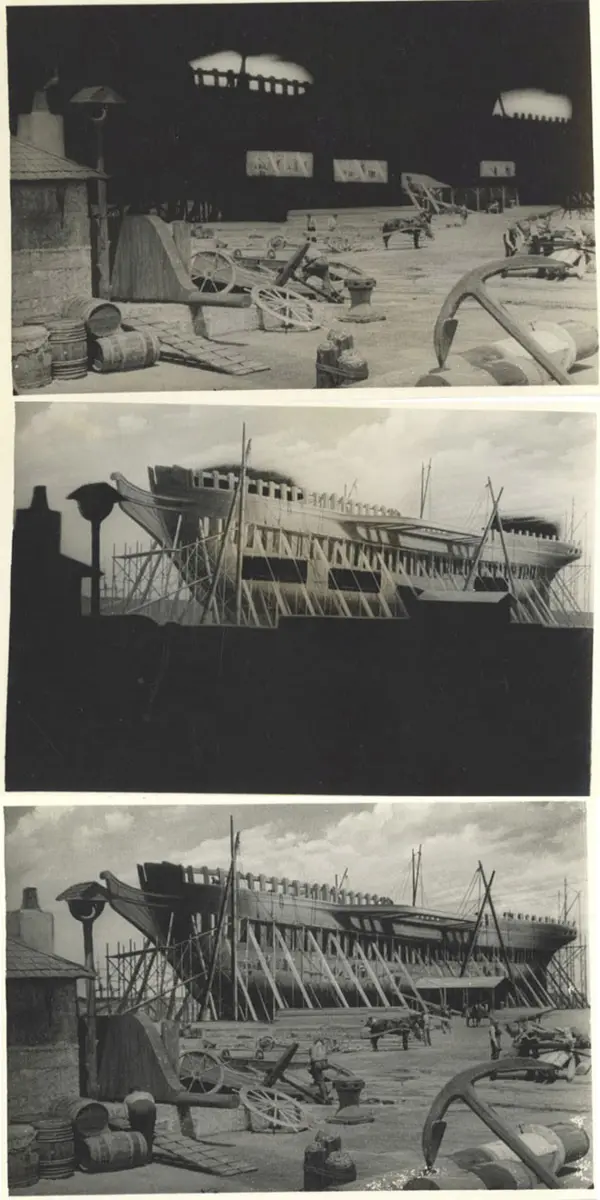
The three steps of in-camera matte.
Enter the travelling mattes. This technique appeared in the 1920s. Actors would first be shot in front of a completely black background, or black screen. Then, the film would be copied and the exposure would be altered so that only the silhouettes of the actors remain, completely washed out and white on the black background. This would then be the mask used to film the background, and compositing the two films would give you a scene where actors, background and camera could move, all the movements being matched thanks to the mask. Travelling mattes have been used since then but they have evolved a lot. Blue screens were first used in 1925 but weren't perfect either, since the early techniques couldn't get rid of a blue outline around whatever was being keyed out, and they couldn't get that much detail, especially on the hair of the actors. They were introduced because blue was the farthest away from the skin tones, so it was the easiest to key out. Yellow screens were a technical prowess and a major step forward in technology, especially demonstrated in Disney's 1964 Mary Poppins. It used a prism that would single out the specific yellow that was used in the background and kept all the other colors. Problem is, only one camera was ever made using this technology, and Disney owned it. Not super convenient. So other studios, MGM in particular, fought back with new ways of using blue screens. It was hard, expensive and long, but it worked great (think 1959's Ben-Hur). I'll skip the technical details of how blue or yellow screens exactly worked back then, to avoid entering into a physics and chemistry class, but it definitely gave amazing results for the time. Using paintings as set extensions has also been widely used, even recently (Indiana Jones, Star Wars and the Lord Of The Rings all used this technique). But, eventually, the emergence of computers opened a new realm of possibilities for the film industry.
The emergence and domination of green screens
Blue screens were dominating the industry before movies started getting digital post production treatments. Green screens offer a few advantages over their blue counterparts: they are brighter and yet require less light, they work better outdoors and it's a color that is less commonly found on actors and decor. Newer digital cameras are also more sensitive to the green color. All of this means it is cheaper, easier and faster to use a green screen. Of course, other colors are still being used (filming a Yoda puppet in front of a green screen might not be a great idea...), but green screens quickly became a standard of the industry.
What now?
With today's existing softwares, it is easier than ever before to edit green screen footage and key out a color in a couple clicks. You still need to make sure your screen is properly and evenly lit, or else it's not gonna be that easy to key out. But on a small scale, it's definitely not that hard. Even I can do it:
So why change this if it works great? Well, as I just pointed out, there are still some constraining factors coming with green screens, whether it's light, costumes or time in post. That's why new techniques are being born today. Using machine learning, new tools such as RunwayML let you easily key out elements of your videos even if they were not shot on a green or blue screen. If you're interested in this topic you should definitely check them out, it's quite impressive.
But the most impressive revolution was done by ILM (Industrial Light and Magic, the artists behind Star Wars) for the Mandalorian. If you have watched the show, you should watch some behind the scenes. And if you haven't watched the show, you should still watch the behind the scenes. ILM developed what they call the Volume. Basically, the actual set was surrounded by LED panels, that projected the background using a video game engine, and that projection was programmed to follow the camera movements, making it perfectly realistic. Say a scene was to take place in a desert: the set would have sand on the floor, and props like rocks, plants and whatever the actors had to interact with, and the walls of screens would show a desert background with the sky, dunes and everything, color corrected to match the set. Another advantage of this technology is actor immersion. Sir Ian McKellen broke down while shooting a scene as Gandalf in The Hobbit movies, because he was playing alone in a completely green set, so he could be added to scale in the full scene with dwarves in post. An actor being inside the Volume is immediately and fully immersed in the environment of the scene. The crew even said they were all being extra careful because it was not easy to tell where the set ended and where the screens started. This is to date the most immersive way to do a set extension.
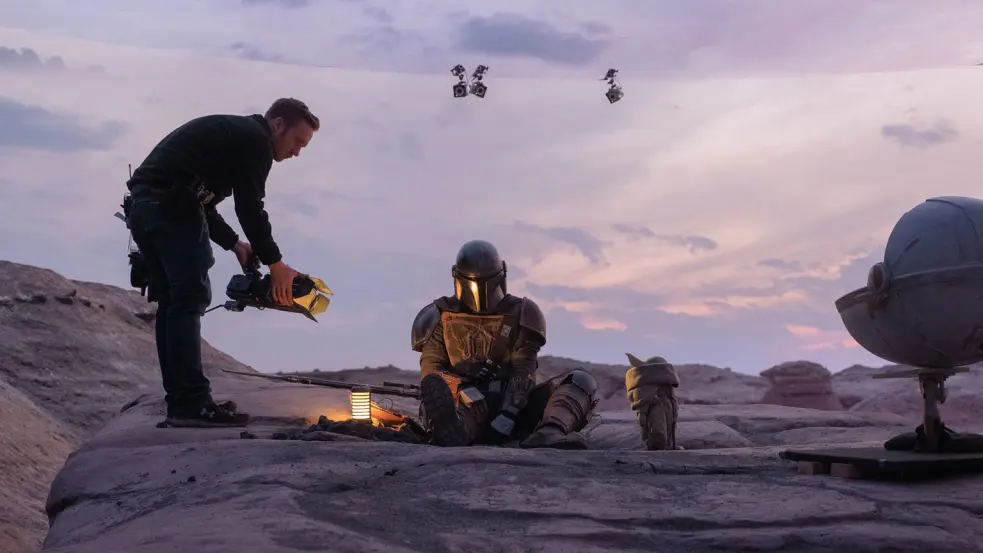
I'll let you guess what's real and what's projected. All Right Reserved to Disney.
Even if green screens are still widely used in the majority of movies, tv shows and even weather and news casts, the future of compositing, set extension and background enhancement is not necessarily blue or green. Machine learning, augmented reality and technology that might not even exist yet will keep making the post production work easier and easier while reducing travel costs and putting the actors in a more immersive environment.
Until next time, stay creative! See you!
---
Any kind of support, even a simple "like", is truly appreciated and helps me grow and create more quality content for you to enjoy.
Buy Me A Coffee: https://www.buymeacoffee.com/piliz
Youtube: https://www.youtube.com/c/PierreLizetVideo
Twitter: https://twitter.com/PierreLizet
Instagram: https://www.instagram.com/pierre__lizet
Enjoy one free random stock (no deposit required) by signing up here: https://join.robinhood.com/nathaln-81f11a
And if you are new to Publish0x, it is a blogging platform where you get paid for reading articles! You can join using this link to support me: https://www.publish0x.com?a=Vyb8NjLevA
Thumbnail credits: Photo by Dane Kelly on Unsplash