
The digital asset has accumulated a price drop of nearly 22% in the last quarter of 2025
This year, the Christmas rally didn't materialize for Bitcoin (BTC). Instead of gifts, Bitcoiners found coal under the tree, with the market closing the year down and far from the usual bullish expectations for this time of year. At the time of publication, the price of Bitcoin is $88,000, 30% below its all-time high (ATH) of $126,100.
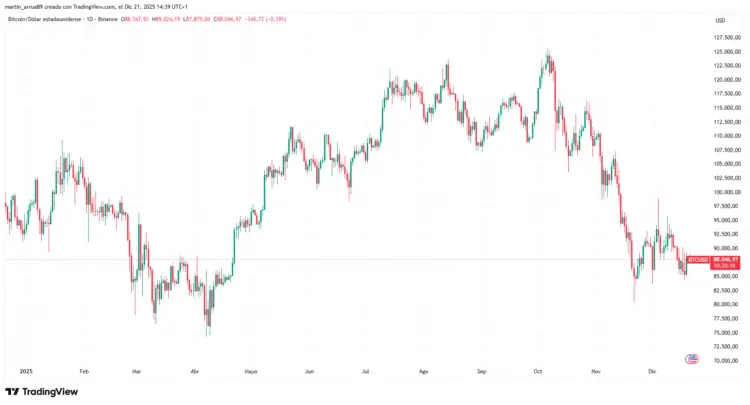
The end-of-year holidays typically coincide with periods of upward momentum for Bitcoin, a pattern that fueled the idea of a "Christmas rally" for years. However, 2025 breaks with this trend. The digital asset is experiencing one of its worst quarters in history (September, October, November, and December), with a cumulative drop of nearly 22.06%.
If 2025 ends this way, it would be the second-worst year-end for BTC, surpassed only by 2018, when the price plummeted by 42.16%. Now, it's worth asking what's behind this drop. At the beginning of October, BTC surpassed the $126,000 mark for the first time in its history.
At that time, the market was buzzing with enthusiasm, with growing expectations that the asset could advance toward the $130,000 mark. However, on October 10, the market reacted sharply to a new point of tension between the United States and China, triggering a steep drop in prices. That day, President Donald Trump used his account on Truth Social to warn that his administration was considering imposing a “massive increase in tariffs” on Chinese goods. The message was enough to reignite fears of a new escalation in the trade war between the world’s two largest economies and severely dampen investor sentiment.
That episode marked a turning point for the market. Geopolitical noise emerged at a time of demanding valuations and with much of the optimism already priced in. This weakened confidence and left BTC without room to sustain the upward momentum that typically characterizes the final stretch of the year, giving way to a more cautious scenario and profit-taking. An event expected to act as a catalyst for the market was an interest rate cut by the US Federal Reserve (Fed). On December 10, the Federal Open Market Committee (FOMC) met, defining the monetary policy of the world's leading financial power.
As anticipated by the markets, the Federal Reserve, chaired by Jerome Powell, cut interest rates by 25 basis points. Historically, this type of decision tends to stimulate risk appetite, as it lowers the cost of borrowing and encourages liquidity to flow into financial markets. However, this time the cut wasn't enough to reignite the euphoria. Risk appetite didn't return, and assets considered risky, such as Bitcoin and cryptocurrencies, failed to capitalize on the measure. This Bitcoin correction reflects a shift in market sentiment. After reaching all-time highs in early October, the momentum faded, giving way to a dynamic of profit-taking and caution, with investors less willing to take risks in the absence of clear new bullish signals. But neither expectations of a seasonal rally nor the Fed's rate cut managed to reverse this trend.
With the euphoria out of the picture, BTC navigated the end of 2025 in defensive mode, delivering one of its worst performances in the final stretch of the year and breaking, once again, with the narrative of the Christmas rally.






