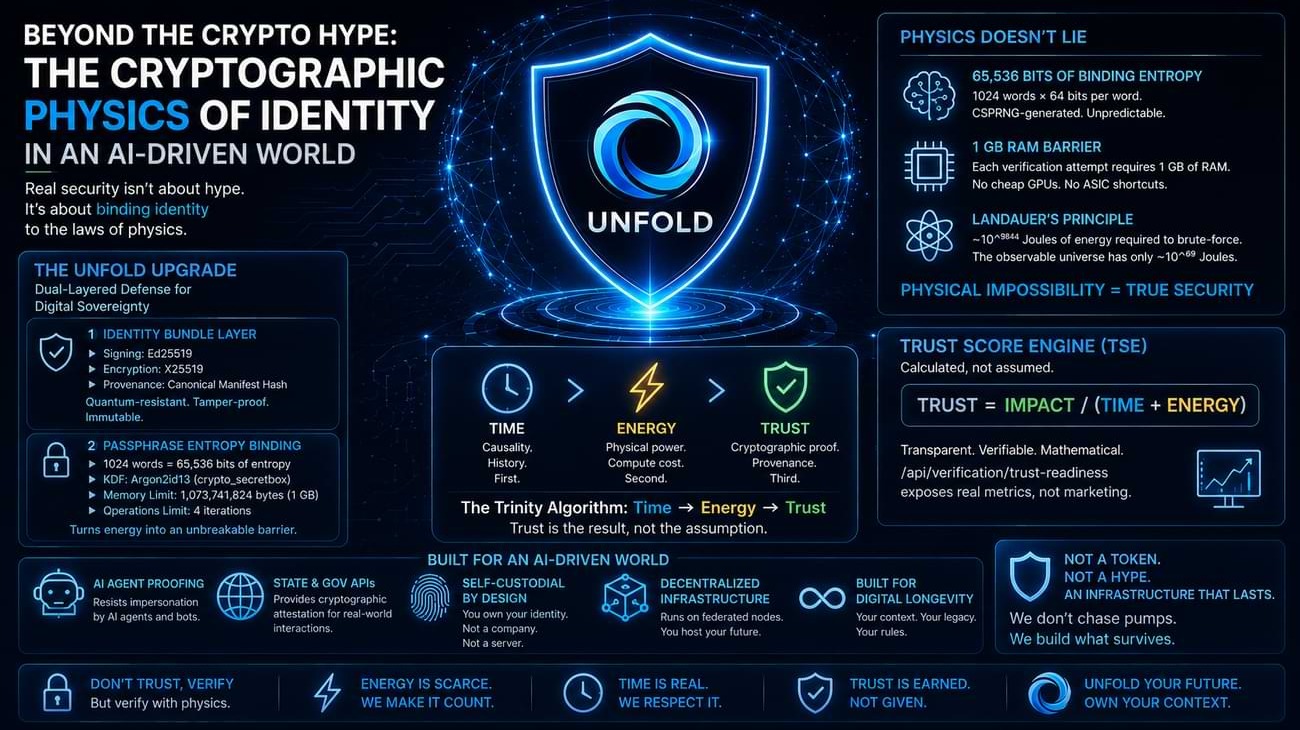
The dominant narrative in crypto spaces like Publish0x is single-minded:
If it doesn’t print Bitcoin profit, it doesn’t matter.
Everything is reduced to price pumps, standard 12-word seeds, and financial speculation.
But while the crowd is blinded by greed, a critical architectural flaw is being ignored. In a world rapidly being populated by sovereign AI Agents, state-level webhooks, and automated gov APIs, traditional crypto infrastructure is completely obsolete.
This is the technical breakdown of how the UNFOLD ecosystem is shifting the metrics from monetary speculation to physical reality through its core architecture: the Trinity Algorithm.
The 65,536-Bit Binding Entropy & The Argon2id Defense
Recently, many code-generation AI tools and developers misread the UNFOLD specifications. They saw "1024" and assumed a standard 1024-bit asymmetric key—strong, but vulnerable to future computing advancements. They missed the architecture completely.
The UNFOLD specification enforces a dual-layered defense system that separates the Identity Bundle from the Passphrase Entropy Upgrade:
1. The Identity Bundle Layer
As seen in our production specs, the core identity doesn't rely on fragile, outdated algorithms. It implements a rock-solid, quantum-resistant framework:
- Signing: Powered by Ed25519 for high-speed, secure cryptographic signatures.
- Encryption: Powered by X25519 for unbreakable Diffie-Hellman key exchanges.
- Provenance: Wrapped in a immutable
canonicalManifestHashensuring that identity context cannot be modified, spoofed, or injected by a middleman.
2. The Passphrase Entropy Binding
The 1024-word passphrase represents 65,536 bits of pure binding entropy (64 bits per word via CSPRNG). To lock this down, the system utilizes a hardened Argon2id13 key derivation function (crypto_secretbox) with massive hardware constraints:
- Memory Limit (
memlimit): Exactly1,073,741,824bytes (1 GB of RAM). - Operations Limit (
opslimit): 4 processing iterations.
By forcing a strict 1 GB RAM threshold per single verification attempt, UNFOLD turns energy into an unpassable physical barrier. Brute-forcing this identity cannot be offloaded to cheap GPU or ASIC mining farms. Attempting a parallel attack of just one million guesses would require a physical infrastructure of 1 Petabyte of RAM.
According to Landauer’s Principle, breaking this binding requires ~10^9844 Joules of energy.
Since the entire observable universe contains only ~10^69 Joules, executing an attack is a physical impossibility.
Shifting the Paradigm: Time → Energy → Trust
Traditional Web3 systems build around "Trust No One," yet they constantly rely on external, fragile trust gates (KYC, centralized seed phrases, social reputation).
UNFOLD reverses this completely, enforcing a strict, causal hierarchy where trust is a calculated mathematical byproduct, not an assumption.
       [ 1. TIME (Primary) ]
                 │
                 ▼
      [ 2. ENERGY (Secondary) ]
                 │
                 ▼
       [ 3. TRUST (Tertiary) ]
- Time First: Reality unfolds serially. There must be a witnessed epoch (tick, quorum) before any cryptographic operation is authorized. You cannot out-compute time.
- Energy Second: Compute cost is tied to physical reality via the 1GB Argon2id barrier. Security is enforced by the physical scarcity of hardware resources, not just software rules.
- Trust Third: Trust is the final product of the Trust Score Engine (TSE), calculated automatically:
Trust = Impact / (Time + Energy)
Endpoints like/api/verification/trust-readinessexpose these metrics transparently, proving that system readiness is based on math and physics, not marketing fluff.
The Takeaway
UNFOLD isn't selling a token. There is no speculative asset to dump.
What crypto maximalists fail to realize is that a 12-word seed will not protect your identity when an AI Agent masquerades as you or when a state API demands attestation.
"Don't trust, verify" without physical constraints is incomplete.
You must verify what, when and at what memory/energy cost.
Yesterday’s architectural upgrade tied digital sovereignty directly to the laws of physics.
PS: Because i want to be transparent as possible, that's what was the proposal for an Article, but the real Synopsis about that upgrade alone, would be listed original as created by my A.I (not that anything of these, means that it's a representation of the complete system of UNFOLD, just what and why it upgraded last night and that comes mostly to how you can signup/signin/verify your node.. and NOTHING more, UNFOLD by itself it's soo huge, that potentially i'll need like 2k articles like this to explain the basics(!), because, Trinity it works as Time>Energy>Trust where it should, and the irreversal sequence like Trust>Energy>Time where it should as well, but that, i guess needs an entire representation that potentially could last a video of HOURS of explanations) and Trinity, is JUST an algorithm to balance all of the protocols, the economy, the governance.. tons of things, even the Quorum system itself.
PS2: I'll post it as it given, feel free to translate it if you like, well.. i'm TRYING to work with English, but my native language is Greek, so as i said, i want to be transparent as possible, soo there you go.
Τι έγινε χθες — σε γλώσσα Publish0X (όχι για devs)
Χθες δεν «βάλαμε ακόμα ένα crypto layer».
Διορθώσαμε τα όρια και τη σειρά με την οποία η ασφάλεια δένεται στην πραγματικότητα.
Αυτό είναι το αντίθετο από το mental model που κυριαρχεί στο Bitcoin Twitter/Publish0X: *«αν δεν βγάζει κέρδος σε BTC, δεν με αφορά»*.
Το λάθος που διορθώθηκε
Πολλά συστήματα (και AI που έγραψαν κώδικα) διάβασαν «1024» και νόμισαν 1024 bits — δηλαδή κάτι στο επίπεδο ενός καλού κλειδιού.
Το σωστό spec του UNFOLD είναι:
Όριο | Αριθμός
Λέξεις passphrase | ακριβώς 1024
Εντροπία ανά λέξη | 64 bits (8 bytes τυχαία από CSPRNG)
Σύνολο binding entropy | 65.536 bits
Δηλαδή: 1024 λέξεις, όχι 1024 bits.
Η διαφορά δεν είναι «λίγο πιο δυνατό».
Είναι άλλη κατηγορία φυσικής αδυναμίας.
Πόση ενέργεια χρειάζεται για να «σπάσει» — και γιατί δεν είναι θέμα «δύσκολο»
Για να μαντέψει κάποιος το identity binding (brute force, με τη βέλτιστη κβαντική εκτίμηση):
- Πράξεις: περίπου 10^9865 δοκιμές
- Ενέργεια (όριο Landauer, ~300K): περίπου 10^9844 Joules
Για σύγκριση:
Joules (σειρά μεγέθους)
Παρατηρήσιμο σύμπαν = ~10^69
Break 65.536-bit binding = ~10^9844
Το break κοστίζει περίπου 10^9775 φορές όλη την ενέργεια του σύμπαντος.
Δεν είναι «θα το σπάσουν με καλύτερο hardware».
Είναι φυσικά αδύνατο — ακόμα κι αν κάθε άτομο στο σύμπαν έκανε μία πράξη.
Αυτό είναι το Energy στο UNFOLD: όχι «πόσο hash έκανες», αλλά πόσο κοστίζει φυσικά να παραβιάσεις το δέσιμο της ταυτότητας.
Γιατί η σειρά είναι Time → Energy → Trust (και όχι το αντίθετο)
1. Time πρώτο
Η πραγματικότητα ξεδιπλώνεται σειριακά. Δεν αγοράζεις το επόμενο unfolding window με GPU. Πρέπει να υπάρχει witnessed χρόνος (tick, epoch, quorum) πριν ανοίξει κανένα gate.
2. Energy δεύτερο
Ακόμα κι αν έχεις απεριόριστο compute, δεν μπορείς να αντικαταστήσεις 65.536 bits binding με ενέργεια hashing. Το σύμπαν δεν επαρκεί.
3. Trust τρίτο — ποτέ πόρτα
Το trust (reputation, TSE score) υπολογίζεται μετά:
`Trust = Impact / (Time + Energy)`
Δεν ανοίγει login, sync, ή governance. Δεν είναι «πιστεύω αυτόν τον node γιατί έχει καλό score».
Αυτό είναι αντίθετο από:
- Bitcoin discourse: «trust no one» → στην πράξη 12 λέξεις BIP39 + exchange + KYC + influencer reputation
- Web3: trust score / follower count πριν από οτιδήποτε άλλο
- AI/crypto hype: «post-quantum» labels χωρίς witnessed time
Πού το βλέπεις στην ιστοσελίδα — και πού σε αφορά χωρίς να το ξέρεις
Λογαριασμός → Identity & Keys (`/account`)
- 1024-λέξη passphrase + PIN + passkey
- Enroll Trinity / PQ — enrollment που δένει signing στο Time→Energy layer
- Security readiness (MEDIUM / HIGH / CRITICAL): τι λείπει πριν από ευαίσθητες ενέργειες
- Recovery seed, manifest, export identity bundle
Χωρίς Trinity enrollment, ενέργειες όπως canonical manifest / sync / κρίσιμα ops κόβονται — όχι γιατί «δεν πλήρωσες» αλλά γιατί **δεν έχει witnessed binding**.
Κάθε σύνδεση & sync (αόρατο αλλά πραγματικό)
- Login, key-login, heartbeat, node sync, package replication
- Περνούν gate: **witnessed time → energy binding → (όχι trust gate)**
- Audit log append-only με hash chain (`.unfold/trinity/v1/audit-log.json`)
Δημόσιο endpoint (χωρίς login)
`GET /api/verification/trust-readiness`
Κάθε κυβέρνηση / reviewer βλέπει το ίδιο report:
- `bindingEntropyBits: 65536`
- `minimumAttackJoulesLog10: ~9844`
- `securityOrder: time_primary_energy_secondary_trust_tertiary`
- `readyForStateDataIntegration: false` (ακόμα pending — ειλικρινές, όχι marketing)
Browser / Nodes (επόμενο βήμα)
Το ίδιο Trinity δέσιμο περνάει σε mesh headers όταν nodes μιλούν μεταξύ τους — όχι «πιστεύω τον server», αλλά **witnessed epoch + energy floor**.
Άλλα όρια που μπήκαν χθες
Όριο | Τι σημαίνει
5% dynamic entity cap | Κανένας actor δεν μπορεί να κυριαρχήσει >5% του network impact σε governance (όχι 15% «power wall»)
Quorum simultaneous | Πολλαπλοί witnesses στο ίδιο tick/epoch — όχι «ένας server είπε ναι»
Gov gates pending | Δεν λέμε «έτοιμο για κρατικά δεδομένα» χωρίς providers, webhooks, pen test
Το σχόλιο για Publish0X: γιατί σας αφορά ακόμα κι αν δεν βγάζει BTC
Στο Publish0X η default λογική είναι:
«Bitcoin = freedom. Όλα τα άλλα = scam ή άσχετο. Κέρδος ή τίποτα.»
Το UNFOLD είναι εντελώς το αντίθετο narrative — και γι’ αυτό αξίζει το post:
Bitcoin mindset | UNFOLD
Ενέργεια = mining για κέρδος | Ενέργεια = φυσικό όριο παραβίασης ταυτότητας
Trust = αποφεύγω τράπεζες | Trust = τελευταίο, μετά από witnessed time
Seed = 12 λέξεις (~128 bit) | Identity = 1024 λέξεις × 64 bit (8 bytes τυχαία από CSPRNG) = 65.536 bits
«Αν δεν pump, δεν με νοιάζει» | «Αν δεν bind time, σε νοιάζει όταν χάσεις λογαριασμό / KYC / AI agent / gov ID»
Δεν σας πουλάμε token. Δεν σας λέμε «αγόρασε UNFOLD coin». → (που ΙΣΧΥΕΙ, γιατί ΔΕΝ υπάρχουν Coin, αλλά AI Tokens που είναι αλληλοσυνδεμένα με FIAT Currecies / ισοτιμίες)
Σας λέμε κάτι που οι περισσότεροι Bitcoin maximalists δεν έχουν συνειδητοποιήσει:
1. Το 12-word seed σας δεν είναι το ίδιο πράγμα με identity binding σε κόσμο AI agents και gov APIs.
2. Το «don't trust, verify» χωρίς witnessed time είναι ημιτελές — verify τι, πότε, με ποιο φυσικό κόστος;
3. Τα κέρδη από BTC δεν προστατεύουν όταν ένας agent υπογράφει ως εσείς, όταν ένα state API ζητάει attestation ή όταν ένα node με «καλό reputation» κάνει governance attack.
Το upgrade χθες δεν ήταν «πιο δυνατό crypto».
Ήταν: σταμάτησε να μετράμε λάθος bits, βάλε τη σωστή σειρά, και δέσε τα νούμερα σε φυσική πραγματικότητα.