
The throne of the Store of Value only admits one King. And while the future holds a fall, it may be further away than we expect.
Not since World War II have there been as many armed conflicts in the world as there are now. There have been 61 armed conflicts involving at least one nation-state, the highest number since 1946, for 79 years. Of these 61, at least 11 reached the status of war, defined as a conflict causing at least 1,000 battle-related deaths. In other words, we are living in the most fearful and uncertain times of the last eight decades.
Given this reality, it's no surprise that gold is not only at all-time highs, but growing parabolically. So far in 2025, the price of gold has risen 60%, to $4,250. We're talking about gold, not a tech stock or some small-cap instrument, but a $30 trillion behemoth. Even Bitcoin, with its much-maligned volatility, has risen only 5% more than gold in 2025.
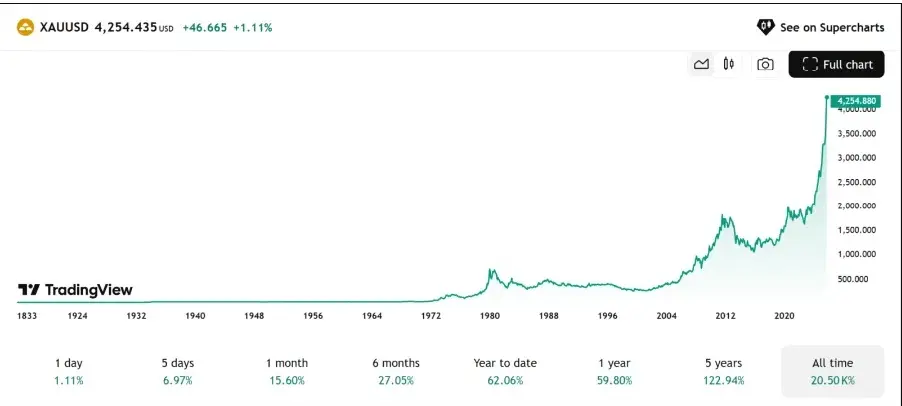
Given the context of global uncertainty, which includes not only wars but has also been shaken by Trump's tariff war, especially those concerning his relationship with China, expectations of interest rate cuts amid the growing fiscal deficit, and the US government shutdown, the current demand for gold is not surprising. Faced with a 10% drop in the value of the dollar, Ken Griffin, CEO of Citadel, one of the world's most profitable hedge funds, says that "capital is moving to de-dollarize and reduce US risk exposure."
In the first half of 2025, central banks around the world purchased 415 tons of gold, with Poland, China, and Turkey leading the list of buyers. But investment demand, both through ETFs and bars and coins, exceeds central bank purchases by nearly 1,000 tons, noting that institutions and retailers are the most interested in turning to the precious metal as a refuge from uncertainty.
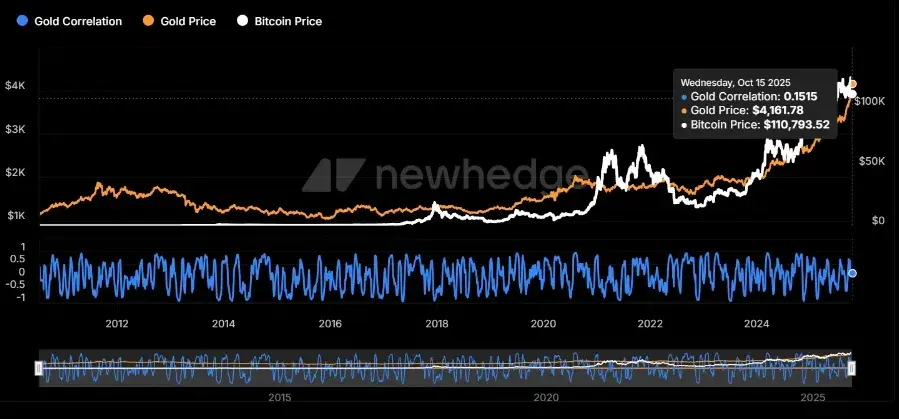
If we look at the comparative graph between gold and bitcoin (BTC), we can see that, although the correlation between the two has historically been low, right now, at this time of global uncertainty, they seem to be getting closer. However, the time is still too short to talk about them being correlated.
For years, but reaffirmed by the largest dollar printing in history during the COVID-19 pandemic, the dominant narrative surrounding Bitcoin has been that it is a store of value and a refuge against inflation, possessing monetary qualities similar to gold. And it is with this perspective that institutional investors have positioned Bitcoin as an asset to hold for the long term.
The world's largest asset manager, BlackRock, has said that Bitcoin is a "hedge against risks that traditional assets cannot address, particularly in times of heightened geopolitical and economic uncertainty," while its CEO, Larry Fink, has pointed out that "Bitcoin is an instrument you invest in when you are most afraid."
But BlackRock hasn't been alone. Fidelity, an asset manager with over $15 trillion in AUM, has called it "exponential gold." VanEck, a pioneering global asset manager in emerging markets, has projected it to become a global reserve asset. Ray Dalio of Bridgewater Associates, a hedge fund whose flagship fund manages $92 billion, places it on par with gold compared to debt assets. Cantor Fitzgerald, a leading institutional brokerage firm with $16 billion in AUM, has also said that bitcoin should be treated like gold. Deutsche Bank, one of Europe's largest banks; Paul Tudor Jones, the legendary fund manager; Stanley Druckenmiller, an investor renowned for his success in global macro strategies; even the U.S. Treasury Department has called it digital gold.
While all these big names fill the headlines with praise for Bitcoin, it's often overlooked that they still represent a relatively small percentage of the market, and that there's still another large—perhaps even larger—segment that still views Bitcoin as a risky asset. This is borne out by the growing correlation between BTC and the S&P 500, which has remained high since September 2024.
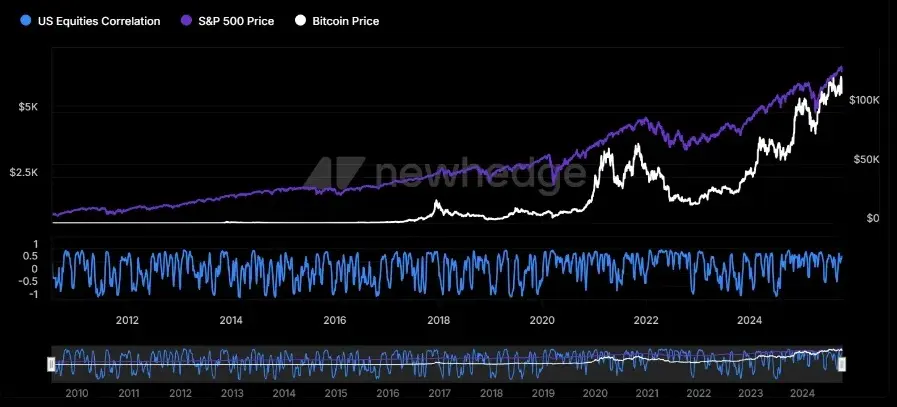
Bitcoin finds itself in this hybrid or transitional status: halfway between a risk asset and a safe haven asset. And gold's movements could be decisive in determining how BTC consolidates in the near future.
For the largest US bank, JP Morgan, bitcoin and gold are in a zero-sum competition to lead in what they describe as "depreciation trading," an investment strategy to protect or profit in times of economic uncertainty.
In this scenario, JP Morgan projected that BTC would take the lead. "We anticipate the zero-sum competition between gold and bitcoin to extend into the remainder of the year, but we believe that catalysts specific to the digital asset will generate greater upside potential for bitcoin versus gold in the second half of the year," the analysts stated.
VanEck shares this opinion, arguing that Bitcoin's intrinsic characteristics, coupled with growing institutional and technological adoption, reinforce its long-term potential compared to the precious metal. And beyond the conceptual, the firm asserts that its clients are more interested in Bitcoin than in gold.
However, much of this demand may stem from speculative appetite rather than a search for safe haven, and although it may seem like a minor, merely narrative nuance, in uncertain times like the current one, where fear leads to greater investment caution, it can be decisive when deciding where to place money.
Although the price of Bitcoin has grown slightly more than that of gold, percentage-wise, by 2025, we must consider that there is a difference of USD 28 trillion between the capitalization of gold and Bitcoin. In other words, the capitalization of gold is thirteen times greater than that of Bitcoin. Therefore, much more money is required to move its price.
To compare how much money has flowed into each of these instruments, it seems fair to use ETFs, which, while not the only investment vehicle, are a metric where they share similar ground. While Bitcoin ETFs have invested $30 billion by 2025, gold ETFs have invested $64 billion, more than double that amount.
Although this is a limited comparison, it shows that gold continues to beat Bitcoin in investment volume in this race to become the dominant store of value. In other words, much of the money expected to flow into Bitcoin is actually flowing into gold.
However, another way of looking at it is that, if Bitcoin didn't exist, the inflow into gold would be much greater. This is the first time in modern history that gold has a competitor as a store of value, and in just 16 years of existence, it has stolen nearly half of the investment volume from an asset that has served as a store of value for millennia.
And just as this is the first time gold competes with another instrument during its boom phase, it will also be the first time it competes against another instrument in its bust phase. Because that's how all markets work. Prices are a mechanism for social coordination, but they're also a thermometer of public opinion. When you're in the middle of a storm, seeking to hedge, you calculate the worst-case scenario, which can overestimate prices. When the storm passes, it's normal for the thermometer to readjust, once the fever has passed.
After Richard Nixon broke the gold standard, in the context of the Vietnam War, the price of gold soared for the first time due to the great uncertainty surrounding it, and other assets fell. Later, in the 1980s, Fed Chairman Paul Volker raised interest rates to 20%, managed to lower inflation, the dollar became attractive again, and the price of gold fell.
The price of gold remained low and relatively stable throughout the 1980s and 1990s. There was prosperity with the tech boom, confidence, and no need for a safe haven. In the 2000s, the dot-com bubble burst, the attack on the Twin Towers, and the subprime crisis occurred, and large amounts of money began to be issued to save banks and alleviate the crisis. In this new moment of uncertainty, gold reached a new all-time high.
Later, between 2012 and 2018, with a little more economic stability around the world, interest in gold and its price fell again; stocks rose, and the dollar strengthened.
Before the current parabolic growth, gold had already reached an all-time high during the COVID crisis, thanks to the inflationary context resulting from the massive monetary issuance, which has increased distrust in the dollar. Furthermore, the dollar has been used to sanction enemy countries, which has increased the need to seek alternative instruments for dissident countries.
While we know that, like all crises in history, this one too will pass, we cannot know what phase of the crisis we are in. Therefore, we do not know how long the need for store-of-value assets will last. Some believe, like Credit Suisse analyst Zoltan Pozsar, that we are entering a new monetary order, which represents a more profound and, probably, more prolonged change than the crises mentioned in the previous paragraphs.
In any case, as long as global uncertainty persists, this battle between gold and Bitcoin to become the dominant store of value will continue. But this publication believes that, once the storm calms and the gold bubble bursts, Bitcoin will be the biggest beneficiary.
As we have seen, despite the large amount of money issued in recent years, money is not infinite; resources are limited, and investors are forced to decide where to place it. Until now, when the need has been to store value, more money has been chosen to place gold than Bitcoin. In the short term, at this transitional moment in the Bitcoin narrative, this may seem rational, but the long-term opportunity cost likely benefits the segment of investors who decided to position themselves in Bitcoin rather than gold.
Already, Bitcoin is experiencing one of the most unpredictable moments in its history. The entry of new players such as ETF managers, corporate treasuries, and even a few nation-states, whose outlook is largely focused on long-term accumulation of as much of the supply as possible, has cast doubt on the continuation of the four-year boom-bust cycles we've become accustomed to with each halving, or at least a reduction in the intensity of these moments.
This would lead to greater stability in Bitcoin's price, reinforcing its transition away from a risk asset and toward a store of value. In this scenario, and given a backdrop of economic stability and geopolitical certainty, there will no longer be an appetite for gold, but Bitcoin will continue in its adoption phase, reaching the hands of investors with increasingly deeper pockets, such as states.
But this isn't the reality right now. Gold remains the dominant store of value because it has something Bitcoin can't compete with: millennia of history as money. The Lindy Effect, in the words of the philosopher Nassim Nicholas Taleb. And while Bitcoin may surpass it in monetary qualities like programmability, portability, divisibility, verifiability, and custody, it remains in that hybrid form in the eyes of the public and the market, still perceived more as a risk asset than a store of value.
For now, tradition is winning, but it will likely be the more advanced monetary technology that will win in the long run, when we see further demonetization of gold in favor of Bitcoin, with more individuals, companies, and states participating in this transition.






