
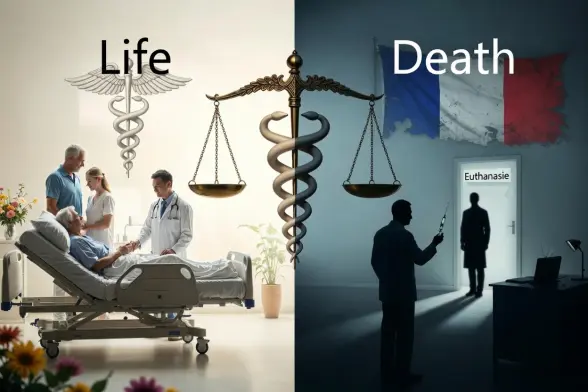
Euthanasia is presented to us as the achievement of a new right: the ‘right to die with dignity’. But a right that can only be realised through the intervention of the public authorities, and which must be protected by making obstruction a criminal offence, is not a right. It is a false right. The most pronounced symptom of ‘human rights fundamentalism’. And behind the rhetoric of compassion lies a very real operation: transforming suicide into a public service, managed, funded and soon to be recommended by the state.
The crucial question: what is a true right?
The debate on euthanasia is almost always framed as a debate between compassion and cruelty. This is a misguided framing. The real question is philosophical, and it comes first: what is a right?
Let us follow Murray Rothbard and the tradition of natural law here. A genuine right is a negative right: it requires nothing more from others than abstention. My right to life ensures that no one will kill me; it does not compel anyone to feed me. My freedom of expression obliges others not to gag me; it does not oblige anyone to publish my work. These rights all stem from self-ownership: I am the owner of my body, so no one may dispose of it without my consent.
The criterion is crystal clear. A true right can be exercised by everyone, at the same time, without taking anything away from anyone. It is realised through the silence and inaction of others.
Let us apply this criterion to suicide. Do I have the right to dispose of my own life? From the perspective of self-ownership, one can argue that I do. But then this right is already complete, and it needs no one else. Anyone who wishes to commit suicide will always have the means to do so. Suicide has never required the authorisation, assistance or funding of the state.
So where does euthanasia as a political demand come from? Precisely from the fact that we are not demanding the freedom to die – we already have that – but a service. We are demanding that society organise, fund and administer death. And this is where the right turns into its opposite.
From a negative right to a false positive right
For ‘medical assistance in dying’ is not a negative right. It is a claim right, a positive right. It does not require others to refrain from action: it requires them to act. It requires a doctor to administer the injection, public funds to pay for it, a bureaucracy to assess eligibility, and taxpayers to finance it. This is precisely the criticism Rothbard levelled at the Universal Declaration: that it had conflated genuine rights with pseudo-social rights, which can only be realised by imposing an obligation on third parties by force.
The socialist conception posits that ‘my freedom can only be realised through the intervention of society’. This then gives the National Health Service doctor the power of life and death over anyone who expresses the need for it, and creates an offence of obstructing euthanasia.
The offence of obstruction is the tell-tale sign. Think about it: an offence of obstruction is never created to protect a negative right. No one can ‘obstruct’ my freedom to remain silent or to stay at home. An offence of obstruction is created when one wishes to force the participation of those who refuse. The offence of obstruction is an admission that the so-called right does not stand on its own: one must break recalcitrant consciences to make it exist.
A right that can only be realised through the intervention of the state, and which must be defended by means of an offence of obstruction, is a false right. It is not a freedom that is being protected, but a service that is being imposed.
‘Human-rightsism’: death as a civil religion
This inversion has a name: ‘human rightsism’ – the transformation of human rights into a secular religion. Originally, human rights protected a people against their rulers. Turned on their head, they become a corrosive force: a factory churning out unlimited subjective rights, disconnected from any duty or social order.
State-sanctioned euthanasia is the perfect illustration of this. The individual’s subjective right to their own death becomes a claim on the entire community, which must now organise itself around the production of death. The Hippocratic Oath — ‘first, do no harm’ — is rewritten in an Orwellian sense: it is better to kill the patient. A form of ‘therapeutic nihilism’.
There is a humanist liberalism that frees us from tyranny by guaranteeing self-ownership; and a false, anti-humanist liberalism that claims to free us from reality itself—from biology, from finitude, from human nature. Euthanasia enshrined in law falls into the latter category. It is based on the idea that man has no nature: it is up to him to decide what he is, and therefore to decide on his own elimination. It stems from the same mindset as animalism or transhumanism. Once human nature is denied, nothing can stop ‘liberation’.
What do we really want?
Let us return to the original question: do we really want suicide to become a public service?
The traditional liberal position is neither cruelty nor obstinacy. It is a distinction. That the sovereign individual may, in the privacy of their conscience, dispose of their own life is one thing — and no state has ever been able to prevent this. For society to organise itself to administer that death, to fund it, to recommend it and to punish those who refuse it is quite another matter. It is not society’s role to manage the deaths of individuals.
The boundary is clear. The freedom to die needs no one. The ‘right’ to euthanasia, however, needs everyone — willingly or by force. The former is a freedom. The latter is power granted to the state over the lives of innocent people, disguised as compassion.
Conclusion
State-sanctioned euthanasia is not the culmination of human rights: it is a caricature of them. It transforms a negative liberty, which everyone already possesses, into a public service accompanied by a criminal offence for obstruction. Yet a right that requires the action of others, that conscripts the doctor and the taxpayer, that protects itself by penalising objectors, is not a right. It is a false right. Human rights activism in its purest form.
The real question, therefore, is not ‘do you have the right to die?’ – you have always had that right. It is: do you wish to hand over to a bureaucracy, whose every interest drives towards death, the power to decide which lives are no longer worth funding? A civilisation is recognised by the fact that it protects its weak rather than disposing of them.






