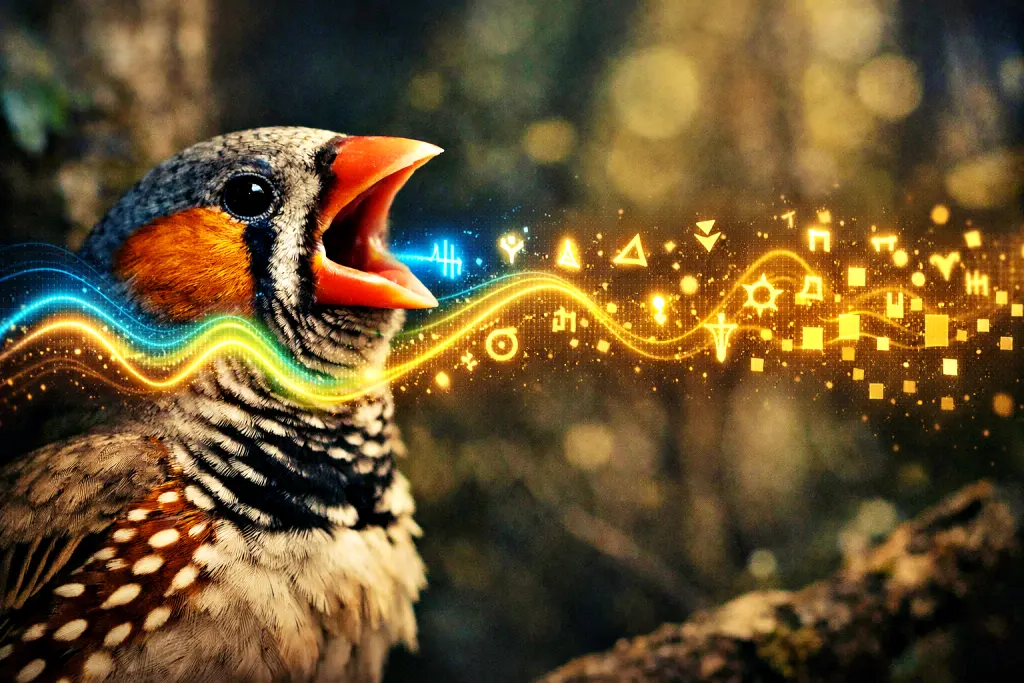
Research on bird communication has been around for a long time but what has changed recently is the scale of it.
In the past, scientists would spend hours listening to recordings and manually sorting bird sounds into rough categories. Things like this might be an alarm call or this seems social. It worked but it was limited by one simple fact: human hearing can only process so much data at once.
Now the situation is different.
Large datasets, thousands of hours of recordings from species like zebra finches are being analyzed using machine learning models.
These systems are not trying to understand sounds in a human sense.
Instead, they look for patterns that repeat across time and context.
It’s less about decoding meaning and more about figuring out when the sound shows up and what’s usually happening at that moment.
That shift might sound small but it changes the entire approach.
Because once you start looking at repetition at scale, patterns emerge that were invisible before. Certain calls consistently appear in specific social situations. Some sequences of sounds are repeatedly linked with movement, alarm responses or individual recognition.
But it is important not to jump too far ahead.
This does not mean birds have language in the human sense.
At the same time, it is also becoming harder to argue that their communication is just simple reflex noise with no structure at all.
The reality seems to sit somewhere in between.
What has changed most is not the birds themselves but the tools we use to study them.
Machine learning expands both the scale and sensitivity of analysis.
It allows researchers to process millions of data points and detect weak patterns that would otherwise be ignored or averaged out.
This is why the goal of current research is not to build a translation system for birdsong.
It is not about converting bird calls into human language.
It is about mapping relationships between sound and behavior.
For example, identifying how certain call types correlate with group movement or how individuals distinguish each other through vocal patterns.
At that point, the discussion shifts away from language and more toward structure.
Their sounds are proving to be more organized and more context-dependent than previously assumed.
And the real value of this research is not in finding a hidden language but in revealing that systems we once thought were simple may contain far more layers than expected!