I was planning on just taking a quick check of my USDC/ETH pool on Uniswap when I noticed that v3 has just been released.
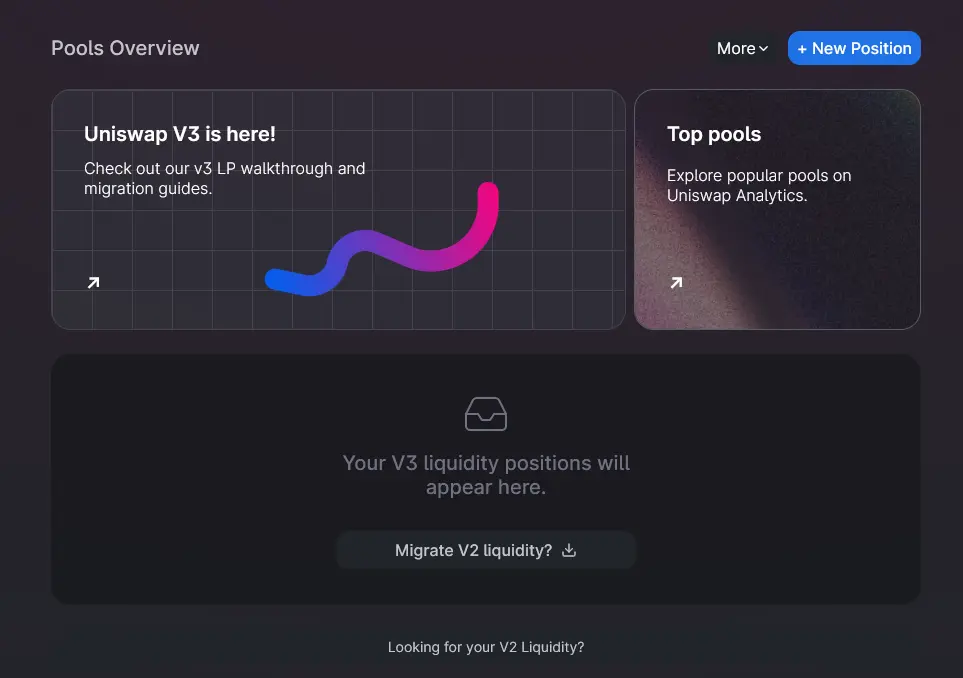
I'm not going into every new change or concept behind it in this post, for that I would suggest taking a look Uniswap's V3 documentation here, its worth the read. I will however briefly go over two of the new concepts present in V3: Pool Fees and Concentrated Liquidity.
Pool Fees
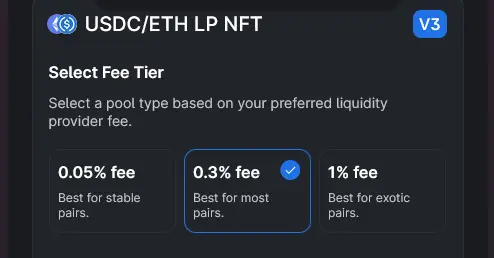
Whether you're migrating liquidity from V2 or adding liquidity to a pair for the first time, the first thing you will asked to do is to chose one of three pool for that pair based on the amount charged to those swapping that pair and from which you'll be earning your fees. The split pools allow those providing liquidity a way to balance their risk/reward when it comes to the assets they're putting up as well as potentially attracting more trades involving their assets by offering a less expensive swap. In this sense they could make up for low fee earnings per swap with volume.
The Uniswap team believes most assets will tend to gravitate toward specific fee tiers, but its certainly possible for there to be trade at various tiers as we can see below:

As we can see the 0.05% Fee pool for USDC/ETH has about 30% more TVL (total value locked) than the 1% pool, yet almost 10x the volume (for the record: the .3% pool of this same pair is current ranked #1 on V3 with just under $56 million locked and $47 million volume) because the system will automatically try to find the best rate when it comes to fees that will still fill your order, and may even recommend using a V2 liquidity pool if it would end up being more advantageous for your swap. In the example above the 1% USDC/ETH pool would only see activity if the 0.05% and 0.3% pools didn't have the liquidity at the current spot price to complete a swap, which brings us to Concentrated Liquidity.
Concentrated Liquidity
Once we have selected a pair and fee pool we want to add liquidity in, we'll need to chose a price range that we wish to provide liquidity within:
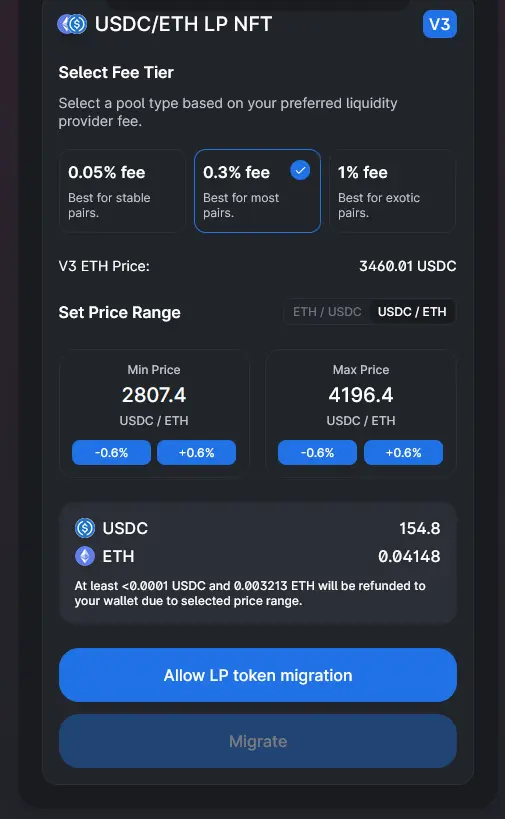
The idea with concentrated liquidity is that while pools in V2 could provide liquidity from 0 to infinity when it came to relative prices, most pairs are going to trade within a relatively small sized window. In such cases a lot of liquidity isn't even used as outflows of one half of the liquidity pair will be made up by demand for the other half of the pair as the spot exchange rate of the two assets slides up and down a certain range. For something like a dual stablecoin pairing you really only need a fraction of the liquidity you might see right now with other AMMs as their relative rates are so stable that the in and out flow of each half of the pair is almost perfectly balanced.
With concentrated liquidity, the liquidity provider is able to chose how large a range they wish to cover in terms of relative prices for pair which determines how much of each half of the pair they must provide. The smaller the range between the minimum and maximum price, the less assets the provider must commit to the pair and therefore raise their return on investment (ROI) if the relative price remains within the range they've set. However, if the price falls outside of their range then the provider would not earn any fees as they would at that point only have liquidity in one of the two assets in pair as the other would have been entirely traded out depending on if the minimum or maximum price was breached. With a larger range a liquidity provider would have to supply more of each asset but at the same time would be less likely to exhaust one side of their provided pair during normal market movements. In this case they could earn fees for longer without having to pull and resubmit liquidity pairs with new price ranges if the market for one of the two assets made a major move.
Now you might have noticed my set prices above are somewhat odd numbers. This is because in V3 the price range has been broken up into ticks.
These ticks break up the price curve of an asset, with each tick representing a .01% increase in price at any point of the curve. When adding a potential pairing you would select your price range based on these ticks while the system would attempted to fill a swap order using the liquidity provided within the tick pair that currently contains the spot price of the pairing and will attempt to fill the swap orders until all the liquidity from that area is going. Once that point is reached the system will look for the closest tick pair that will help complete the swap order at the best price available from the new bucket of liquidity between these ticks.
Now, I was hoping to show you how the new account section looks for providing liquidity by merging my V2 pool, but...
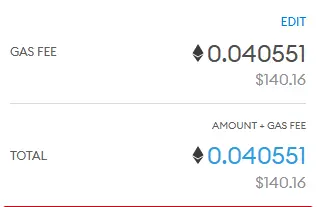
Still, I believe this is a very useful maturation of Uniswap's protocols and could become a standard for AMMs in good time. I'd like to know your thoughts on V3: Have you tried swapping with the new fee pools in play? How well did your migration go? Leave a comment below and let me know your thoughts on this or what you'd like me to cover next.
--------------------------------------------------------------------------------------------------------------------------------------------------------------------
Looking for good faucets to help stack satoshis? Check out Cointiply, Fire Faucet, and Pipeflare. Each have their own ways of earning bits of crypto, so there's a good chance at least one of them will fit your preferences.






