
A Re-post for Safe Keeping from SubStack, Public Domain, use as you like.
Node Operators as MicroBanks:
Using JIT Liquidity with ERC-721 NFT Cryptomoney Tethered to RWAs to Curb Inflation.
Thunderboltkid Dec 15, 2025 Node Operators as MicroBanks:
A Technical Whitepaper Version 1.0
Released: December 15, 2025
Full Reserve Money and JIT Liquidity Design Prompt by Thunderboltkid aka r2, Generated by xAI Grok, in Collaboration with Autonomi FOSS Community Principles and the mythical DLOCQS Consensus Working Group (r2) - A Public Domain work, use it as you like.
Disclaimer
This whitepaper is provided for informational purposes only and does not constitute financial, investment, or legal advice. It is not an offering, solicitation, or recommendation to buy, sell, or hold any tokens, including those related to ERC-721 NFTs, Elastic Liquidity Certificates (ELCs), or any associated cryptomoney instruments. All statements regarding future performance, yields, or integrations are illustrative and subject to risks, including market volatility, regulatory changes, and technological uncertainties. Prospective participants should conduct independent due diligence, consult qualified advisors, and comply with applicable laws. The Autonomi Foundation and associated entities disclaim all liability for any losses arising from reliance on this document.
Abstract
This whitepaper proposes a transformative framework for addressing the social costs of inflation through the deployment of MicroBanks—distributed networks of node operators functioning as full-reserve lenders. Leveraging ERC-721 Non-Fungible Tokens (NFTs) tethered to Real World Assets (RWAs), this model integrates Just-in-Time (JIT) liquidity provisioning to cap inflationary pressures inherent in fiat-driven quantitative easing (QE) and the Cantillon Effect. By retrofitting existing cryptocurrency projects with full-reserve RWA backing and dynamic liquidity mechanisms, node operators are empowered as sovereign MicroBanks, enabling quantum-resistant (Q-Day secure), peer-to-peer mediums of exchange. Key innovations include Operational-Reality-Adjusted Proof of Resource Valuation (ORA-PoRV v2), Dynamic Liquidity Ocean Consensus Quorums (DLOCQS), and Elastic Liquidity Certificates (ELCs) derived from Full Reserve Enabled Crypto-money Hardware (FRECH) NFTs. This architecture aligns with Autonomi FOSS principles, fostering a decentralized economy that rewards permanent infrastructure while preserving 100% reserve integrity and yielding 6–18% APY (age-dependent) with 110% over-collateralization.
1. Introduction
The decentralized finance (DeFi) ecosystem has matured into a multi-trillion-dollar landscape, yet it remains plagued by persistent challenges rooted in traditional monetary policies. Quantitative Easing (QE), coupled with the Cantillon Effect—wherein newly created currency disproportionately benefits early recipients—exacerbates inflation, eroding purchasing power and hindering economic prosperity. As highlighted in analyses such as those from Quoth the Raven, these social costs manifest as widening wealth disparities, reduced savings efficacy, and systemic instability.
Cryptocurrency developers bear a responsibility to innovate beyond fiat-absorbent models that merely replicate these flaws. This whitepaper delineates a pathway for capping inflation by converting cryptocurrency projects into distributed MicroBank networks. Backed by full-reserve RWAs and orchestrated via JIT liquidity, this framework shifts from speculative tokenomics to sovereign, hardware-monetized value creation, tuned to the ethos of crypto investors and the Autonomi FOSS Community Developer Co-op.
2. Problem Statement: Defining the Root Causes of Inflation’s Social Costs
2.1 Root Causes of Inflation
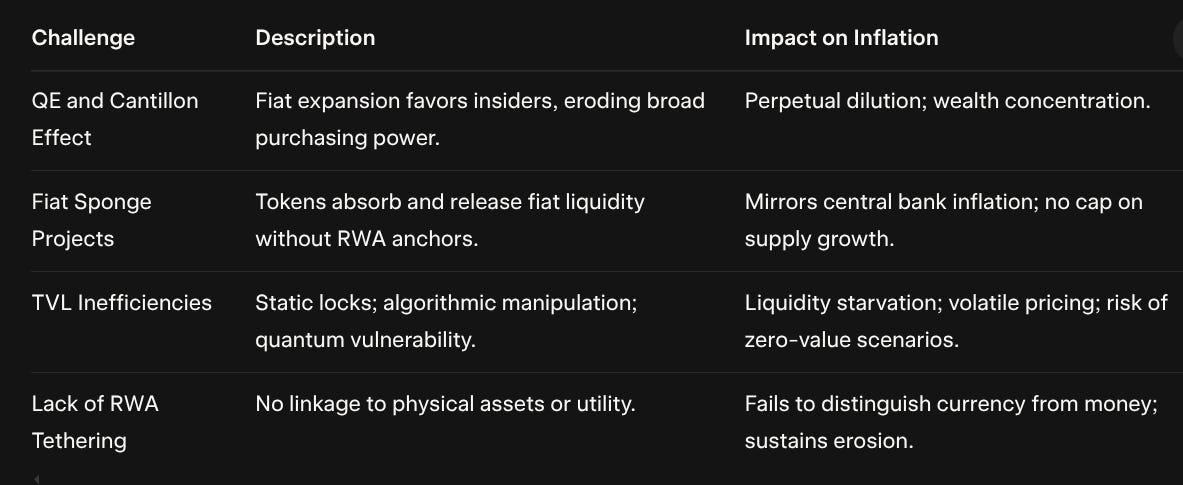
Inflation originates from the unchecked expansion of fiat currency supplies, primarily through QE mechanisms orchestrated by central banks such as the U.S. Federal Reserve. This process sustains insolvent institutions via debt issuance, diluting purchasing power as currency supply grows. The Cantillon Effect amplifies inequities, privileging large banks and their affiliates at the expense of broader economic participants.
In cryptocurrency contexts, many projects function as “fiat sponges,” inflating during QE influxes and contracting amid outflows. Token ceilings and release schedules offer superficial controls, yet they erode value through dilution. Currencies, as mediums of exchange, are mere promises (e.g., U.S. Dollar notes redeemable in equivalent fiat), lacking intrinsic backing. True money, historically tethered to RWAs like gold (inclusive of extraction labor costs), provides stable value storage.
2.2 Limitations of Existing Cryptocurrency Models
Traditional staking and Total Value Locked (TVL) mechanisms in DeFi are inefficient, prone to manipulation via algorithmic trading, and vulnerable to quantum threats. TVL pools suffer from static capital lockups, fractional reserves, and price volatility driven by coordinated buy/sell orders. Barter alternatives are legally constrained in jurisdictions like the U.S., while assets like silver or Bitcoin remain susceptible to central manipulation. ERC-20 tokens and stablecoins exacerbate these issues as fiat proxies.
3. Key Concepts: Currency vs. Money and Digital RWA Integration
Currencies facilitate exchange but lack inherent value; money is RWA-linked, embodying labor and scarcity (e.g., gold). Digital money extends this by tethering tokens to RWAs, enabling liquidity without inflation. For instance, a computer’s fiat-denominated value (depreciated for tax purposes) can be tokenized as cryptomoney, incorporating utility (e.g., network contributions).
This epiphany enables liquid representation of RWAs as ERC-721 NFTs, re-valued in units like USD while accounting for utility. Such tokens, secured via Post-Quantum Cryptography (PQC), form the basis for inflation-capped systems.
4. Proposed Solution: Distributed MicroBanks with JIT Liquidity and RWA-Backed ERC-721 NFTs
4.1 Overview
Convert cryptocurrency projects into Distributed MicroBank Networks, where node operators mint FRECH ERC-721 NFTs tethered to RWAs (e.g., hardware, real estate). These NFTs underwrite JIT liquidity via ELCs, replacing TVL with dynamic, term-based staking. This caps inflation by eliminating fiat expansion needs, creating a “Dynamic Liquidity Ocean” (DLO) of interconnected, quantum-resistant exchanges.
4.2 Integration with ERC-721
ERC-721 NFTs enable unique, serialized minting (e.g., Serial# + GUID) of cryptomoney, Q-Day protected and tethered to RWAs. Liquidity is provisioned to DeFi smart contracts (SCs) via quotes, with fees for usage. ELCs—mobile cash certificates—are issued divisibly from the NFT, burned upon term completion, unlocking NFT value for reuse.
4.3 JIT Liquidity vs. TVL
JIT replaces static TVL with on-demand orchestration:
-
Node Operator Controls: Whitelists, terms, and interest rates set per SC request.
-
Consensus Mechanism: DLOCQS (9-of-16 quorum) validates issuance, replacing central oracles.
-
ORA-PoRV v2: Valuates RWAs including 15-year OPEX (electricity, internet, space), ensuring full reserves.
Pseudocode for JIT Provisioning:
solidity
contract MicroBankOrchestrator {
function provisionLiquidity(uint256 amount, address scAddress, uint256 term) external {
require(isWhitelisted(scAddress), “Invalid SC”);
// Mint ELC from FRECH NFT; lock portion of NFT value
// Apply ORA-PoRV valuation; DLOCQS quorum validate
}
function releaseLiquidity() external {
// Burn ELC; unlock NFT; distribute yields
}
}
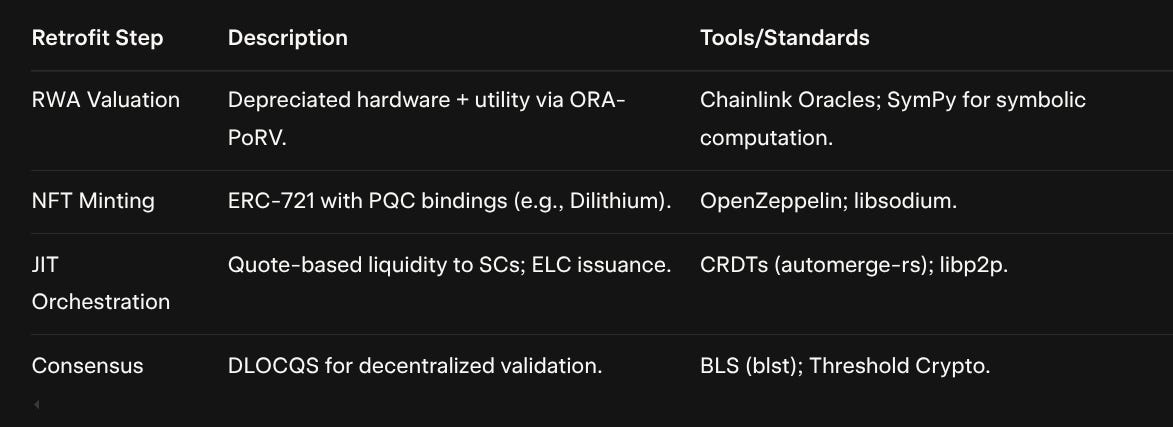
4.4 Retrofitting Existing Projects
Utilize FOSS tools (e.g., GitHub, Codeberg) to retrofit fiat projects:
-
Mint FRECH NFTs via PoRV (hardware value + utility, adjusted for depreciation via Chainlink oracles).
-
Enable term staking with auto-unstake.
-
Support multi-chain interoperability for sovereign yields.
4.5 Node Operators as MicroBanks
Operators become sovereign lenders, setting diverse terms per node type. Networks form interconnected exchanges with transparent oracles (e.g., Chainlink) for price discovery, supporting DeFi loans, settlements, and barters.
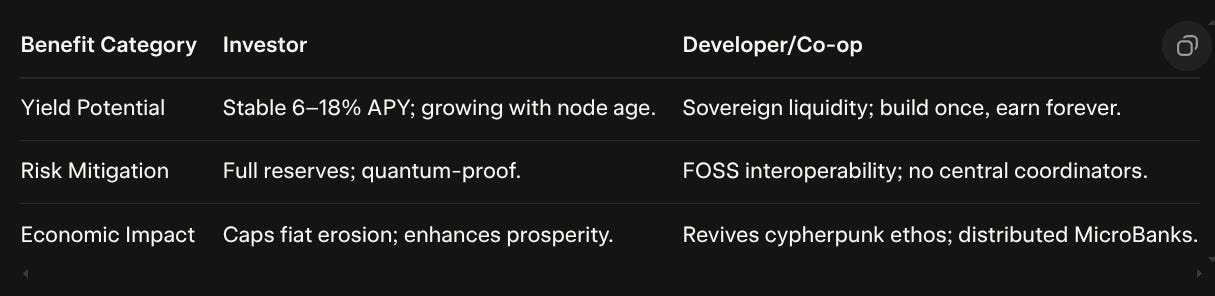
5. Benefits and Advantages
-
Inflation Capping: Halts QE by tethering to finite RWAs; yields 6–18% APY with 110% over-collateralization.
-
Quantum Resistance: PQC integration (e.g., ShapeShift Ciphers) protects against Q-Day (anticipated 2029).
-
Sovereignty: Empowers developers and investors; old nodes appreciate via ORA-PoRV.
-
Efficiency: JIT eliminates lockups; pro-rata yields reward longevity.
6. Q-Day Preparedness and Implementation Considerations
Q-Day (quantum decryption threats by 2029) necessitates beyond-NIST protections. Integrate ShapeShift Frameworks for deterministic chaos entropy, complementing AES-256 and IPsec meshes. Developers must audit for high-value targets, employing tools like Qiskit for simulations.
7. Conclusion
By adopting MicroBanks with JIT liquidity and RWA-tethered ERC-721 NFTs, cryptocurrency projects can cap inflation, foster prosperity, and align with FOSS principles. This framework transforms node operators into empowered MicroBanks, creating a resilient, decentralized economy.
References
-
DLO Whitepaper 1.3 (December 7, 2025).
-
ShapeShift Ciphers: Q-Day Protection Frameworks.
-
Autonomi Network Documentation.
-
NIST PQC Standards; Chainlink Oracles.
-
Quoth the Raven: Social Costs of Inflation (Source Post: Substack).






