
IOTA (MIOTA) has been one of the newer cryptocurrencies that have stood out because of its unique approach to the Internet of Things (IoT) by facilitating transactions between IoT devices. Currently, the #24 coin by market cap at the time of this writing, IOTA seems to have a lot of work ahead if they want to make it among the top-ranked coins by market cap.
What is IOTA?

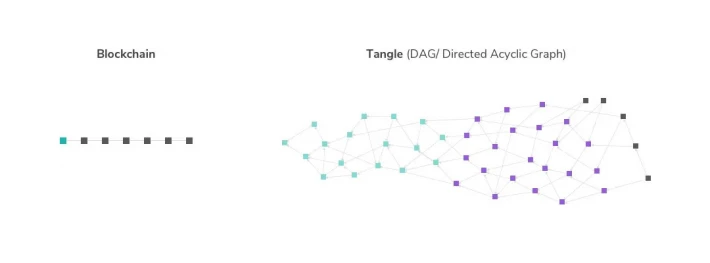
IOTA held their Initial Coin Offering (ICO) in 2015 and launched its mainnet back in July of 2016. Maintained by the IOTA Foundation, not only was their approach with the integration of IoT devices unique, but also the fact that they are a "block-less" blockchain. Yes, that is right. Despite being a public ledger, IOTA does not produce blocks and so there are no miners.
Devices on the IOTA network randomly verify each other's transactions and build consensus through the connections between transactions. So each new transaction confirms the 2 previous ones and uses an implementation of Directed Acyclic Graph (DAG) cryptography IOTA calls Tangle and is used differently compared to Ethereum's mining Ethash DAG. IOTA uses DAG for a way to store transactions with a relationship with each other and Ethash uses theirs as a dataset of values to be used for mining.
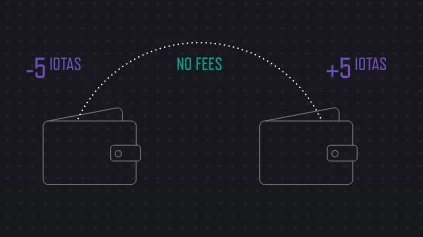
One key benefit from the design of Tangle is no transaction fees which in turn allows for micropayments on the IOTA network.
Another thing that differentiates IOTA from other cryptocurrencies is how they handle the 51% attack of the computing power being controlled by bad actors. Since IOTA uses Tangle for transaction verification, it is actually vulnerable to only a 34% attack where bad actors only need to gain control of 34% of the network nodes. To prevent this from happening, the IOTA Foundation runs a special node they call the Coordinator that directly or indirectly verifies transactions. The Coordinator is closed-source and the location of the node is not made publicly available. Eventually, the IOTA Foundation plans to remove the Coordinator once the network reaches a certain number of confirmed transactions per second.
Read the Whitepaper for more detailed information.
Growth
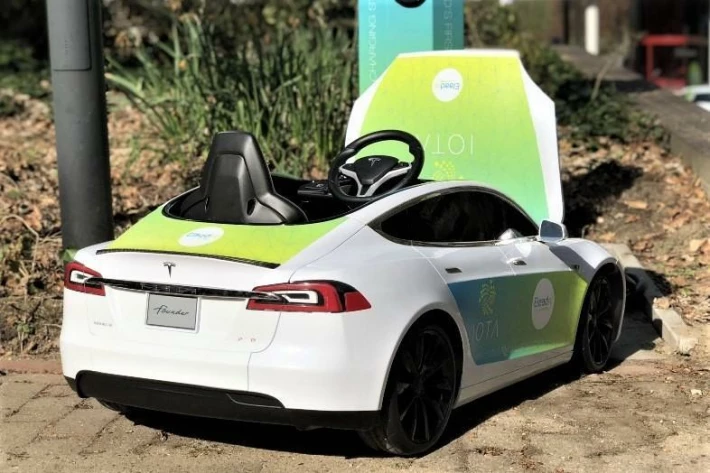
IOTA seen early growth as their technology was integrating on IoT devices. We even got to see a use case with electric vehicles (EVs) when IOTA release a charging station with one of their partnerships.
IOTA was seeing tremendous growth as a long list of partnerships began to build with the likes of some of the world's biggest companies such as Volkswagen, Fujitsu, and even Microsoft.
Here some milestone events that happened from 2016-2018.
- October 24, 2016: First IOTA Foundation grant of $5,000 for API libraries is announced.
- November 27, 2016: The IOTA JavaScript Library is released as the first IOTA library.
- November 29, 2016: IOTA Testnet is announced for community experimentation with the protocol.
- December 3, 2016: IOTA GUI is released.
- February 8, 2017: Community made IOTA mobile wallet is released.
- March 24, 2017: IOTA Learn is released as a community-lead effort to make learning and creation around IOTA collaborative and fun.
- May 5, 2017: IOTA Ecosystem Fund is announced, worth around $10 million and designed for fostering the growth of IOTA.
- June 13, 2017: The first exchanges began to list IOTA.
- June 20, 2017: IOTA launched Distributed Ledger Technologies (DLT) Research & Innovation Network.
- August 8, 2017: IOTA’s Curl hash function is switched with Keccak-384.
- September 7, 2017: IOTA team and researchers from Boston University and MIT released a report on the vulnerability with IOTA’s Curl hash function.
- September 24, 2017: IOTA team announced Flash Channels, a bi-directional off-Tangle payment channel designed for high frequency transactions.
- October 19, 2017: Chicago Connectory, organization backed by Bosch, and IOTA Foundation announced partnership.
- November 3, 2017: IOTA Foundation is officially registered as a non-profit entity under German law.
- November 23, 2017: The IOTA Foundation hires cryptography and security company CYBERCRYPT to help mature Curl cryptography.
- December 22, 2017: IOTA is selected by the Tokyo Metropolitan Government to participate in their accelerator program.
- January 4, 2018: Partnership announced with IOTA and the International Transportation Innovation Center (ITIC) to work on autonomous vehicle testbeds.
- February 7, 2018: IOTA Ecosystem announced as a platform for developers, startups, hobbyists, and worldwide initiatives.
- April 19, 2018: ElaadNL released the first IOTA Smart Charging Station, where charging and paying can be done with IOTA.
- April 20, 2018: Partnership announced with IOTA and InnoEnergy to explore new business models for e-mobility and smart energy markets.
- May 2, 2018: IOTA joined the Mobility Open Blockchain Initiative (MOBI).
- May 22, 2018: Collaboration announced between IOTA and UNOPS to bring transparency and efficiency to United Nations work.
- May 29, 2018: Trinity mobile wallet beta is released.
- June 11, 2018: IOTA and Volkswagen present Proof of Concept for autonomous cars.
- July 7, 2018: EU Commission gave approval for IOTA and the European Smart City Consortium to work together on creating smart positive energy cities.
- July 25, 2018: Audi Think Tank and IOTA Foundation announced partnership to explore Tangle-based mobility use cases.
- August 15, 2018: First cohort of Ecosystem Development Fund Grantees are announced.
- August 25, 2018: Trinity desktop wallet beta is released.
- August 28, 2018: Fujitsu named IOTA as the new protocol standard for its IT equipment manufacturing service.
Towards the end of 2019, IOTA released there new 2020 roadmap and are focusing on 4 key parts:
- Technological maturity - Updating the current IOTA technology stack to support the demand for real-world applications.
- User adoption - Building new products and features to further widespread adoption of IOTA.
- Coordicide - Component to remove the Coordinator from the IOTA network and make a newer better protocol.
- Qubic - Audited smart contract stack that uses oracles.
Stunted Growth
Despite the recent roadmap, things have been taking a turn recently for IOTA as it has been plagued with vulnerabilities and controversies that are causing some major disturbances to the network.
In December of 2019, a bug caused a stall of the mainnet for 15 hours as the IOTA Foundation rushed to fix the problem.
The latest controversy is that co-founder Sergey Ivancheglo left the IOTA Foundation and is threatening a lawsuit against the foundation and one of the other co-founders, David Sønstebø. Ivancheglo is demanding 25 million IOTA or 25 tera-IOTA.
Sønstebø published a letter to the IOTA community to clarify what's going on and officially announced the separation from Ivancheglo. Sønstebø went into detail where 2 versions of a Coordinator-free ITOA have been developed and one of them was by Ivancheglo and how he would use it to fork IOTA. However, Ivancheglo hasn't seemed to have delivered any proof of concept.
As IOTA kept progressing, CFB kept distancing himself from the project while simultaneously becoming more erratic and irrational. For every improvement to the protocol we made, he would reject it out of hand, refuse to review it properly, talk with engineers, or explain it. In addition to trolling and spreading nonsense in his own Paracosm Discord, he now started threatening the IOTA Foundation actively. Repeatedly stating that if we didn’t just accept his magical solution (which he never properly described or delivered), he would fork IOTA. Not only would he fork IOTA, but he would also sue the IOTA Foundation and insist that his fork was the ‘real’ IOTA and that he would pursue legal action to secure the IOTA brand (ironically, as most have come to learn, CFB’s brand is legal threats and actions when he doesn’t get what he want). The brand which I single-handedly conceived. I dismissed a lot of this as CFB “being CFB” and tried to reason with him and explain the strategy, to make him understand that no one was abandoning the real vision (hell, it’s our collective vision).
Just days after the controversy with its founders, IOTA is now currently dealing with a hack that resulted in the theft of 8.55 million IOTA and has shut down the mainnet for almost 2 weeks now and is expected to come back on by March 2, 2020.
The hack was due to the integration of Moonpay to the Trinity wallet. The integration allowed users to buy IOTA directly from within the wallet and at the time of integration, Moonpay code was delivered by a Content Delivery Network (CDN) and is not a secure method but was shipped into the Trinity wallet which resulted in an attacker to exploit this vulnerability to inject malware into Moonpay's Software Development Kit (SDK). Moonpay's CDN would load the infected SDK and deliver it to users when they open their Trinity wallet and send the decrypted seed and password to a server controlled by the attacker.
As a result of the hack, a seed migration plan has been developed primarily for Trinity Desktop wallet users but it is also strongly recommended for Trinity Mobile wallet users to use the migration tool as well.
- It should be noted that this migration plan was developed primarily for Trinity Desktopusers. But we strongly recommend that Trinity Mobile users also make use of the migration tool.
- Token holders that have used other ways to secure their tokens (including Ledger Nano, custodians or exchanges and offline storage) are not affected and do not need to worry about the migration tool.
- Passwords and seeds have been obtained by the attacker. All Trinity Desktop users from 17 Dec to 17 Feb should change their wallet password (and anywhere else it has been used). Note, changing password alone does not make you safe, you will also need to use the migration tool.
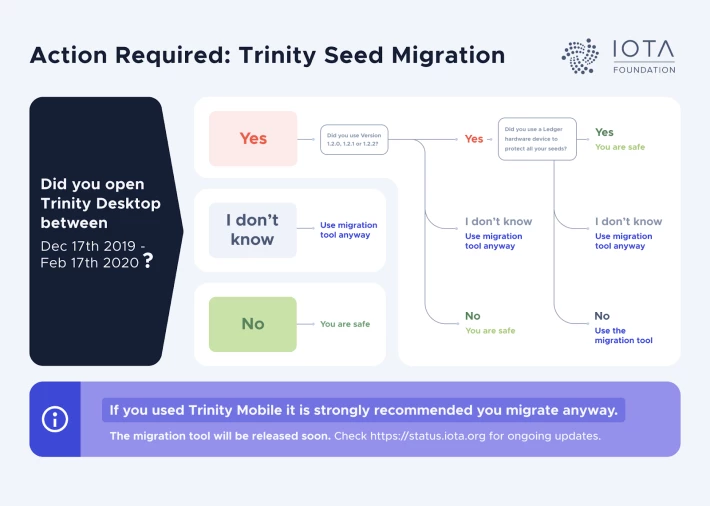
The IOTA Foundation is currently building the seed migration tool and will release it as early as next week. The release and announcement of the tool will happen ahead of time and when it is released, users will have 7 days to perform the seed migration. After the 7 days, the IOTA Foundation will validate submissions and any conflicting submissions will be required to be reviewed through a Know-Your-Customer (KYC) process. On day 10, the network will restart with a new ledger state and the Coordinator will be back online.
In the meantime, users are able to use a "safe" version of the Trinity wallet released by the IOTA Foundation
Read the announcement for further details.
Despite the latest hack and shut down of the mainnet, IOTA has been up on its price in the past 30 days. Which is rather surprising when the mainnet was shut down before just 2 months ago. Even with the type of growth IOTA has had, things are not looking good at the moment for the #24 ranked coin by market cap. Will IOTA be able to maintain their big-name partnerships after this poor start to 2020? We will have to see how everything plays out from this seed migration and what the IOTA Foundation has up its sleeves for the future.





