
The continuous rise of bitcoin and the various altcoins, consequently leads to an increase in cybercrime.
Cryptography has a rather established security, so to be able to get around it you need to be shrewd programmers in order to be able to take possession of the private keys of the wallets, or to be able to insert yourself in resident wallets of the exchanges.
I have treated this topic in other terms in this article.
Given the situation, in order to cheat people, the simplest way is to get around them and make them voluntarily commit acts whose consequences will, in some cases, be disastrous.
The RiskIQ platform is in charge of monitoring these fraudulent situations and interesting data has emerged.
The first to be targeted by scammers was the social Twitter.
In July 2020 this twit was posted from Bill Gates (who obviously wasn't him):
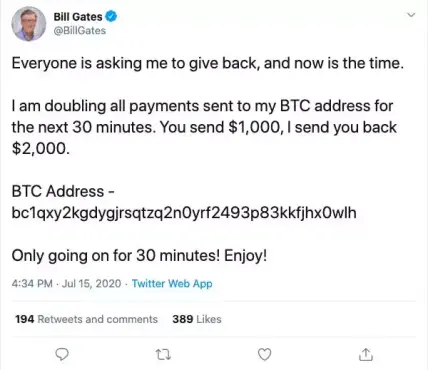
Following the publication of this message, the most inexperienced, made the payment to the address indicated and were robbed of the money paid. In the short time that the scam was active it brought $ 118,000 into the pockets of these criminals !!!
Hackers manage to take possession of these accounts in cases where protection is poor (it is therefore necessary to perform all the procedures that are often reminded to us by the platforms to increase security) or when the profile is scarcely used. Being already considered valid by the platform, the offenders can move freely by making the other participants believe that they are the person on the account.
Scams: Initial Pips
The most common scams involve brokers, miners and cryptocurrency services, which after a few periods prove to be fraudulent.
The simplest method of attracting victims is the promise of astounding earnings in the face of meager investments and with really short deadlines.
Initial pips is a portal disguised as a cryptocurrency broker: the platform and its domains appear legitimate and advertise profitable opportunities, tricking users into sending cryptocurrencies.
RiskIQ also monitored this platform and managed to discover that the malicious pages are a mirror of the original domains. All using free and open source software: HTTrack.
Another way that was highlighted by RiskIQ, is cryptocurrency phishing
There have been a multitude of this type of scam; always with the same mirroring method of legitimate sites, scammers come into possession of personal data simply by filling in the required fields, with secret information.
The most famous were those of MyetherWallet and that of the Ledger. Another platform that has been subject to phishing was Uniswap, in fact when you open the page to be able to transform the tokens, a disclaimer appears warning you of the possibility of being inside a phishing site.
For any further information I leave you the link to the RiskIQ report.
https://community.riskiq.com/article/df2384a5






