
The term Ethereum 2.0 is a way to describe the Ethereum Blockchain’s need and plan to increase scalability for mass adoption. In this article the current state of Ethereum 2.0 in comparison with the current state of Matic will be critically considered. As with fake news being an issue of concern in the world, so is the degree of misinformation and also lack of accurate knowledge and understanding inherent in the blockchain space. In what follows the facts will be presented and it will be shown that at this stage in history, Ethereum 2.0 is Matic, as no other viable options currently exist to achieve scalability for the Ethereum blockchain currently; Eth 2.0 is still a long way away from being realized (potentially 3-5 years). Matic will launch in Q1 2020.
Ethereum 2.0
According to Lucian (2019), eth 2.0 also referred to as “Serenity” is 3-5 years from completion. This is due to the complexity of not disrupting the original chain (Eth 1.0) during the massive transition and this will require smaller updates. The Ethereum team are actively looking for solutions to the existing problems. Joe Lubin, co-founder of the Ethereum Blockchain stated recently, “you can think of Ethereum 1 as a prototype . We had to release something we knew would not be scalable so that you could build decentralized applications”.
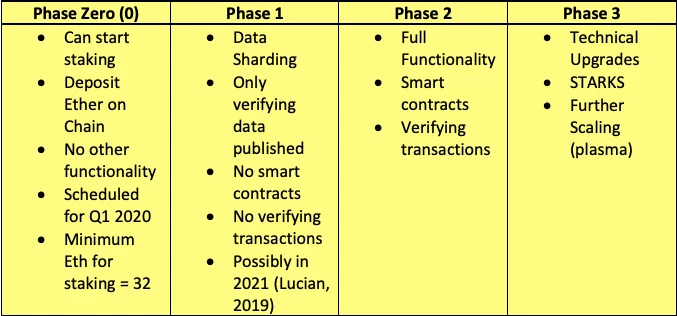
In a presentation that is circulating, Vitalik Buterin gave a thorough overview of Eth 2.0 in 2019. The different phases are presented in the chart below.
Phase Zero (0)
As can be seen from the chart above phase zero of Serenity will allow staking for the purpose of moving from proof of work (POW) proof of stake (POS). What this means is that not every computer in the network will have to verify every transaction, rather each validator will only need to process a small portion of transactions. Tokens will be able to be deposit on the new chain. However, phase zero has no other functionality and all smart contracts and transaction verification will still be done on the Eth 1.0 network.
Phase 1
Phase 1 will implement sharding but it is important to understand that this will only be for data not transactions or smart contracts, so all the processes related to mass adoption will still be done on the Ethereum 1.0 network (smart contracts and payment verification). The sharding phase may be completed sometime in 2021 but this is uncertain due to technical problems that need to be solved. Scalability at this stage will be incrementally improved.
Phase 2
Phase 2 will introduce full functionality to the Ethereum 2.0 Network. Smart contract and verification of transactions will be now be done on the new chains.
Phase 3
Will be the technical update phase which will incorporate STARKS and further scaling.
On the authority of Vitalik Buterin (Overview of Ethereum 2.0) “even on completion of Ethereum 2.0 only tens of thousands of transactions per second (TPS) will be possible, which arguably is not enough, but a stepping stone
Overall Ethereum 2.0 is theoretically sound but the transition will take a minimum of three years. In the meantime the need for mass adoption is intense and competition is fierce. Matic has overcome many problems associated with the development and modification of plasma in order to provide the Matic Network solution for scalability. Even though minor issues still exist, this is common for all blockchains and none are perfect.
Matic is Ethereum 2.0
Matic Network is due to launch in Q1 2020. Institutions are ready for blockchain technology and 2020 is likely to see institutional on-boarding. Many Dapps that have not been able to be developed due to scalability issues will now be able to be developed due to Matic’s incredible capacity to scale the Ethereum blockchain and other blockchains. Matic is capable of 65 000 TPS on a single sidechain and an organization, institution or Dapp can link as many sidechains as is required (horizontal sharding). This literally equates to optimal scaling sufficient for any institution.
All the while Ethereum 1 will be strengthening the layer 1 infrastructure to enable the continued security and decentralization of Ethereum blockchain applications.
In answer to the question, How will Matic be affected by stage zero of Eth 2.0 (changing to proof of stake)? Sandeep Nailwal (Matic Co-Founder and COO February, 2020) responded, “No effect on Matic as Matic interacts with the Ethereum smart contract layer, at consensus layer whether its proof of work (PoW) or proof of stake (PoS), it hardly matters for us.”

Source:© Can Stock Photo / Elnur
Staking – Matic Versus Ethereum 2.0
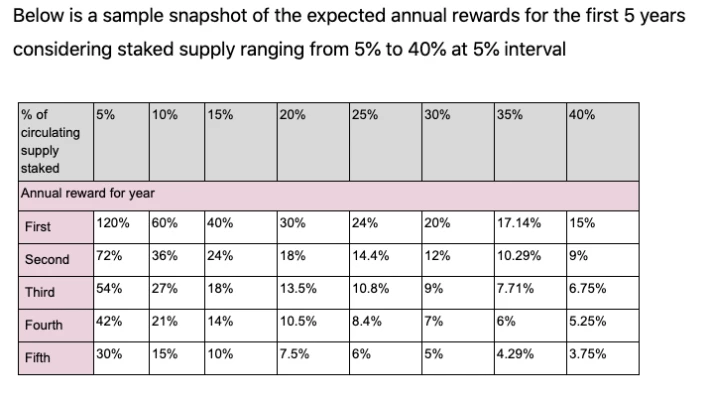
Matic stage 1 test staking is due to start on the 10th of February 2020 and rewards of $40 000 are up for grabs for participants. This test staking will run for a few weeks before mainnet is launched. Staking will continue with mainnet launch. A chart listing the annual rewards can be seen below. For example, for the first year if 40% of the circulating supply are staked the reward will be 15%, guaranteed. Matic will be allocating 12% of its total supply of 10 billion tokens to fund the staking rewards for the first five years = 1.2 Billion tokens. https//docs.matic.network/staking/economics/
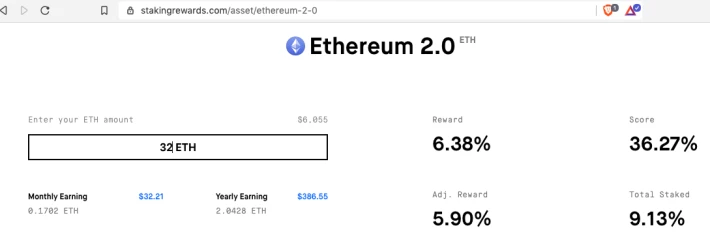
Ethereum staking will also begin shortly. The image below shows a screenshot of rewards for year for those staking 32 Ethereum – currently $32 per month for an investment of $6000 (approximately) at the current price. Matic in contrast will likely yield much higher returns for staking. Any amount of Eth can be entered into the chart below to view earnings.
In summary, Ethereum 2.0 for scaling the Ethereum Network is still years away. Matic which is able to achieve optimal scaling over any other solution is ready to be launched within weeks. Failure of mass adoption mainly due to scalability issues will not hinder institutional blockchain adoption in 2020 and it is likely that hundreds if not thousands of Dapps will integrate with Matic in the coming months. After a few more weeks of test staking, full mainnet will launch. Staking promises to be a good investment on the Matic Network due to high likelihood of the massive increase in usage following mainnet.
Contact a Core Team Member
For those interested in building / integrating with the Ethereum / Matic network you can contact a member of the team at https://matic.network/about/ where individual team members contact information can be found, or at [email protected]
For Matic Articles by the same author
https://www.publish0x.com/blockchain-innovation?a=l9avxlgdG1

Sources
Blockchain image
© Can Stock Photo / Elnur
Cover image
© Can Stock Photo / carloscastilla
Ethereum 2.0 Won’t Be Released for ‘Potentially Many Years’
https://beincrypto.com/ethereum-2-wont-be-released-for-potentially-many-years/
Ethereum 2.0 Staking Rewards
https://www.stakingrewards.com/asset/ethereum-2-0
Lucian, A. (2019, December). Ethereum 2.0 won't Be released for 'potentially many years'. Retrieved from https://beincrypto.com/ethereum-2-wont-be-released-for-potentially-many-years/
Horizontal Sharding
Matic Network |Vitalik Buterin’s 2017 Plasma-Sidechain Vision Imminent | Millions TPS |Multiple Blockchains |Interoperability |Horizontal Sharding | Ethereum Classic |Bitcoin Gold |Cosmos Inter-Blockchain Technology
https://www.publish0x.com/blockchain-innovation/matic-network-vitalik-buterins-2017-plasma-sidechain-vision-xlvdww
Matic Stage 1 Staking – 10 February 2020
http://blog.matic.network/counter-stake-stage-1-stake-on-the-beach-full-details-matic-network/
Matic Staking Economics
https://blog.matic.network/matic-network-staking-economics/
Vitalik Buterin, "Overview of Ethereum 2.0"
https://www.youtube.com/watch?v=izzMuxD4OAM
Source: https://twitter.com/Smartmen6





