I've always wanted to give trading on an exchange a shot. Encouraged by this publish0x contest and following the instructions in this article, I am now proud to say that I made my first trade... and it was awesome! Here's how it went down.
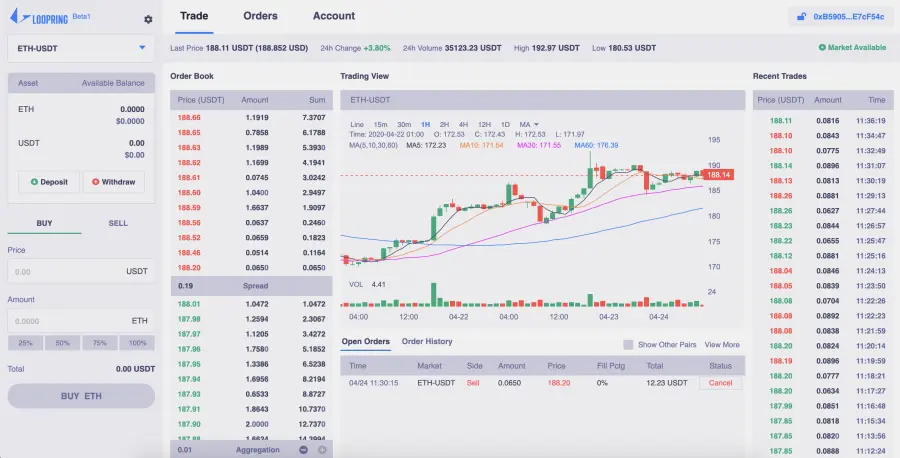
For this trial, the DEX (decentralized exchange) I chose to use was loopring.io. Despite not having actually traded before, I have seen and opened accounts at several DEXs before and I have to say that loopring.io is one of the simplest. No crazy signup process, no KYC - just connect MetaMask and begin. For a guide on how to connect your wallet and make your first deposit to the exchange, see here.
So you've connected your wallet, chosen a password and deposited a bit of crypto with which to trade. Now you're facing down the UI of an exchange for the first time and like me are probably thinking: what the hell IS all of this stuff? It's much simpler than it looks, but let's talk about the theories that lie behind it.
Coincidence of Wants
All financial exchanges, regular or decentralized, and even exchange systems that are strictly barter, revolve around a phenomenon known as Coincidence of Wants (or Double Coincidence of Wants, depending how much you nitpick). I have something you may want and you have something I may want... but we both have to want each others' thing at the same time and we both have to agree to the terms of the trade. So for example, if you have a banana that I want at the same time that I have an orange that you want, we can agree to exchange a banana for an orange. There exists a coincidence of wants.
But the Coincidence of Wants does not always exist. How so? Well, let's think specifically about the Loopring DEX. I have ETH that I want to sell for Tether (USDT). You have USDT that you want to sell for ETH. First of all, it's one step forward that we want each others' thing to begin with, so far so good... BUT! I want to sell my ETH at 190USDT:1ETH and you want to sell your USDT at 180USDT:1ETH. Even though we want each others' coin, we do not agree to the conditions (the price). That's a problem.
How the DEX Works
As I mentioend before, Loopring is a very simple DEX. Other ones have far more advanced features and this is a good thing if you are trading for the first time. At the topleft of your screen there is a dropdown menu where you can select the market you are interested in. I had some ETH and wanted a little bit of USDT, so I chose ETH-USDT. I already depositted ETH from MetaMask to the DEX, so that is already reflected below. Beneath that, there is the option to BUY or SELL.
When you have a two-coin exchange, buying one just means that you are selling the other. Because the market is listed as ETH-USDT as opposed to USDT-ETH, the anchor is ETH. So if you select BUY, it means your are selling USDT to buy ETH. If you select SELL, it means your are selling ETH to buy USDT. I chose SELL because that's what I'm going to do.
The next two fields are price and amount. Here is where it gets interesting and where you might get the tiniest taste of why it's so wild to be a daytrader of any sort. In my specific case, I know how much ETH I want to sell: all of it. I didn't submit that much anyway and I'm looking to trade as much as possible for USDT... now how do I know at what price I want to trade?
If you look at the main screen, you have three columns: order book on the left, trading view in the middle and recent trades on the right. To trade on the exchange, we actually place an "order". I'm going to place a sell order for my ETH, which basically says I want to sell all of it (0.0650 ETH) at the rate of 188.20 USDT:ETH. Why did I choose that? Because I had a look at the recent trades on the right. Recent trades are orders that were filled, meaning the trade was executed. I noticed that at the time I was looking, the rate of confirmed USDT:ETH trades was hovering around 188, but I wanted a tiny bit more, so I added 0.20.
So I selected SELL, put in 0.0650 ETH and the price of USDT at 188.20 and clicked "SELL ETH" to place my order. Lo and behold, my order popped up in two places. The first is under the Trading View chart, where it says Open Orders, obviously. The second is in the order book along with everyone else's orders. Notice in the screenshot below that my order is all the way at the bottom of the top half (red = selling ETH, green = buying ETH). And in my open order, it says Fill Pctg (percentage) 0. I've been waiting for 10 minutes already. Let's see why I don't have my USDT yet.
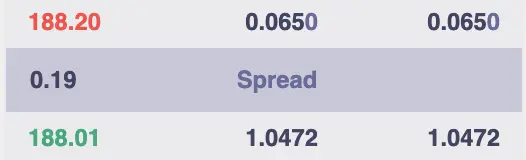

Have a look again at the screenshot above. I am selling my ETH at the cheapest rate amongst all sellers at that moment, only 188.20 USDT for 1 ETH, that's why it's at the bottom... but the highest someone is willing to BUY my ETH is only at 188.01 at that specific moment! There does not yet exist a Double Coincidence of Wants. So my order will stay there until there is one and a few moments later -- there was! Someone was willing to buy my ETH at my price. Isn't that cool? :)
That's all there is to it! I imagine that in certain instances, if you are buying significant amounts of coin, then it's possible the DEX fills your order piece by piece when necessary and that's why the "Fill Pctg" field exists.
This was a great first experience for me. I'm going to take my new 12.23 USDT and buy something nice with it. Thanks to publish0x for sponsoring the gas fees of the first 40 trades! Gas in the real world may have gone cheap but definitely not on the Ethereum mainnet!
Next step for me: a more advanced DEX ^_^.






