
There has never been a longer queue to exit Ethereum staking. This is shown by the graph of validator input and output queues, known as the Ethereum Validator Queue. Since the beginning of July, the network's validators have been processing the release of their coins. Today, more than 640,000 are in the exit queue. At current ether (ETH) prices, this could be a case of profit-taking in dollars.
According to data from the Ethereum Validator Queue, an equivalent exit queue formed in January 2024, when there were over 500,000 on the waitlist and the price of ETH surged from $2,200 to $3,500.
Ethereum's history has never seen two validator escape attempts like the one last year and this one, in July 2025:
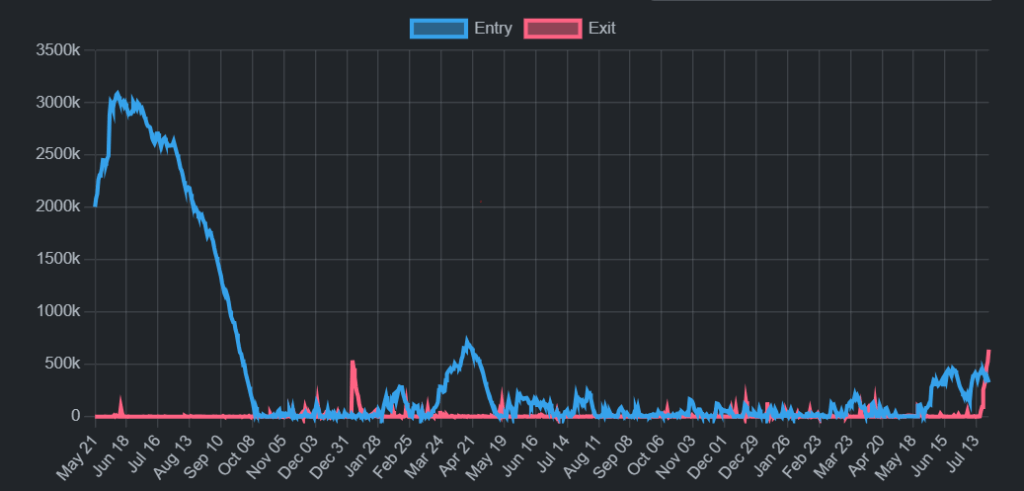
Ethereum saw a similar, though not equivalent, outflow in January 2024. Source: https://www.validatorqueue.com/
Since the end of May of this year, Ethereum staking has been booming. This is demonstrated by the following data: the network went from having a waiting list of 70,000 users at that time to having a membership of more than 400,000 by mid-June.
However, the number of validators seeking entry is beginning to decline : there are around 350,000 at the time of writing, while the number of exits is almost double that.
When a user wants to enter or exit staking, they enter an activation or deactivation queue, respectively.
This queue exists to ensure network stability and prevent this number from changing abruptly, which would have repercussions for its infrastructure. The current wait time ranges from approximately 6 to 11 days to enter or exit.
Not all of the applicants in the queue will eventually take over or resign from their role as validators. They could change their minds. But it's assumed that the vast majority of the 640,000 will drop out for the time being, or wouldn't have initiated the staking exit process in the first place. Seeing that their coins have been locked up for years and have benefited from the yield and price increases, validators are tempted to sell their holdings. To effectively realize these gains, they must first withdraw them from staking.
To a lesser extent, users may be abandoning their role to migrate to other platforms (within Ethereum) or to restake, as Everstake aptly points out. The validator in Ethereum is the equivalent of the Bitcoin miner after the Merge. Their role is to propose and validate new blocks and keep the network secure with their presence. Instead of using ASIC equipment to contribute hashrate and select and verify blocks, the system they use ( proof of stake) provides a financial incentive for staking ether.






