
In a market where every move counts, the slowdown in the issuance of stablecoins like USDT is raising red flags among investors.
Liquidity, a key driver of the cryptoasset ecosystem, is showing signs of moderation that could redefine the course of Bitcoin (BTC) and other digital assets in the coming months.
Stablecoin market capitalization growth remains positive, but at a slower pace. According to a report by on-chain analytics firm CryptoQuant, weekly stablecoin expansions (led by USDT) have fallen to $1.1 billion, far from the $4 to $8 billion that fueled Bitcoin's rise in late 2024, as seen in the following chart.
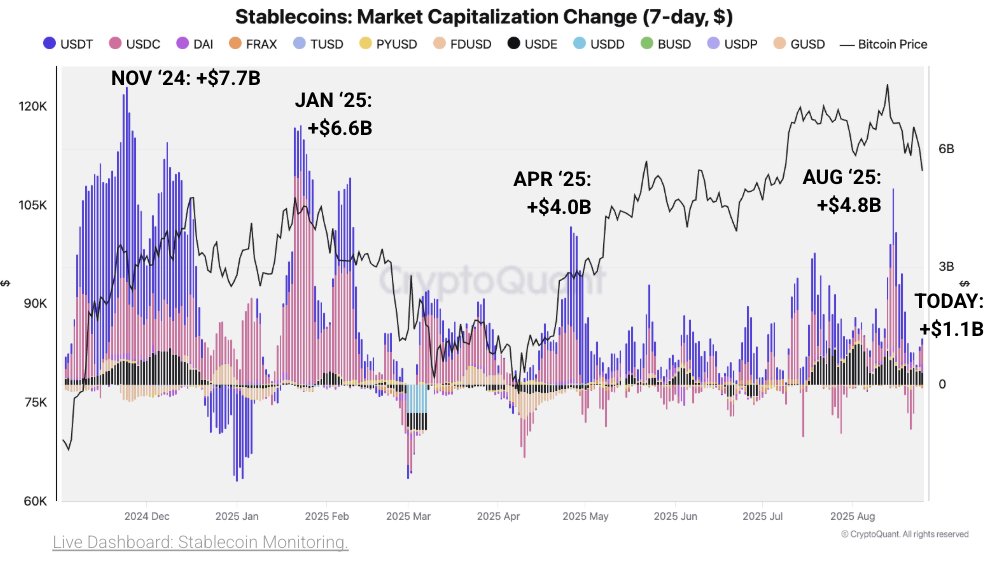 Slowdown in stablecoin capital injections. Source: CryptoQuant.
In particular, USDT issuance, managed by Tether, has seen an increase of $10 billion in the past 60 days, compared to previous peaks of $21 billion.
This downward trend suggests a slower inflow of fresh capital into the digital asset market. "The slowdown in the issuance of USDT and other stablecoins indicates a cooling interest in investing in cryptocurrencies," CryptoQuant details.
Record bookings, but with nuances
Despite this moderation, stablecoin reserves on exchanges reached an all-time high of $68 billion on August 22, surpassing the record set in February 2022. USDT leads with $53 billion, followed by Circle's USDC with $13 billion.
However, this milestone contrasts with the slower pace of market capitalization growth. Although reserves reflect significant purchasing power, the lack of robust expansion could limit the upward momentum, favoring phases of consolidation rather than sustained increases.
The outlook becomes more complicated with the arrival of September, a historically weak month for Bitcoin and other digital assets. This behavior is due to a seasonal effect: after the summer, financial markets tend to adjust portfolios, take profits, or sell risky assets to cover year-end expenses and tax obligations.
Furthermore, a psychological bias among traders reinforces this pattern. Many anticipate declines and act accordingly, which, combined with the lower liquidity typical of this season, amplifies volatility and price corrections.
Not everything is negative. Enthusiasm could pick up as the next meeting of the Federal Open Market Committee (FOMC) of the United States Federal Reserve (FED) approaches, scheduled for September 16 and 17.
Two weeks ago, Fed Chairman Jerome Powell, without explicitly mentioning an interest rate cut, offered statements that markets interpreted as a possible easing of monetary policy in the coming months.
These signals have raised expectations among investors, who will be closely monitoring the FOMC's decisions, as interest rate policies often directly influence cryptocurrency markets.
For now, the winds of liquidity are blowing less strongly. Without a rebound in stablecoin issuance, the market could face a period of stabilization , challenging investors to navigate cautiously in a lower-momentum environment.





