
The hangover from the election of a new US president has not yet been overcome, but several winners can already be identified. Alongside Donald Trump, bitcoin (BTC) and digital currency miners, Polymarket stands out, the cryptocurrency-based prediction market that has managed to position itself as one of the main sources of information.
Polymarket is a decentralized prediction market where people can place bets with tokens on the outcome of future events.
Polymarket itself is a decentralized betting platform that functions as a sort of stock exchange for future events, where users buy stocks tied to specific questions, such as the outcome of an election or the price movement of a cryptocurrency. And in the recent US election landscape it stood out for its ability to anticipate election results more accurately than traditional media.
Unlike the polls, which showed a close race between Donald Trump and Kamala Harris, Polymarket established before the election that the Republican candidate had a 67% chance of winning the race. And then, it projected a 97% probability that Trump would win, before the media made their announcements.
This precision is due to its platform's high trading volume and the ability to react quickly to new information.
In itself, the prediction market aggregates, in each action of its users, the information held by many different participants to derive data that transcends biases. It is therefore more accurate than polls, especially since the market does not care about ideology, it only cares about whether the result is correct.
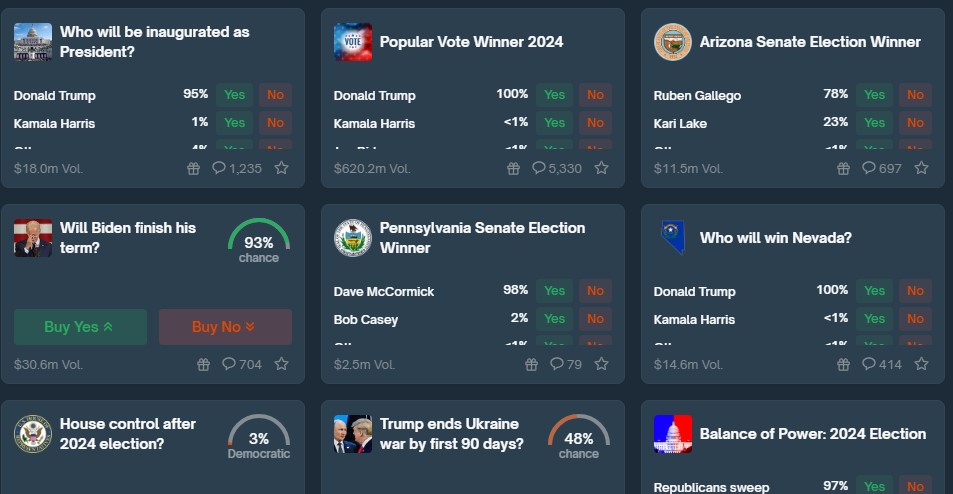 At Polymarket, users can predict future events on a variety of real-life events, from politics, sports, and entertainment. Source: Polymarket.
The above is clear from the facts, in the sense that, based on the results, we can discover that in Polymarket there is a new way to detect the true sentiment of tens of millions of Americans, more accurately and immediately, and without depending on traditional and outdated Internet survey agencies.
Trump won comfortably, slapping down most polls that had predicted an increasingly narrow margin between the two candidates in the popular vote, and which as the election approached, almost all showed Harris ahead.
When polls are so wrong, “it exacerbates a key challenge in this race: the perceived lack of legitimacy of polls,” Tina Fordham of risk advisory firm Fordham Global Foresight told Al Jazeera. According to research, predictions have often been correct, historically, but lately, they have been horribly wrong.
The reason polls are wrong, say the researchers, comes down to who takes part in these polls, how representative they are of the electorate and how truthful their responses are. “Without accurate data, polls mean nothing, ” they add.
Several American political analysts had warned that pollsters had not solved their problems and were therefore underestimating Trump. Some of them, such as Nate Silver of the New York Times, wrote that “a key challenge facing pollsters is getting enough likely voters to respond to their surveys. Typically, opinions are collected by telephone, but this has become more difficult because of caller ID apps that help filter out calls deemed spam.”
What makes Polymarket a reliable source of information?
Meltem Demirors, an executive at investment firm Coinshares, highlights the potential of marketplaces to redefine the way people interact with and value information. As distrust of traditional media continues to grow, marketplaces are emerging as critical sources that help navigate the complex structure of contemporary information, and that’s where Polymarket comes in.
For the analyst, liquidity, market microstructure and the creation of new indicators are key issues to follow in the way the world is evolving and in that sense she believes that “markets are truth-telling machines.”
In this sense, Demirors sees Polymarket emerging as a key player in the future of information due to its unique ability to value and translate data into reliable market signals. In a context where distrust towards traditional media is on the rise.
One of the reasons why Polymarket is so important is the assessment of information. It happens because of the “alpha” players, which refers to obtaining returns above the market. This is something that the analyst perceives as tangible in Polymarket, where participants can take advantage of privileged information or unique perspectives. This in an environment of increasing information uncertainty, where the ability to discern and monetise information becomes essential.
Another key aspect that Demirors highlights is liquidity, which in the case of Polymarket stands out compared to other markets such as Kalshi. According to him, the greater liquidity in Polymarket allows the signals generated to be stronger and more reliable, which maximises the effectiveness of predictions and investment decisions based on them. This underlines the importance of the market microstructure in the quality of the information that can be extracted from it.
In this sense, Meltem Demirors' vision points to the advantages offered by markets: as we enter a world where distrust towards traditional sources of information increases, markets such as Polymarket have the potential to redefine people's relationship with information and offer a new way to navigate the information complexity of the future.
«The wisdom of the market is more accurate than any expert»
In an interview after the election, Polymarket CEO Shayne Coplan highlighted how the cryptocurrency prediction market offered a more accurate and real-time view of election results compared to traditional media.
 Shayne Coplan says the creator of Polymarket went to bed early on Election Day. Source: X/Shayne_Coplan.
While Polymarket was pointing to a Trump victory in key states, the media was painting a seemingly close picture. Coplan stressed that the advantage of the platform he created lies in the “wisdom of the crowd,” where participants make informed decisions when risking their money, resulting in more accurate predictions than those of experts.
Coplan has no doubt that the recent elections have highlighted the potential of prediction markets to transform political analysis and coverage from now on. And in that sense, it is clear that yes, is the answer to the question: will traditional polls disappear? or perhaps more and more people will believe less in them as a source of accurate information.






