
With the recent entry into force of the Market in Crypto-Assets Regulation (MiCA) in the European Union, USDT (Tether) has been in the spotlight of many. This is due to expectations that the stablecoin will leave European territory and that unregulated exchanges will be left out of the region.
Tether’s market cap and trading volume have both been on the decline , which some are linking to the possibility that the crypto asset is being massively delisted from exchanges in Europe. However, a closer look at the data suggests that this perception may not be entirely accurate.
In a recent report, cryptocurrency services provider Matrixport stated that “this [declining] trend may be due to seasonal factors such as reduced trading volumes during the Christmas and holiday periods.” Based on these comments, it can be deduced that the seasonal lull around the Christmas season, as well as uncertainty and misinformation regarding the MiCA regulation, combined to drive the decline in USDT trading.
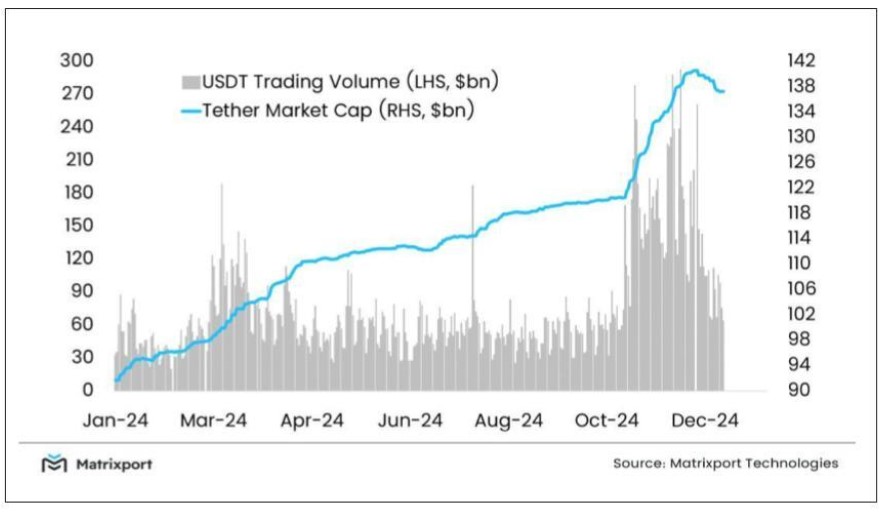 There were declines in USDT trading volume in December, but this cannot be attributed to the crypto asset being delisted from European exchanges. Source: Matrixport.
Beyond that, it is worth noting that while some exchanges, such as Coinbase and OKX, decided to delist USDT, others have not directly commented on the issue. For a digital asset industry insider like Samson Mow, what is clear “is that no other exchange platform has plans to delist USDT in the short term for European users.” He also recalled that local regulators have given a grace period of between 6 to 18 months for companies to comply with the regulations.
“Crypto-asset service providers who provided their services in accordance with the applicable legislation on 30 December 2024 may continue to do so until 1 July 2026 or until they are granted or denied authorisation in accordance with Article 63, whichever occurs first,” reads Article 143 of the regulation, which relates to transitional measures for service providers.
This makes it clear that cryptocurrency exchanges continue to comply with regulations. and may therefore keep USDT listed for longer.
Uncertainty over USDT arose due to MiCA requirements, which impose strict requirements on issuers of electronic money tokens (EMTs), such as stablecoins, such as liquid reserves held by EU-authorized custodians and integration of digital token identifiers (DTIs).
In this regard, Tether CEO Paolo Ardoino said that “the main problem is that the regulation foresees a huge risk for stablecoin issuers, since they must keep 60% of the reserves in bank deposits.” He claims that such a requirement is almost impossible for Tether to meet.
The executive recalled that bank deposits are only insured up to 100,000 euros by the European Central Bank, a small figure compared to the volume moved by a stablecoin such as USDT.
As far as we know, USDT is still not MiCA compliant and while it is not explicitly banned, its accessibility and use in the EU may be affected as the ecosystem is configured under the rule. Until then, USDT remains available on most regulated exchanges operating in Europe, such as Bitpanda and Kraken, Crypto.com, Nexo, Binance and YouHodler.





