
On February 11, Agustín Cruz, a Chilean bitcoin developer, presented a proposal on the Bitcoin Development Mailing List (bitcoindev), a discussion forum managed by Google, aimed at protecting Bitcoin (BTC) from future threats posed by quantum computing.
Called the Quantum Resistant Address Migration Protocol (QRAMP), the initiative seeks to anticipate a scenario in which technological advances threaten the cryptographic security underpinning the Bitcoin network by requiring mandatory migration of funds to quantum- resistant addresses .
The debate on the quantum threat
The impact of quantum computing on Bitcoin is a recurring theme among analysts and experts. Most agree that while advances in this technology are real, its ability to compromise Bitcoin's cryptographic security system, known as ECDSA, still seems distant.
In this sense, to highlight an example, Adam Back, co-founder of Blockstreams , stated that for a quantum computer to have the potential to break Bitcoin encryption, it will take “1 or 2 decades.” However, other experts point to a time much closer to the present, such as a period of “2 to 5 years.”
In addition, other anti-quantum projects have emerged for Bitcoin, such as the idea of Jameson Llop, a Bitcoin software engineer, who aims to “burn quantum-vulnerable BTC.”
Forced migration as a solution
Cruz's initiative, detailed in a document hosted on GitHub, focuses on a clear objective:
"The goal of this proposal is to protect Bitcoin against potential future quantum attacks by imposing a mandatory migration period for funds in legacy Bitcoin addresses (secured by ECDSA) to quantum-resistant addresses."
Agustín Cruz, Bitcoin developer.
ECDSA, or Elliptic Curve Digital Signature Algorithm, is the mechanism Bitcoin uses to ensure that transactions are signed only by the legitimate owners of the private keys, guaranteeing the integrity and authenticity of every transaction on the network. However, the theoretical possibility that quantum computers could eventually break this system has motivated proposals like Cruz's.
The proposal establishes a mandatory migration period during which users must transfer their funds from traditional ECDSA addresses to the new post-quantum addresses. After this period, the old addresses would become obsolete, and funds that have not been migrated could become vulnerable in a future quantum scenario.
The approach is based on a technical premise: quantum computers, using algorithms like Shor 's , could in the future decrypt private keys from public keys exposed on the network, something that is practically impossible today with classical computers. In Bitcoin, public keys are only revealed when funds are spent, meaning that unused addresses, protected only by a hash, remain secure for now.
The Chilean developer argues that while the quantum threat is not imminent, acting proactively is essential to preserving the security of Bitcoin as a network and trust in Bitcoin as an asset.
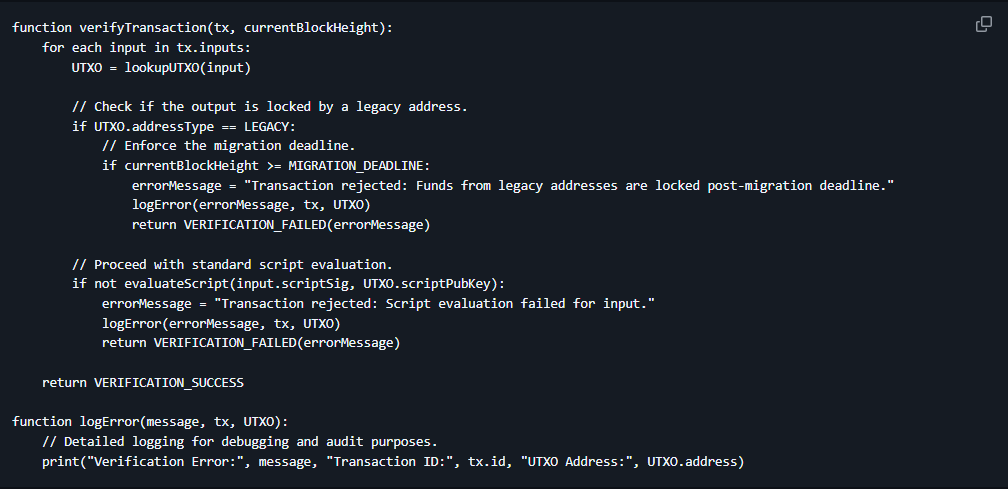 Agustín Cruz proposes a hard fork to protect Bitcoin from future quantum attacks. Source: GitHub.
Addresses based on anti-quantum cryptography
Cruz proposes a hard fork that implements a new type of address based on post-quantum cryptography. This change would involve replacing ECDSA with algorithms that are supposedly resistant to quantum attacks, such as those based on lattices or hash signatures, which do not rely on mathematical problems that quantum computers could solve efficiently.
In his GitHub proposal, Cruz highlights the XMSS (Extended Merkle Signature Scheme) and LMS (Leighton-Micali Signature System) hash-based signatures. These algorithms employ Merkle tree structures, a technique that organizes signatures or keys into a hierarchy verifiable by hashes.
“This BIP introduces a new type of address designed to be secure against the threats of quantum computing, ensuring that Bitcoin remains a reliable store of value for the long term,” Cruz explains in his document.
Technical details and challenges
Cruz's paper not only proposes cryptographic change, but also addresses the technical implications of its implementation. Post-quantum algorithms, although more secure against quantum computing, tend to generate larger signatures and keys than current ones.
This could increase the size of Bitcoin transactions, affecting its scalability. To mitigate this problem, Cruz suggests optimizations that could be developed during the community consensus process.
Another challenge highlighted by the developer is the need for broad agreement among network participants. "The success of this proposal depends on community consensus and coordinated action among miners, node operators, and wallet providers," Cruz says.
A hard fork, by definition, requires all nodes to update their software, and a lack of support could fragment the network, a risk Bitcoin has faced before, such as with Bitcoin Cash in 2017.
Although consensus in the Bitcoin community on the urgency of this change is far from being reached, the Chilean maintains that acting early is key. "Bitcoin's strength lies in its adaptability, and preparing now for quantum threats ensures its survival as a decentralized system,” he concludes in his proposal.






