
The Chicago Stock Exchange (CBOE) has applied for permission to list two solana (SOL) cryptocurrency exchange-traded funds (ETFs), proposed by asset managers VanEck and 21Shares.
The requests were made yesterday, Monday, July 8, to the United States Securities and Exchange Commission (SEC) through 19b-4 filings. These documents force the regulator to decide whether to approve solana ETFs within a 240-day window, that is, before March 2025.
Exchange-traded fund analyst Eric Balchunas said, however, that the most important date to watch is November, when the US presidential election takes place. “If Biden wins, they probably have no chance of existing. If Trump wins, anything is possible,” he said.
This initiative takes place while BTC ETFs have already been on the US market for six months and Ethereum, is expected to be launched in the coming days.
The SEC approved Ethereum ETFs just over a month ago, raising expectations for new instruments of this type based on other cryptocurrencies . In order to authorize Solana ETFs, the regulator would have to dismiss this asset as an unregistered security , which is the classification it has given it.
“After successfully listing the first U.S. spot bitcoin ETFs on our exchange and securing SEC approval for our rule filings to list spot ether ETFs, we are now addressing the growing investor interest in solana,” said Rob Marrocco, global head of ETP listings at Cboe Global Markets.
 Night view of the CBOE main building – Source: Wikipedia.
SOL market reacts calmly to CBOE filings
SOL is the fourth most volatile crypto asset by market capitalization after BTC, ETH, and BNB. It is currently trading at $141 (USD), which is 45% below the all-time high it reached three years ago.
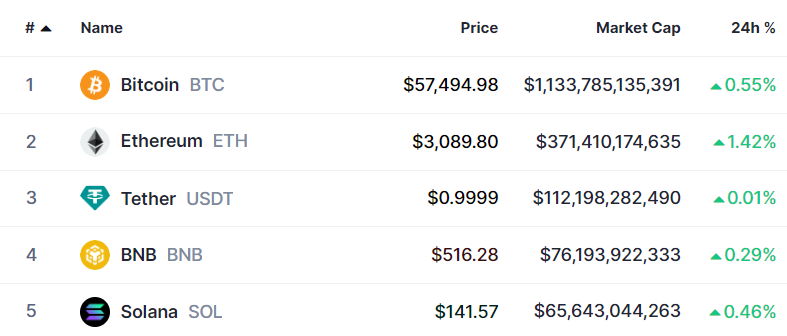 Cryptoassets with the largest market capitalization. Source: CoinMarketCap.
Following CBOE’s applications for approval to launch VanEck and 21Shares solana ETFs, SOL’s price experienced a slight increase of less than 1%. This rise was in line with the muted rise seen in the cryptocurrency market, indicating that the market is taking the news in stride. Further advances could mean more volatility.





