Overview
Both XDC Network and Cosmos are Layer-1 blockchain ecosystems designed to support decentralized applications (dApps), tokenization, and enterprise use cases. However, their architectures, consensus mechanisms, goals, and technical approaches are fundamentally different.
1. Core Architecture
XDC Network
- Layer-1 Blockchain: XDC is a public, enterprise-oriented blockchain designed from the ground up for global trade, payments, and real-world asset tokenization.
- Hybrid Public/Private Model: Supports both public transparency and private data sharing for regulated business workflows.
- EVM Compatibility: Fully supports Ethereum Virtual Machine (EVM), enabling developers to deploy Solidity contracts and port existing Ethereum dApps with minimal changes.
- Interoperability: Bridges to Ethereum and other blockchains facilitate cross-chain liquidity and asset flows.
- ISO 20022 Support: Built-in compatibility with global financial messaging standards, which uniquely positions it for integration with traditional banking systems.
Strength: Designed with enterprise and financial system interoperability as first-class citizens.
Weakness: More niche focus compared to wide ecosystem-level adoption like Cosmos.
Cosmos
- Modular Blockchain Framework: Cosmos is not a single blockchain but a network of sovereign, interoperable blockchains.
- Cosmos SDK: A modular framework that lets developers build custom, application-specific blockchains using pre-built modules (governance, staking, tokens, etc.).
- Inter-Blockchain Communication (IBC): A secure protocol for connecting independent chains, enabling trustless cross-chain data and token transfers.
- CometBFT/Tendermint Consensus: A Byzantine Fault Tolerant (BFT) consensus engine that ensures rapid finality and security across chains.
Strength: Enables a highly modular, scalable ecosystem where separate blockchains can interoperate.
Weakness: The complexity of managing sovereignty, interoperability, and security across many chains can require more development expertise.
2. Consensus Mechanisms
XDC Network
- XDC 2.0: XDC Network's consensus protocol (XDPoS), bringing enhanced security, scalability, and performance through its "Chained HotStuff" BFT algorithm, real-time forensic monitoring to detect malicious nodes, and features like customizable subnets, making it a more robust, enterprise-ready Layer 1 blockchain.
- Validator Requirements: Validators must stake a minimum amount and often complete KYC by trusted 3rd party for enterprise compliance.
- Performance: Achieves ~2 second block times and over 2,000+ TPS with near-zero fees.
- Security Focus: Designed for enterprise with additional monitoring and compliance tooling.
Consensus Strength: High throughput and enterprise compliance features.
Security Model: Centralized validator selection with KYC may be less decentralized than pure PoS.
Cosmos
- CometBFT (formerly Tendermint BFT): A PoS+BFT consensus ensuring safety and liveness; validators are chosen based on stake.
- Validator Decentralization: Cosmos Hub and other chains can have dozens to hundreds of validators.
- Finality: Fast finality, designed to be responsive and secure under Byzantine faults. l
Consensus Strength: Proven Byzantine-tolerant system with broad adoption.
Security Model: A widely accepted standard in PoS ecosystems; slightly more generalized than XDC’s enterprise-oriented approach.
3. Smart Contracts & Development
XDC Network
- Smart Contracts: EVM-based, supporting standards like XRC-20 and XRC-721 (NFTs).
- Developer Tools: Standard EVM toolchain (e.g., Remix, Hardhat) works with minimal modifications.
- Subnets: Allows enterprise subnet deployment with custom rules.
Developer Audience: Ethereum-experienced developers find it accessible due to EVM compatibility.
Cosmos
- SDK Custom Blockchains: Unlike smart contract layers, Cosmos encourages building full blockchains tailored to use cases.
- Cosmos EVM: Optional component for EVM compatibility, enabling Solidity support in the Cosmos ecosystem.
- IBC Enabled: Chains built with Cosmos SDK can communicate using IBC.
Developer Audience: Offers greater flexibility but has a steeper learning curve for custom chain development.
4. Interoperability & Ecosystem
XDC Network
- Cross-Chain Bridges: Supports bridges to Ethereum and major networks for interoperability.
- Omnichain Integrations: Integrations (e.g., LayerZero, Stargate) expand cross-chain capabilities.
- Focus: Primarily enterprise cross-chain needs rather than broad ecosystem connectivity.
Cosmos
- IBC Protocol: A general-purpose interoperability standard that becomes core to a multi-chain ecosystem, not just asset bridges.
- Interoperable Ecosystem: Over 200+ Cosmos-based chains, enabling diverse use cases and cross-chain execution.
- Network Sovereignty: Each zone (blockchain) maintains autonomy while communicating through hubs.
Interoperability Strength: Cosmos delivers a richer, protocol-native interoperable landscape.
5. Performance & Scalability
XDC Network
- TPS & Speed: ~2,000+ TPS; ~2 second block times.
- Scalability Approach: Scales via efficient consensus and subnets for enterprise chains.
Cosmos
- Horizontal Scalability: Multiple independent chains can operate concurrently and communicate via IBC, scaling the ecosystem.
- Vertical Scaling: Performance depends partly on chosen consensus and chain design; Tendermint can handle high throughput under optimal conditions.
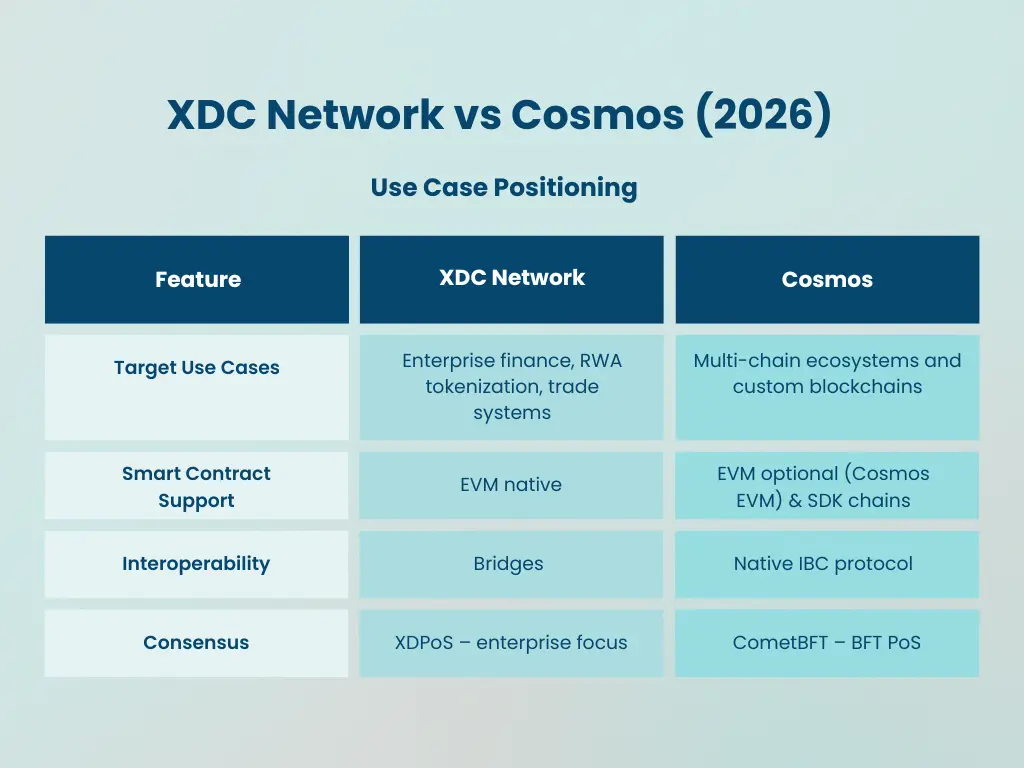
6. Use Case Positioning
7. Market Position & Rankings
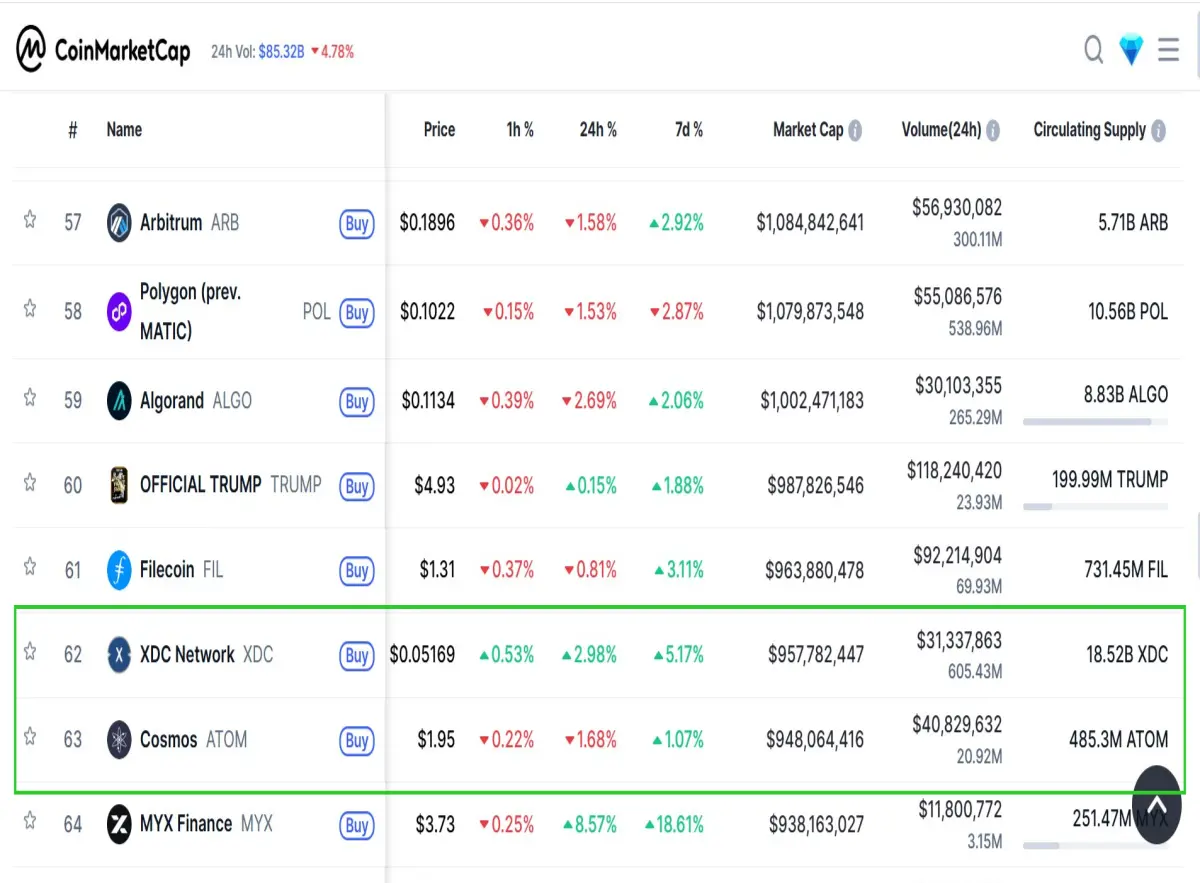
As of the latest CoinMarketCap data, XDC Network (XDC) is ranked #62 in market capitalization, ranking just above Cosmos (ATOM) at #63 — reflecting a close contest in relative industry presence. This position highlights an ongoing shift in market sentiment where XDC’s growth in real-world finance infrastructure is increasingly recognized alongside Cosmos’s long-standing interoperability narrative.
Recent Trends & Adoption
In 2025–2026, the adoption trends between Cosmos and XDC have shown diverging trajectories:
- Cosmos (ATOM) has seen comparatively slower market cap expansion and adoption curve momentum in recent months, especially as other interoperability and modular blockchain ecosystems attract developer interest. While Cosmos pioneered the Inter-Blockchain Communication (IBC) standard and remains influential, its native token’s adoption and market cap growth have not kept pace with some newer sector growth trends. Analysts note that some parts of the broader ecosystem face competitive pressures and challenges in tying token demand directly to ecosystem activity.
- XDC Network (XDC) has been experiencing notable organic growth in real-world finance adoption — particularly in stablecoin (USDC) liquidity, DeFi infrastructure, and Real World Asset (RWA) tokenization. According to recent industry data, the total RWA value tokenized on XDC has surpassed $717 million, with a substantial portion deployed in USDC-denominated private credit and other structured finance instruments. This on-chain capital reflects a shift from experimental RWA pilots to meaningful institutional deployments that leverage stablecoin settlement and blockchain transparency.
- USDC & Stablecoin Adoption: XDC has seen over $132 million in USDC liquidity on chain, tapping into stablecoin demand for predictable settlement and compliance-aligned use cases. This trend aligns with broader financial infrastructure adoption, where regulated dollar-pegged assets enhance DeFi usability and institutional engagement.
- DeFi & RWA Momentum: Beyond stablecoins, XDC’s engagement with RWA tokenization — including tokenized credit, corporate debt instruments, and real estate-linked issuances — signals growth across segments that tie blockchain utility to real cash flows and yield-bearing financial products. These developments are attracting institutional workflows that extend beyond traditional DeFi experiments.
In contrast, while Cosmos remains strong in interoperability and modular blockchain infrastructure, its native token ATOM has not captured the same level of real-world finance narrative or market cap expansion relative to competitors recently. This difference partly reflects a broader industry trend where specialized financial infrastructure and stablecoin integration are significant drivers of ecosystem growth.
Conclusion
XDC Network excels as a hybrid, EVM-compatible enterprise blockchain tailored for regulated environments and real-world asset workflows with minimal gas costs and high throughput.
Cosmos, on the other hand, is a modular, customizable ecosystem where independent blockchains can be built and interconnected using IBC, enabling an “Internet of Blockchains.”
Choose XDC if you need enterprise blockchain infrastructure with existing financial standards support and EVM compatibility.
Choose Cosmos if you need flexible, sovereign multi-chain frameworks and decentralized interoperability at scale.