
In the case of Bitcoin Halving, the supply of Bitcoin is cut in half. After halving, miners of the crypto-currency only receive half of the BTC for each successfully mined block.
When is the Bitcoin Halving?
Bitcoin Halving takes place every 210,000 blocks and thus approximately every four years. The next Bitcoin Halving is expected to take place on May 12, 2020 at 17:20 CEST.
The halving will support the deflationary supply structure behind Bitcoin - after all, there will be a maximum of 21 million Bitcoins.
Where do new Bitcoins come from?
New Bitcoins are issued during so-called mining. In mining, all transactions made over the network are grouped into blocks, which in turn are confirmed by miners.
You can imagine it like this: When a new transaction is added, it is validated by a Miner and put into a block. If the block is "full", Miners let this block go through a process. They take the information and apply a mathematical formula that converts the transaction into something much shorter, actually just a string of letters and numbers. This is also called a hash. This hash is kept in the block at the end of the block chain.
What is the Block Reward?
For this service, Miners receive transaction fees that vary depending on the volume of transactions made. In addition, they currently receive 12.5 BTC for each successfully confirmed block in the so-called coinbase transaction - the reward that is halved when halving. Coinbase transaction and transaction fees together form the "Block Reward".
What influence does the Bitcoin Halving have on the price?
In the past, Bitcoin Halving has always meant an increase in the Bitcoin price - at least in the long-term horizon. It took some time until this event was "priced in".
But as a result, there were always Bull Runs at Bitcoin. The basic market mechanisms were in play: supply and demand. Demand increased, but the supply of new Bitcoins decreased.
What happened in the past after the halving?
In the past, the Bitcoin price increased after each halving.
The first Bitcoin halving took place on November 28, 2012. The reward for Miner was halved from 50 BTC to 25 BTC. The Bitcoin exchange rate at the time of the halving was 12.35 US dollars. After 150 days it reached 127 US dollars. It reached its peak in the phase between Halving 1 and Halving 2 in December 2013, just under a year later, at around 1,038 US dollars. The increase thus reached a maximum of over 9,300 percent.
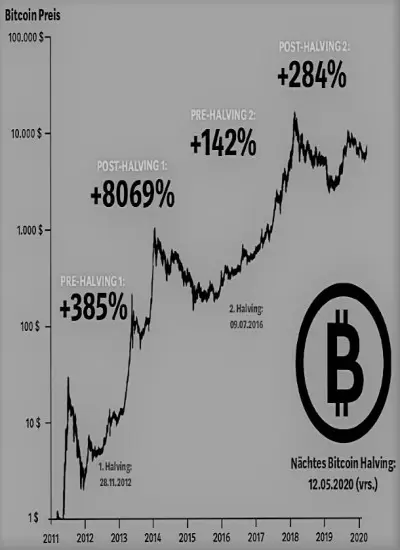
The second Bitcoin Halving took place on 9 July 2016. The halving took place from 25 BTC to 12.5 BTC. At the time of the halving, the Bitcoin exchange rate was USD 650.63. 150 days later it was at 758.81 US dollars. The Bitcoin price peaked on 17 December at just under US$20,000, after about 1.5 years. Here it was "only" just under 3,000 percent growth.
What happens to the Bitcoin price after the halving?
If one assumes that past events will repeat themselves and that market mechanisms will continue to operate at the same or increasing demand of their office, it could well be that the Bitcoin price will rise again.
However, it cannot be excluded that immediately after Bitcoin Halving nothing or nothing great will happen, at least as far as the Bitcoin Price (BTC) is concerned. Although there are indicators that the supply shortage stands for a rising price, there is no guarantee that this will happen. Especially the stock-to-flow ratio, which can be used to calculate the rarity of an asset, gives positive signals here. But this model is also controversial. Simply because a repetition of past events are not set in stone.
Furthermore, it can be assumed with some certainty that word has got around among investors that there have been significant increases in the Bitcoin price as a result of a halving of the BTC supply in the past. Therefore, it is possible that there is already a percentage of speculators who are betting on a Bitcoin price increase before the event. If this were to happen, they would sell more of their Bitcoin after the halving, and the Bitcoin price could also fall.
The same applies to Bitcoin Miner, by the way. The sharp increases in the hash rate, i.e. the computing power used for mining new Bitcoins, indicate that miners have increasingly tried to stock up on "cheap" Bitcoins. After all, as we recall, after halving, they only get half as many Bitcoin units for successfully mined blocks as before. After halving, they could put more of these on the market for sale and thus push the Bitcoin price down.
Halving and the mining profitability
Finally, it may happen that a certain proportion of the miners are no longer profitable after halving. Accordingly, they would take their equipment off the grid. This would in turn increase the block time until the next adjustment of the Mining Difficulty, which could make Bitcoin less attractive for investors. This in turn would be reflected in a declining Bitcoin price and make Bitcoin mining even less attractive.
We learn: The world is not that simple. Neither is the Ice Age of the FUD callers threatening, nor is a golden future for the "number go up" defined solely by halving. In the Bitcoin course, and thus also in the activity of the miners, supply and demand are reflected.





