
Hey everyone, glad we’re still all here. I know that last migration debacle was a bit of a doozy but you know what? We persevered, made it through, and came out the other end stronger than before. So take a bow, pat yourself on the back, and fire up the coffee maker because today we’re diving into the SnowBank.
Didn’t we already cover this?
Aha, yes we did you astute reader, you. Our cleverly titled “So Many Updates” medium piece did touch on the SnowBank. But now we got a lot more details for you yetis to sink your collective teeth into. But first, a recap.
What is?
The SnowBank is a specialized yield aggregation platform that uses investors’ deposits to automatically generate even more yield, leaving less work and more gain for investors. There will be multiple vaults added over time.
There is a lot of flexibility built into the protocol. So while we may only have a few core vaults, more will be created and incorporate novel investment strategies designed to deliver the best returns for users.
Who cares?
Fair enough, allow us to explain. The current state of yield optimizers is still in its infancy. Between Beefy Finance, Swamp, and Auto, there is a ton of room for differentiation. So our yeti developers who we STILL haven’t let out of the basement put their heads together and came up with an idea: What if we created a yield optimizer that delivered high returns for their investors AND generated a new token in the process?
Yes there are projects that do this already, but their project tokens have no price floor or utility other than earning more of the same token. With our SnowBank token, $GALE, a price floor is programmed in from generated interest and a buyback and burn system. Furthermore, the devs will be creating additional use cases for $GALE which will include staking.
If we zoom out, the SnowBank is actually THREE DeFi projects combined into one.
SnowBank is:
A farming vault like Beefy
A banking protocol like Contribute (GALE)
An interest creating system like Dracula (on ETH) (Interest bearing BNB)
This still sounds a little complex
Perhaps a diagram can help get this idea across.
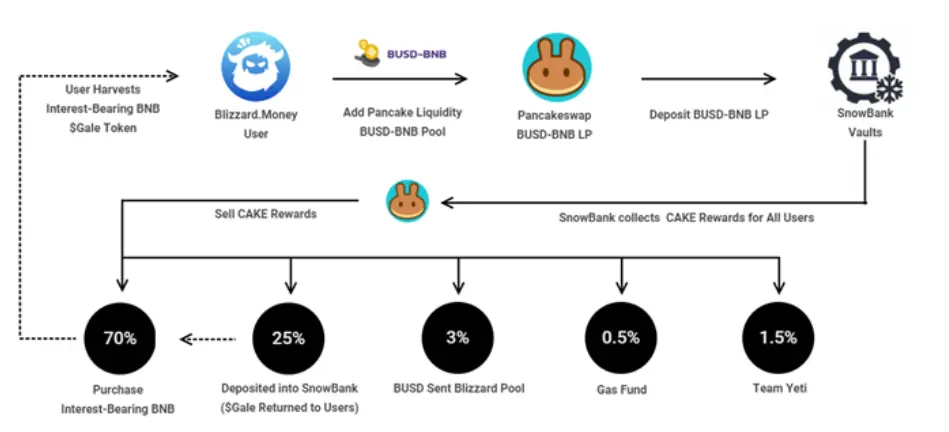
There we go, are you happy now? No? Ok let’s dive further.
How it works:
- An investor deposits a liquidity pair OR single asset into a Snow Bank vault (in this example it’ll be $BUSD - $BNB). In the future there will be vaults that accept multiple assets and LPs.

2. The deposited liquidity pair is sent to a strategy contract that invests and manages the asset on other 3rd party protocols, i.e. Pancakeswap. Pretty normal everyday stuff for vaults.
- The yield generated from these protocols is harvested multiple times a day and distributed to investors in the following way:
- 70% in interest-bearing BNB
- 25% in $GALE token
- 5% Fees
- 3% in $BUSD to $xBLZD Stakers
- 0.5% transaction fee (gas)
- 1.5% to Team Yeti
- Remember, this is the YIELD GENERATED, the LPs remain in the SnowBank
- Users can harvest the interest-bearing BNB and $GALE token anytime.
- Interest-bearing BNB is a token created when someone lends BNB to a money market protocol, like Alpha Homora. This token increases in BNB value over time from the lending interest earned.
Users will get paid in both interest bearing BNB and $GALE tokens.
This looks like a lot of steps
You’re telling us! We’ve had a while to refine and balance these steps and it still makes some yetis heads spin. If it seems like a new process, it’s because this is the cutting edge of DeFi and yield farming. While we have been inspired by several different DeFi protocols, this structure is entirely our own.
So this GALE token . . .
Ah yes, the question on everyones’ mind so far. We have previously mentioned that $GALE is earned from SnowBank Vaults and is only issued through a bonding curve model formula. In a nutshell, bonding curves steadily increase the price of a token the more people buy it. So early adopters are rewarded for buying early. The funds used for the exchange (BUSD) are sent to a smart contract which optimizes yield throughout different projects, continuously generating interest.
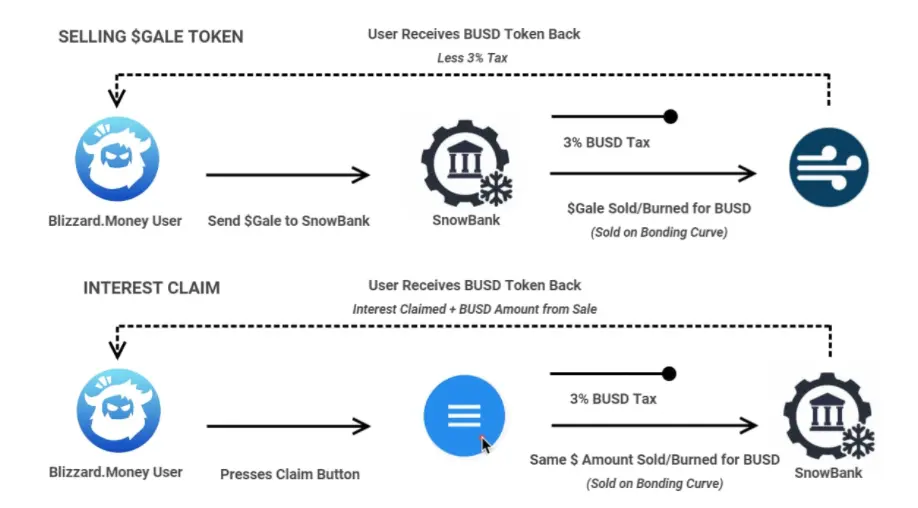
Not only that, but a 3% tax is applied on the initial issuance by the SnowBank vaults and anyone claiming interest or selling $GALE token. This tax is used to buy back and burn $GALE. Those tokens are permanently inaccessible after they are sent to the burn address and even though they are still part of the total supply, they can no longer be redeemed for the underlying asset (BUSD).
Since every $GALE token MUST be backed by their value in BUSD, these locked tokens create a rising minimum price floor and will never be able to be sold, since no one holds the private key to the burn address. You can imagine the burn address as being the strongest hand in the room. The ultimate holder. You know it will never sell but is selfish and continues to earn interest for you.
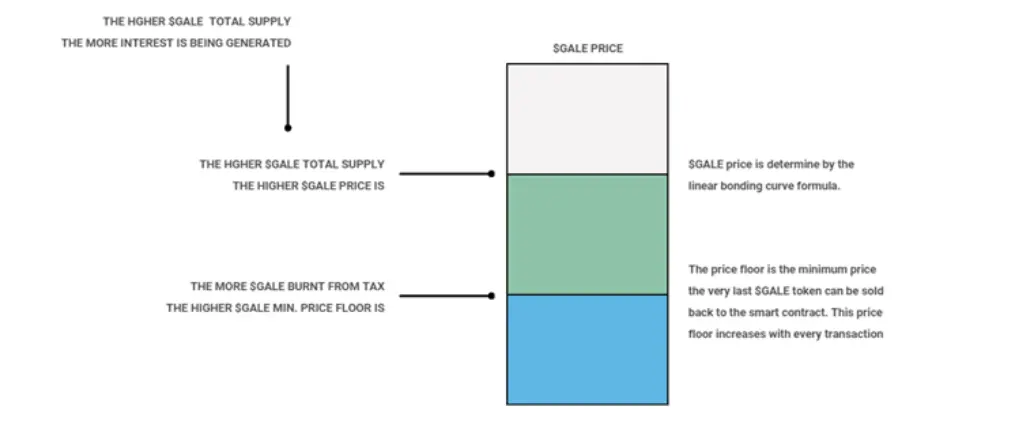
**Pop Quiz** – What happens if ever there is a total supply of 1001 $GALE, 1000 of those $GALE tokens are burnt forever, and only one person holds the remaining $GALE token?
**The first person to message the correct answer in the Telegram price channel wins $1,000 in $xBLZD**
Since every $GALE token MUST be backed by their value in BUSD, these locked tokens create a price floor. Even if everyone sells their tokens back to the SnowBank, these locked tokens will never be able to be sold, since no one holds the private key to the burn address. You can imagine the burn address as being the strongest hand in the room. The ultimate holder. You know it will never sell.
See if this makes any sense.
How do I claim the GALE interest?
The claim function allows any $GALE token holder to withdraw the accumulated interest. In order to do so, the token holder must sell the same dollar amount of $GALE back to the smart contract. The contract will then return the interest plus the BUSD amount from the sale after a 3% tax is taken out. The higher the price of $GALE tokens the less tokens are needed in order to redeem the accumulated interest.
Example – the protocol has generated 100 BUSD of interest over time. In order to redeem this interest, Jimmy needs to sell 100 BUSD worth of $GALE tokens back to the smart contract. The contract applies a 3% tax to the BUSD value of $GALE tokens (3 BUSD) before sending the remaining 197 BUSD to Jimmy. This 197 BUSD is the sum of the interest claimed (100 BUSD) and the $GALE exchange value minus 3% tax (100 – 3 BUSD).
How does GALE benefit me DIRECTLY tho?
There are many different ways a $GALE holder can profit. Waiting for the minimum price floor to increase, claiming the interest generated, and then selling their $GALE when supply becomes greater. The price of $GALE changes with the action of every participant, this creates a new setting where participants re-evaluate their strategy over time.
On Beefy, deposited LPs grow. But our devs know that designs immediate gratification. There’s no compounding LP in SnowBank, but the multiple assets that are returned are all earning interest, both interest-bearing BNB and $GALE.
SnowBank offers interest-bearing BNB and $GALE as rewards only
So, this all sounds great but how does it benefit $xBLZD holders?
Team Yeti loves our faithful $xBLZD holders. This is why we promised that every new product released would benefit $xBLZD by either providing a staking dividend, deflation of circulating supply, or some other form of utility. For the SnowBank there will be a continuous Blizzard pool that stakers can earn their share of the 3% performance fee taken from each vault harvest. This pool will be stake $xBLZD, earn BUSD. If you have been in previous Blizzard pools to earn tokens like BNB, BTCB and ETH then you are familiar with the process already. The more TVL in the vaults, the more xBLZD holder’s benefit.
Go and spread the Yeti word.
Team Yeti will be in the chat as always and an FAQ document will be coming shortly.
P.S. Wen SnowBank? #Xoon
P.P.S. Just kidding, May 12th is the targeted launch date






