
About 3 months back, my co-founder Avijit received a call from his father to explore tech adoption in day-to-day business activities at their family office. Their company dealt in medical equipment supplies to hospitals and clinics and needed to make at least a hundred outbound calls a day to prospects, clients and vendors. With a recent expansion into new territories and categories, their company had started to receive new leads and needed to make even more calls than before. And this time, these also included cold calls. With call lists running into several hundred phone numbers, it was becoming difficult to handle this manually. Avijit was called in to see if he could help, given his technical background.
At their office, he found that they were using printed call sheets or excels and making manual entries for call dispositions. Callback scheduling was not managed effectively either. No means to maintain a DNC list. It was a anything-goes situation to get things done. So we started to look for simple solutions for their office. Point to note, this was a legacy operations company with seasoned hardware sales reps who had ingrained daily practices and rarely made use of any sales software or apps. Moving them away from their normal sales habits by infusing too much technology would only cause more harm than good. Having seen a number of available auto-calling and CRM solutions, we found that these software platforms would create way too much disruption. We needed something that would work like an abstraction layer over the UX of their handheld devices and organise call lists / CRM similarly.

Sales reps were habituated to record call notes in writing
Hence, we started building a tailor-made solution for them. A nifty app that works on top of their calls like a management layer for call handling. Moreover, since the company works in medical sales, data privacy is paramount and in line with physician-patient privileges. The idea was to make a lightweight application that didn’t need to interact with our servers. Something that can be managed entirely from client-side handheld devices. No data would come to us from these client devices.
With these objectives in mind, we got down to work on the app. The first decision we took was to make it a hybrid app. This would allow easy multi-platform deployment. Building a native app on a short notice for a small-storyline product didn’t make much sense. For UI, we decided to work on the open source Framework 7 with Vue.js since it has libraries to handle both iOS and Android. So, we zeroed in on Framework 7 Vue for the frontend. For database management, we used PouchDB since it supports local SQLite DBMS. SQLite works directly from the end program and has data persistence. PouchDB is a NoSQL database and has support for potential server-client syncing. Though server-client was not needed at the moment, this was an important consideration in case we ever decided to build an enterprise version. And finally all of this is would be packed with Cordova and deployed as an app.
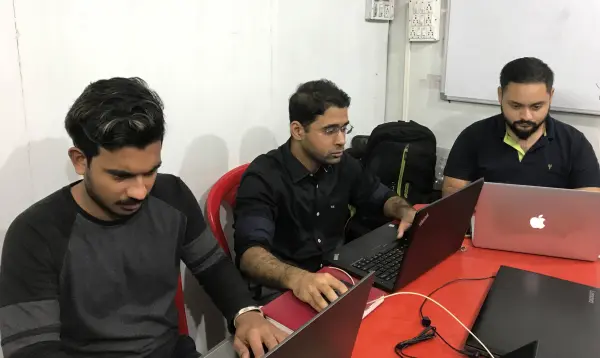
One of the many all-nighters we pulled to get GoDial off the ground within a fortnight. L-R is Sourik, yours truly and Avijit cramped up in our war room as we write/test/deploy code.
A couple of weeks later we had the first complete draft and released it for its original intended purpose: getting outbound call handling organised at the medical equipment company. A week later we started to see the results of this release. Sales reps were able to make more calls in a day, manage dispositions more effectively and reduce missed callback instances to zero.

GoDial is built to be non-obtrusive and acts as an abstraction layer over your calls
Having seen the PoC go off to a successful start, we decided to release it to others as well. We named the app GoDial (simple, isn’t it?) and posted the update on ProductHunt. The post received 120 upvotes and several helpful comments and enquiries. This was a similar strategy we followed for Regular.li - create a lightweight solution for a problem we faced ourselves at work. Then open it up for everyone and add features along the way. The best part of this tech stack is that it works offline. No internet connection is needed to operate it. A working connection would be needed only when downloading the app from Google Play Store or Apple App Store and when paying for a higher limit subscription. The app is free to use for upto 100 contacts. No time limits on the free version. With close to a thousand installs since launch, it’s been a fun ride so far. As GoDial continues to see more traction, we will be sharing further updates on how the journey goes. Cheers!
P.S. The cover pic for this article is a compilation of the app UX. It was designed to be simple with most features available in one or two clicks






