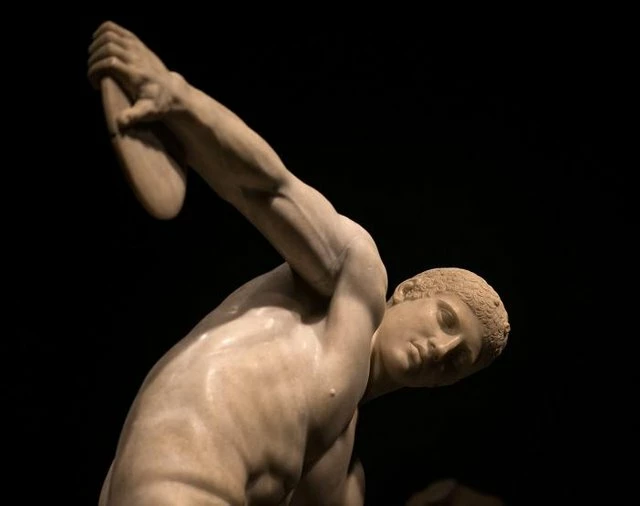
This is the famous sculpture of antiquity, "Diskobol."
And that's what I thought when looking at this sculpture: this position is not typical for an athlete! Because a stone disk, if thrown at it in such a way (bottom-up), will fly up, not forward.
We know that throwing a disc, along with throwing a spear, was part of the discipline of the Olympic Games of antiquity. In modern terms, it was a military-applied sport.
Discus throwing is a modern discipline of track and field athletics. It is part of the Olympic Games, the disc is thrown both by men and women. In ancient times, of course, women were not allowed to enter the Games.
In men, the disc weighs 2 kg, a world record of a range of 74.8 m.
It is interesting that the world record of range now belongs to women - 76.8 m (Gabriela Reinsch, GDR, 1988). The weight of the disc for women is set at 1 kg, which is two times lighter than that of men. Then, according to Vicki, the weight of the antique disk ranged from 1.25 to 5.70 kg (a very strange spread by the way, for the competition). There is information that archaeologists have unearthed discs weighing up to 20 kg.
In our time, the disc is thrown in a different way, namely at a distance, forward. This method is just logical for the sport.
But the grasp of the disk, which is fixed in the sculpture of Myron, is logical for the warrior. On a flat trajectory, like a live howitzer, from top to bottom. In this way, you can throw heavy round stones into a dense array of warriors, such as the phalanx. Or throwing a stone across the wall of the besieged city, straight into the ranks of the assault.
Accuracy for the thrower is not important, the projectile itself falls on somebody. And while doing so will cause severe wounds, from which the enemy will not be saved either by a helmet or shield (if he has time to expose).
Of course, that's just my guesswork. After all, we can not move into the past and see with our own eyes how it really was.