
Key Points
-
Bitcoin is nearing its all-time high, with institutional investments and macroeconomic conditions acting as major drivers.
-
Upcoming events such as the Federal Reserve meeting and the Bitcoin Prague conference could significantly influence future price movements.
-
Political and global economic factors are contributing, but uncertainty remains due to market volatility.
Current Situation
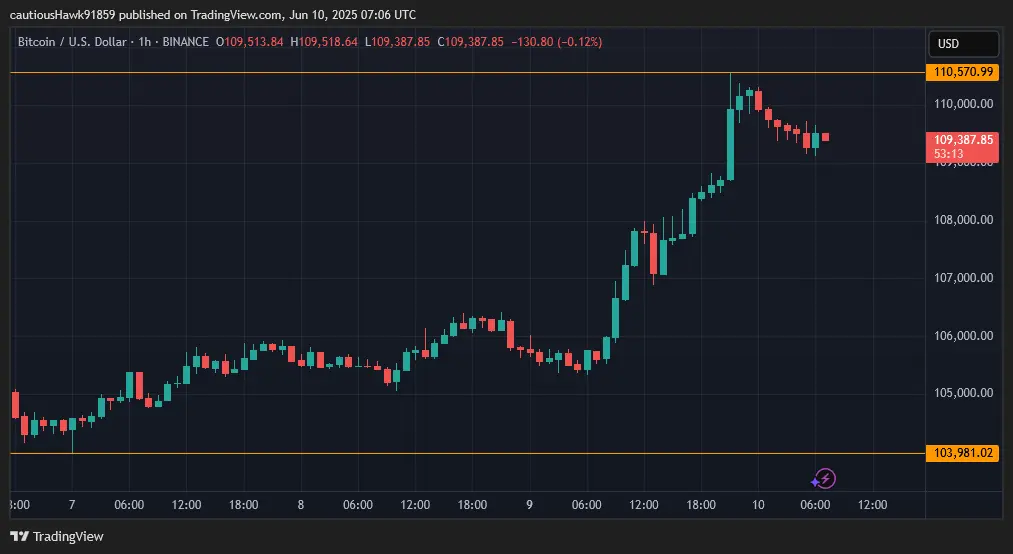
As of June 11, 2025, Bitcoin is trading at approximately $109,669, placing it just below its recent all-time high of $111,814 reached earlier this month. This close proximity has ignited widespread speculation: is this the beginning of a prolonged bull run, or merely a short-term rally?
The market is currently exhibiting moderate volatility, with daily fluctuations of 2–3%, making it difficult to determine a clear direction. Nevertheless, the data suggest Bitcoin is in a critical consolidation phase, teetering between a breakout and a pullback.
Driving Factors
Institutional Inflows
One of the most powerful drivers behind Bitcoin’s surge is the wave of institutional adoption. Companies like MicroStrategy continue to make large purchases, with their latest acquisition totaling 1,045 BTC for $110 million. Their total holdings now exceed 582,000 BTC, valued at $63 billion.
Meanwhile, ETFs such as BlackRock’s have gained substantial traction, accumulating over 1.1 million BTC. This level of institutional interest is helping to stabilize demand and elevate prices. Social media activity and trading data from Fidelity also confirm recent inflows of $174 million, reinforcing the institutional momentum.
Macroeconomic Tailwinds
Macroeconomic signals are also tilting in Bitcoin’s favor. The global expansion of liquidity, paired with expectations of Federal Reserve rate cuts, has created a fertile ground for Bitcoin’s growth. Many analysts expect the Fed to begin cutting rates this June, making risk assets like BTC more appealing.
A widely circulated quote on X summarized the market mood: "Global money supply (up) + rate cuts (coming) + money printer (coming) = liquidity." In parallel, rising government deficits and persistently high interest rates are further encouraging investors to view Bitcoin as a long-term hedge against inflation and fiscal instability.
Political and Regulatory Developments
Bitcoin is also benefiting from a more favorable political and regulatory climate. With the resignation of SEC Chair Gary Gensler in early 2025, pressure on the crypto sector has eased considerably. This shift, combined with the current U.S. administration’s lenient stance on digital assets, has improved the regulatory environment.
Political factors are playing a substantial role too. For example, Trump’s proposed tax cuts and concerns about rising U.S. debt have sparked fears of a potential sovereign default, prompting many to view Bitcoin as a safer store of value.
Geopolitical Dynamics
On the geopolitical front, easing tensions between the U.S. and China have contributed to recent market optimism. As trade discussions between the two countries progress, investor confidence in risk assets is rising — Bitcoin included.
Stability in international relations tends to drive capital toward digital assets, especially when traditional markets appear unpredictable or saturated with uncertainty.
Technical Analysis
From a technical standpoint, Bitcoin is showing bullish momentum. Analysts are tracking key levels, such as support at $105,000 and resistance at $112,000. A breakout above $109,000, already underway, could pave the way for new highs.
Chart patterns, including a bullish flag, suggest that Bitcoin could reach the $120,000 to $125,000 range by the end of June. These projections are supported by moving averages and volume indicators that favor upward price continuation.
Summary of Key Drivers
Factor Details Example/Impact
Institutional Inflows Large corporate buys, ETF inflows > $55 billion in 2025 MicroStrategy’s $110M buy, BlackRock ETF: 1.1M BTC
Macroeconomics Global liquidity, expected Fed rate cuts, BTC scarcity 95% of BTC mined, 95% of global population doesn’t own it
Politics/Regulation U.S. policy, post-Gensler regulatory shift Tax cuts, sovereign default hedge narrative
Geopolitics Eased China-U.S. tensions, economic uncertainty June rally linked to trade optimism
Technical Analysis Bullish patterns, key support/resistance Breakout above $109K could target $120K–$125K
Upcoming Events to Watch
Federal Reserve Meeting (June 17–18, 2025)
The next FOMC meeting is expected to be a major catalyst. Should the Fed signal interest rate cuts, the crypto market — especially Bitcoin — may experience a renewed surge. Current projections anticipate a year-end rate of about 4%, down from the current 4.25–4.5% range.
Bitcoin Prague Conference (June 19–21, 2025)
This event will host over 10,000 attendees and 200+ speakers, making it one of the largest Bitcoin gatherings globally. Historically, similar conferences have triggered positive market sentiment, especially when accompanied by new product launches or partnerships.
Investors will be watching closely for any announcements that could spark short-term price rallies or longer-term adoption narratives.
Regulatory & Geopolitical Developments
Any unexpected regulatory shifts — particularly from the U.S. — could impact Bitcoin's short-term path. For example, Trump’s proposed "Big Beautiful Bill", which raises fears of a U.S. default, could boost Bitcoin’s narrative as a hedge against systemic risk.
In addition, global trade or military tensions remain key triggers for flight-to-safety behavior, of which Bitcoin increasingly benefits.
Technical Price Levels
Price watchers should look for a clean break above the all-time high of $111,814. Such a breakout could unleash a wave of momentum buying and speculative inflows. However, if Bitcoin fails to hold $105,000, a drop back toward $100,000 remains a plausible correction.
Market Sentiment & Outlook
Market sentiment remains strongly bullish, as reflected in the Fear & Greed Index score of 71 (Greed). This suggests investors are optimistic, but not yet euphoric — a phase historically associated with upward continuation.
Still, caution is warranted. Past cycles have seen drops of up to 75% following peak prices. While the current cycle, ongoing since 2023, shows no immediate signs of reversal, the crypto market is inherently volatile, and price swings can be swift and severe.
Conclusion
Bitcoin’s rally appears to be supported by deep institutional involvement, favorable monetary policies, and positive regulatory and geopolitical developments.
Whether this momentum translates into a lasting bull run depends on the outcome of critical upcoming events — namely, the Federal Reserve’s interest rate decisions and the Bitcoin Prague conference.
Investors should monitor price action closely, keep an eye on macroeconomic indicators, and remain prepared for both continued gains and potential corrections. This evolving landscape offers opportunity, but demands vigilance.






