
Bitcoin is often described as digital gold — a long-term reserve asset, a hedge against monetary debasement, and a financial system that does not depend on banks or governments.
But the latest on-chain data tells a slightly different story.
While the price of BTC remains under pressure, activity on the Bitcoin blockchain has been rising sharply. The surprising part is not only that more transactions are taking place. It is the type of transactions driving that activity.
Small transfers now dominate the network.
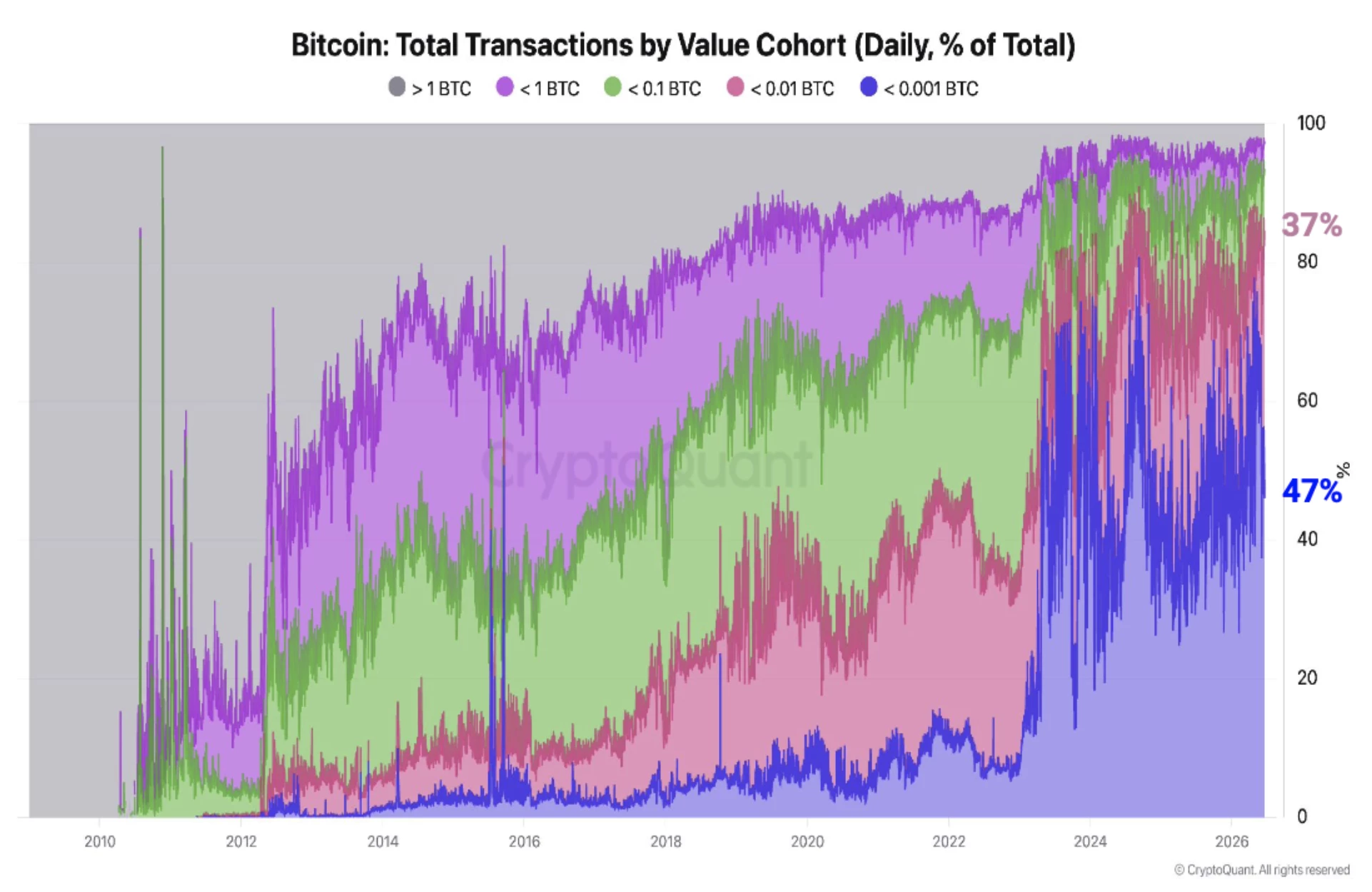
Transactions below 0.01 BTC represent around 80% of all daily Bitcoin operations. A few years ago, that number was much lower. In 2023, these small transfers accounted for less than half of daily activity. Today, they are the clear majority.
This does not necessarily mean that Bitcoin is suddenly being used for everyday payments at massive scale. The reality is more complex — and more interesting.
Bitcoin Activity Is Rising, Even as the Price Struggles
Bitcoin’s price action has not been especially exciting lately. The asset has been trading in a fragile zone, with investors watching support levels, ETF flows, macroeconomic conditions and liquidity across risk markets.
Yet under the surface, the blockchain itself is becoming more active.
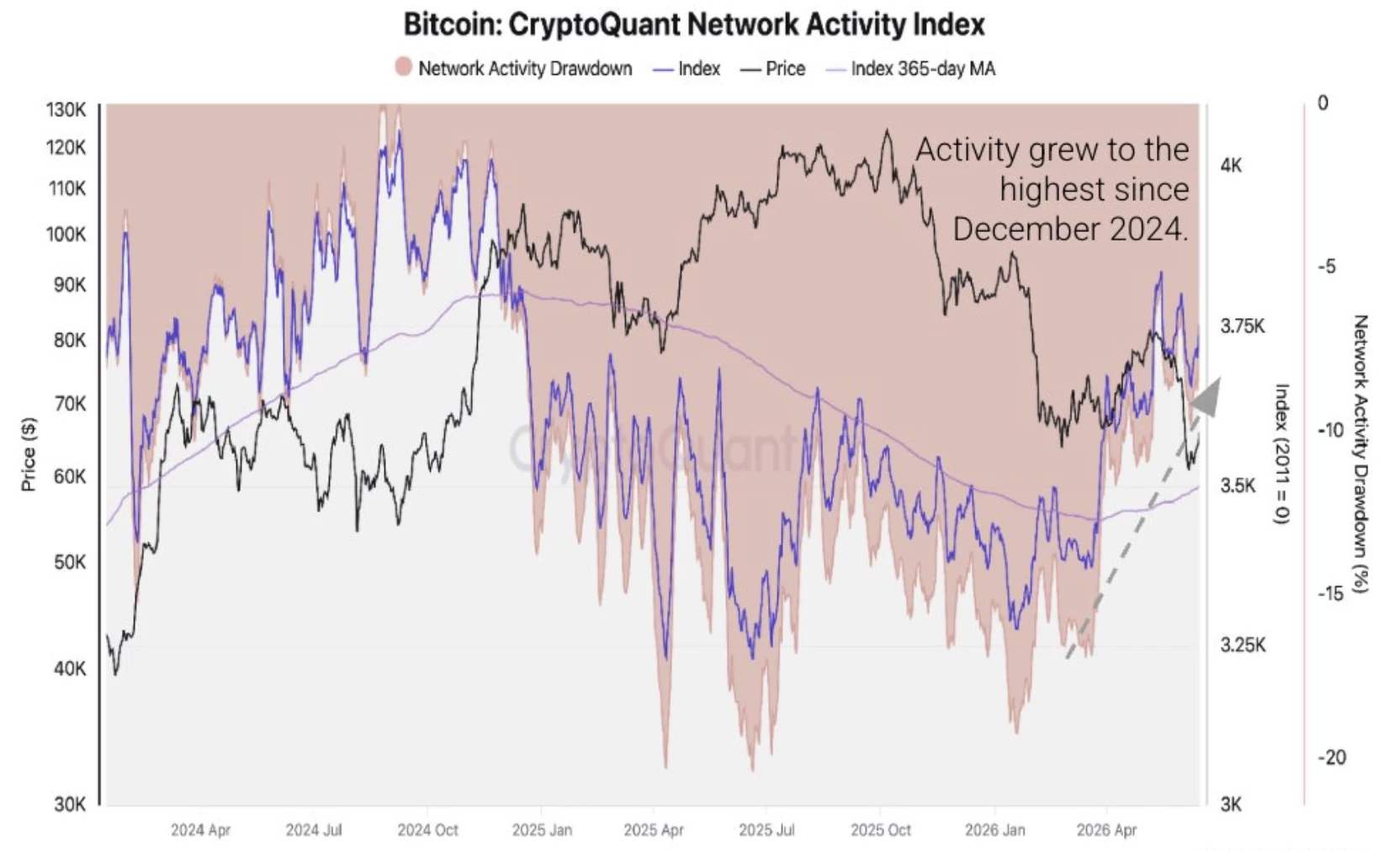
This creates an interesting divergence. Price momentum is weak, but network usage is rising. In traditional market analysis, this kind of divergence can be meaningful because it shows that user activity and speculative price action are not always moving together.
Bitcoin may be struggling on the chart, but its base layer is far from asleep.
The number of daily transactions has climbed back toward levels not seen since the end of 2024. Transactions per block have also increased, suggesting that block space is being used more consistently. In simple terms, people are interacting with the Bitcoin network more often.
But this rise in activity does not mean that huge amounts of BTC are moving around.
That is the key point.
The network is seeing more transactions, but many of them involve small amounts. This is why analysts describe the current trend as activity-driven rather than value-driven. Bitcoin is not necessarily processing a wave of giant transfers. It is processing a large number of small ones.
That distinction matters.
A blockchain can look busy because whales are moving large sums. It can also look busy because thousands of smaller transactions are competing for space. The second case tells a different story about usage, fees and the evolution of Bitcoin’s ecosystem.
Right now, Bitcoin’s activity appears to be increasingly shaped by the second scenario.
What Is Driving the Explosion in Small Bitcoin Transactions?
At first glance, the phrase “microtransactions” may sound like people buying coffee with Bitcoin.
That is not really what is happening here.
A large part of this activity appears to come from data-related use cases on Bitcoin: Ordinals, Runes, BRC-20-style experiments, and protocols that rely on OP_RETURN or similar transaction structures to anchor information on-chain.
These systems generate many small transactions because their purpose is not always to move large monetary value. Sometimes the transaction is used to record data, mint an asset, update a token state, interact with an inscription service or participate in a Bitcoin-native application layer.
This is one of the biggest shifts in Bitcoin’s recent history.
For years, Bitcoin’s base layer was mostly understood through a simple lens: sending and receiving BTC. But since the rise of Ordinals and related protocols, Bitcoin has increasingly become a settlement layer for more experimental activity. NFTs, fungible tokens, inscriptions and data anchoring have all changed the composition of transactions.
Not everyone likes this.
Some Bitcoin users believe the base layer should remain focused on monetary transfers. In their view, inscriptions and token experiments create unnecessary congestion, increase fees and distract from Bitcoin’s original purpose as peer-to-peer money.
Others see the trend as a sign of healthy demand. If users are willing to pay for block space, they argue, then the network is doing exactly what it is supposed to do. Bitcoin does not judge transaction intent. Miners include valid transactions that pay fees. That neutrality is part of the system.
This debate is not going away.
The growth of microtransactions shows that Bitcoin is no longer only a passive store-of-value network. It is also becoming a battleground for competing visions of what the base layer should be used for.
Good News for Miners, but a Challenge for Users
The rise in small transactions has one clear benefit: it increases demand for block space.
That matters especially for miners.
Bitcoin’s block subsidy keeps shrinking over time. Every halving reduces the number of new BTC paid to miners for securing the network. In the long run, transaction fees are expected to become a more important part of miner revenue.
If Bitcoin is going to remain secure for decades, there needs to be sustained demand for block space. From that perspective, more activity is not automatically bad. It can help create a fee market and prove that users value the network enough to pay for settlement.
Microtransactions driven by Ordinals, Runes and data protocols can contribute to that demand.
But there is also a downside.
When the network becomes crowded, fees can rise. That makes simple Bitcoin payments less attractive, especially for smaller users. If someone wants to send $20 or $50 worth of BTC, a sudden fee spike can make the transaction feel inefficient. This is why scalability remains one of Bitcoin’s biggest unresolved challenges.
The Lightning Network was designed to handle faster and cheaper Bitcoin payments off-chain. But the current rise in microtransactions is happening largely on the base layer, not necessarily through Lightning. That puts pressure directly on block space.
This creates a trade-off.
More activity can strengthen miner economics and prove that Bitcoin remains useful. But too much congestion can hurt user experience and make everyday payments more difficult.
Bitcoin has always been shaped by trade-offs. Security, decentralization, scalability and usability rarely improve all at once. The current microtransaction boom is another example of that tension.
It shows demand.
But it also tests the limits of the network.
A Sign of Adoption, Speculation, or Something In Between?
The big question is how investors should interpret this trend.
Is the rise in Bitcoin microtransactions bullish?
The answer depends on what kind of activity we are talking about.
If small transactions reflect genuine user adoption, more experimentation and broader demand for Bitcoin block space, then the trend is positive. It suggests that the network remains alive, useful and adaptable, even during periods of weak price momentum.
If the activity is mostly speculative — driven by token launches, short-lived inscription trends or temporary hype around Bitcoin-native assets — then the signal is more fragile. Speculation can disappear quickly, especially when market conditions worsen.
The truth is probably somewhere in the middle.
Bitcoin is seeing real growth in transaction activity. That activity is being driven by new protocols and new use cases. Some of those use cases may survive. Others may fade. But the important point is that Bitcoin’s ecosystem is still evolving.
This matters because Bitcoin is often described as conservative, slow-moving and resistant to change. In many ways, that reputation is deserved. Bitcoin changes carefully, and that caution is part of its strength.
But the ecosystem around Bitcoin is not frozen.
Developers are experimenting. Users are testing new formats. Miners are earning fees from new types of transactions. Investors are watching to see whether Bitcoin can become more than a store of value without compromising its core identity.
That is why the rise of microtransactions is important.
It does not prove that Bitcoin has become a mass payment network. It does not prove that Ordinals or Runes will dominate forever. It does not guarantee higher prices.
But it does prove that Bitcoin’s base layer still attracts demand.
Even when the market is nervous.
Even when the price is weak.
Even when many investors are waiting for the next clear trend.
Bitcoin Is Still Alive Beneath the Price Chart
Price is the loudest signal in crypto, but it is not the only one.
Bitcoin’s recent weakness has made many investors cautious. Some are waiting for a stronger rebound. Others fear a deeper correction. But on-chain activity shows that the network is still being used heavily, especially for small transactions.
That is not a detail. It is a reminder.
Bitcoin is not only a chart. It is an active settlement network, a monetary asset, a fee market, a cultural movement and now, increasingly, a platform for data-based experimentation.
The rise of microtransactions to around 80% of daily activity may not be universally welcomed. Some will see it as innovation. Others will see it as noise. But either way, it shows that Bitcoin’s block space remains valuable.
And in the long run, that may be one of the most important signals of all.
A quiet price does not always mean a quiet network.






