Summary
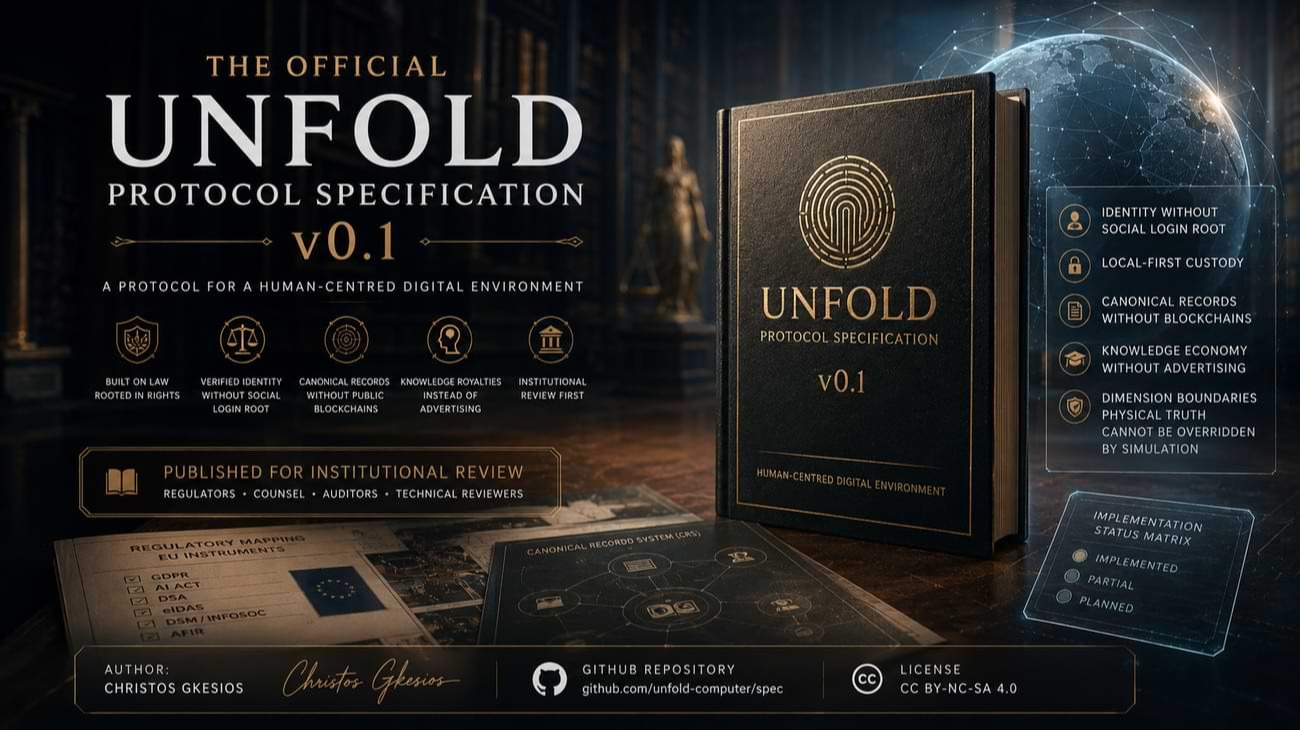
The official UNFOLD protocol specification v0.1 is now published at:
https://github.com/unfold-computer/spec
This repository contains normative design documents only — not application source code, not a product launch, and not legal advice. It is submitted for institutional review: regulators, counsel, auditors, and technical conformance reviewers who need a single, attributable, publicly readable record of what UNFOLD is designed to do, under which legal framing, and with what honest build status.
What this repository is
UNFOLD is a protocol specification for a human-centred digital environment: identity without social-login root, local-first custody, canonical records without public blockchains, an economy based on verified knowledge use rather than third-party advertising, and explicit dimension boundaries (physical truth cannot be overridden by simulation).
The GitHub repository is the authoritative English v0.1 package:
- Root:
LICENSE(CC BY-NC-SA 4.0) +README.md - Specification:
v0.1/(~211 documents)
Author: Christos Gkesios
Copyright holder (v0.1): Christos Gkesios
License: Creative Commons Attribution-NonCommercial-ShareAlike 4.0
Citation:
UNFOLD Protocol Specification v0.1. Christos Gkesios, 2026.
Licensed under CC BY-NC-SA 4.0.
https://github.com/unfold-computer/spec
What this repository is not
To avoid misunderstanding:
This repo is:
- Normative protocol design + regulatory mapping
- Honest implementation status (Implemented / Partial / Planned)
- A public attribution anchor for the author's design work
- English institutional prose
This repo is not:
- A runnable application or demo
- A claim that every mechanism is built
- A Web3 token project or blockchain protocol
- Marketing copy or contributor onboarding
Hard exclusions documented in the spec:
- No public blockchains for integrity, identity, or settlement
- No third-party ad networks (programmatic RTB, cross-site tracking for ads)
- No speculative crypto token economy — settlement is fiat AI Credits, not protocol tokens
- Application code lives in separate repositories, not here
Earlier draft trees are not part of v0.1 and are not included in this repository.
Why publish now, in this form
1. Public attribution
The specification represents integrated research — vision, market prior art, and sector law merged into one design. Publishing under CC BY-NC-SA with named authorship establishes a public, citable record of that work.
2. Institutional review before open contribution
The intended first readers are MEPs and parliamentary staff, qualified lawyers, DPOs and policy reviewers, and technical conformance reviewers — not a general open-source contributor call. External contribution invitations follow after this review cycle.
3. Separation of specification from implementation
Regulators and counsel need documents, not a codebase mixed with normative rules. The spec repo describes what the protocol requires; implementation repos (when public) show what is built. The Implementation Status Matrix marks each mechanism honestly as Implemented, Partial, or Planned.
How to read the specification
The package follows one chain throughout:
Law → rationale → design → function → open questions
If you have 15 minutes
If you are counsel or a regulator
Start at v0.1/REVIEW_README.md, then:
- Overview — Law and Institutional Framing
- Regulatory Mapping
- Design Rationale and Legal Triggers
- Official Instrument Links
If you care about mechanisms, not slogans
- Institutional Solutions Catalog
- Institutional Mechanism Diagrams
- Knowledge Royalties
- Copyright, Provenance, and Royalty Chain
Full package entry
Regulatory grounding (high level)
The specification maps design choices to known EU instruments, including GDPR, AI Act, DSA, eIDAS, DSM/InfoSoc, and AFIR energy infrastructure context.
Important: This is specification text, not legal advice. Binding interpretation rests with courts and competent authorities. v0.1 is presented as best-effort architecture seeking guidance and correction from qualified reviewers — not as final legal truth.
Some rules are architectural choices stricter than current universal enforcement — documented in Vision, Law, and Convergence.
License: why CC BY-NC-SA 4.0
- Transparency — anyone can read and share the full specification
- Attribution (BY) — copiers must credit the named author
- ShareAlike (SA) — derivatives of the spec text must remain under the same license
- NonCommercial (NC) — others cannot commercially exploit the specification documents without separate permission
- No product clone from this repo — cloning gives documents, not runnable application code
Full rationale: Specification License and Attribution
Contact and feedback
- Specification feedback, corrections, law-mapping comments: GitHub Issues on
unfold-computer/spec(primary — public audit trail)
Constructive feedback welcome: factual errors in regulatory mapping, missing instrument references, internal contradictions, or implementation status claims that do not match described behaviour.
This is a review submission, not a finished legal product.
Closing
UNFOLD v0.1 on GitHub is a protocol specification for institutional scrutiny — attributable, licensed, honest about build status, and deliberately separated from implementation code.
Start here: https://github.com/unfold-computer/spec
Entry point: v0.1/REVIEW_README.md
Specification text — not legal advice.
Author: Christos Gkesios.
Copyright © 2026. CC BY-NC-SA 4.0.