Over the last few months, I have been publishing articles about UNFOLD, decentralized infrastructure, AI Agents, Knowledge Royalties, Local-First computing and the future relationship between humans and artificial intelligence.
And yet, one thing has become increasingly obvious:
The people who immediately understand what UNFOLD is trying to build are often not the people I expected.
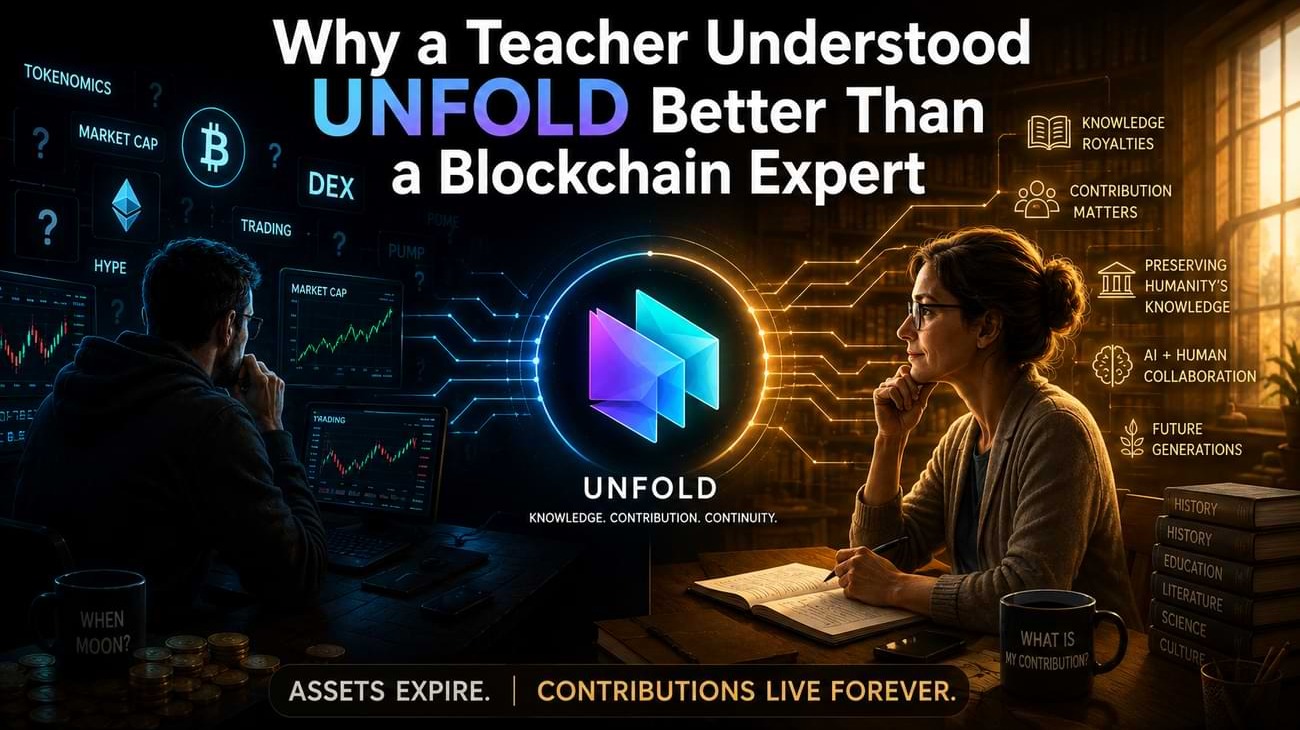
Many discussions in crypto communities quickly drift toward the same questions:
"Where is the token?"
"Which blockchain?"
"Which DEX will list it?"
"What are the tokenomics?"
These questions make sense if your frame of reference is speculation, trading or financial markets.
The problem is that UNFOLD was never designed to solve those problems.
It was designed to solve a completely different one.
A Conversation Inside a Hospital
Today I traveled to Thessaloniki for one of my regular immunotherapy treatments.
Since early 2025, I have been participating in the HARMONi-3 clinical trial led by Summit Therapeutics through Papanikolaou Hospital. When I entered the program, the tumor measurements were dramatically larger. Today, after months of treatment, they have been reduced to only a few millimeters while a few more smaller tumors have been found, dissappeared completely.
What many people don't realize is that clinical trials are not only about the patients who participate in them. Every participant contributes to medical knowledge that may eventually help millions of future patients around the world.
That perspective changes how you see things. You stop asking only what the future can do for you. You start asking what you can leave behind for others.
While waiting, I ended up discussing a completely different project: EasyPCR, a deep-tech startup co-founded by a friend of mine, electronic design engineer Apostolos Dragoumanos.
At some point, I asked the department supervisor a simple question:
"How useful would it be if your hospital could perform DNA diagnostics directly on-site in less than an hour?"
Her first reaction was disbelief.
"That isn't possible."
When I explained that portable PCR systems already exist and can deliver results in approximately fifty minutes, the conversation immediately shifted.
Nobody asked about tokens.
Nobody asked about market capitalization.
Nobody asked about venture capital.
The discussion instantly became practical:
- How would this improve patient care?
- How much time would it save?
- How many lives could benefit from faster diagnosis?
- How could such technology be introduced into hospitals?
For the first time that day, I wasn't discussing speculation.
I was discussing infrastructure.
And that difference matters.
Then a Teacher Joined the Conversation
Later, a literature teacher who happened to be present became interested in the discussion.
The conversation gradually moved from healthcare innovation toward UNFOLD and the concept of Knowledge Royalties.
I expected a long explanation.
Instead, something surprising happened.
She understood the core idea almost immediately.
Not the technical details.
Not the architecture.
Not the cryptography.
The underlying principle.
At one point she said something that genuinely stayed with me.
She pointed out that for centuries, societies have generated knowledge, culture, stories, research, discoveries and educational content that have been reused countless times by others.
Books generate value.
Films generate value.
Educational material generates value.
Historical knowledge generates value.
Yet the people, communities and institutions that originally produced much of that value rarely continue participating in its long-term economic impact.
And then she looked at what UNFOLD was attempting to do.
Suddenly, Knowledge Royalties made sense.
The Difference Between Assets and Contributions
That conversation helped me realize something important.
Many people in crypto are trained to think in terms of assets.
Buy.
Hold.
Trade.
Speculate.
Accumulate.
There is nothing inherently wrong with that.
But UNFOLD is focused on a different question entirely.
Not:
"How do we store value?"
But:
"How do we track contribution?"
Those are not the same thing.
A blockchain can tell you who owns an asset.
But ownership alone does not explain where knowledge came from.
It does not explain who taught whom.
It does not explain who contributed to an idea.
It does not explain why something became valuable in the first place.
UNFOLD attempts to explore those relationships.
Why Some People Understand It Faster
Ironically, the people who seem to grasp the vision most quickly are often not traders.
They are:
- Teachers
- Researchers
- Engineers
- Doctors
- Creators
- Historians
- Architects
People whose daily work revolves around creating, preserving or transferring knowledge.
When they hear concepts like:
- AI Mind Files
- Knowledge Royalties
- Trust Scores
- Digital Continuity
- Collective Intelligence
they don't immediately ask:
"How much can I make?"
Instead, they ask:
"How would this change education?"
"How would this affect research?"
"How could this preserve knowledge?"
"How could this help future generations?"
Those questions are much closer to the problems UNFOLD is actually trying to address.
Perhaps I Was Explaining It to the Wrong Audience
Today's conversations reminded me of something important.
Maybe the challenge isn't that people are incapable of understanding UNFOLD.
Maybe I have simply been trying to explain it inside environments optimized for entirely different goals.
A person searching for the next token pump is looking for an asset.
A teacher is looking for meaning.
A researcher is looking for causality.
An engineer is looking for systems.
A doctor is looking for outcomes.
UNFOLD was never designed to be another speculative asset.
It was designed as an infrastructure for preserving context, contribution and trust across generations.
Final Thoughts
When I left the hospital today, I wasn't thinking about cryptocurrency markets.
I wasn't thinking about token prices.
I wasn't thinking about blockchain debates.
I was thinking about a teacher.
A teacher who, within a short conversation, understood a core principle that many technically sophisticated people still struggle to see.
The future may not belong to the people who ask:
"Where is the token?"
The future may belong to the people who ask:
"Who should benefit when knowledge creates value?"
And perhaps that is the question worth solving first.
Disclaimer
On the resources links below, you can find more informations about EasyPCR, about HARMONi-3 clinical trial and about Summit Therapeutics included their IPO as well, more about why i've included those, in a future article.